Managed Services Provider: Models, Duties and Buyer Checks
It's a Tuesday morning and one page out of forty on a client's site is throwing errors at checkout. The plugin that handles the payment step updated itself overnight, the person who built that page left eight months ago, and nobody on the call can say which change broke it. Someone suggests bringing in a managed services provider to make this stop happening.
That instinct is right, but the phrasing hides the actual decision. A managed services provider doesn't remove work. It moves a defined set of operating work onto a contract with a schedule, a response commitment and a price. Everything the contract doesn't name stays exactly where it is, with you.
The gap between a good managed arrangement and an expensive disappointment is rarely technical. It comes from whether the buyer checked which work moved, and whether the provider can produce evidence that it's being done.
Table of Contents
- What a Managed Services Provider Takes Off Your Hands
- Managed Service Models Compared Side by Side
- Where Provider Responsibility Ends and Yours Begins
- How Managed Platform Operations Cut the Daily Burden
- How to Test a Provider's Security, Recovery and Uptime Claims
- Measuring Whether a Managed Service Lowers Total Burden
- Talk to WebinOne About Moving Your Platform Under Management
What a Managed Services Provider Takes Off Your Hands
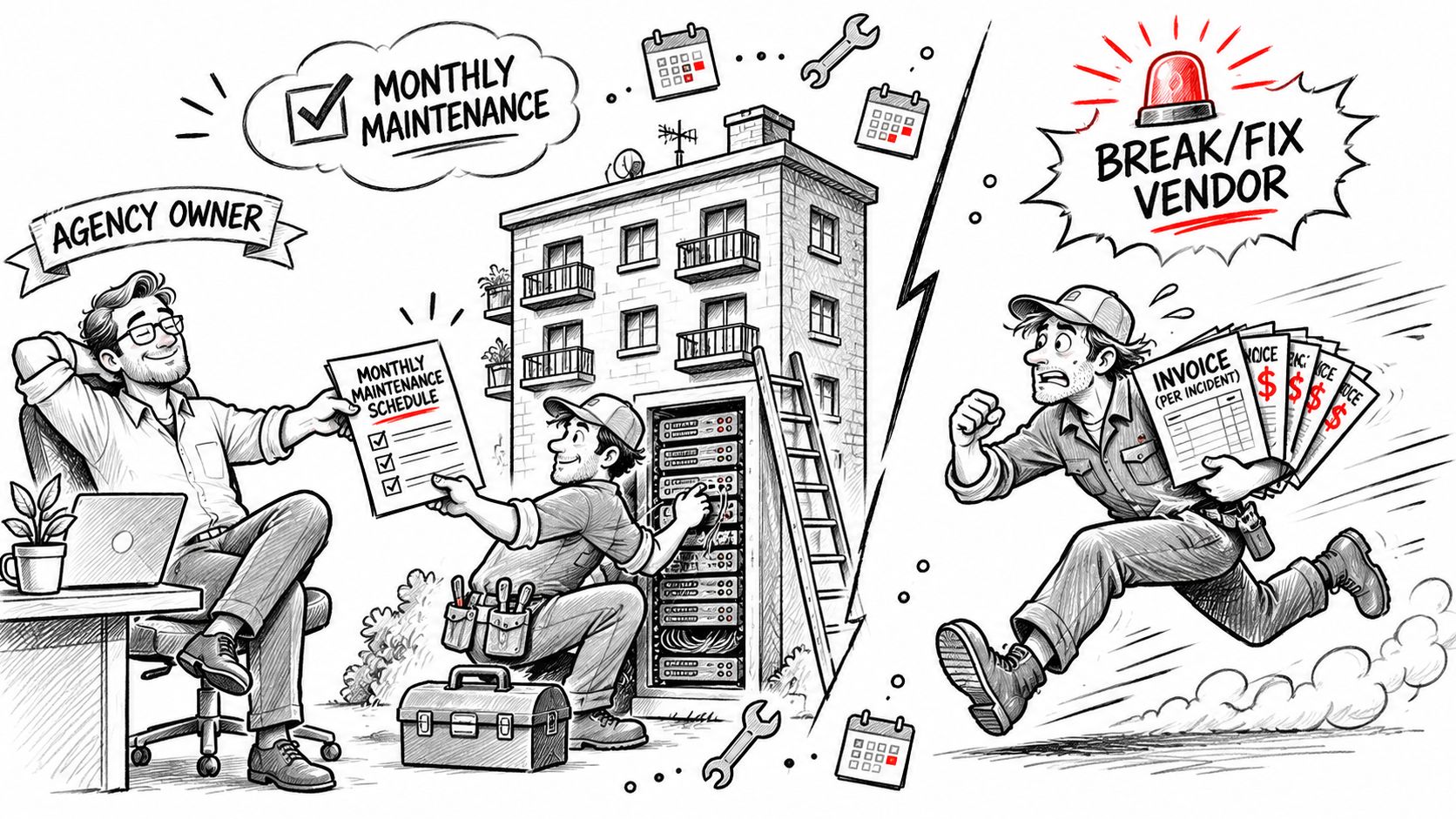
WebinOne takes a defined set of platform operations off your desk on a recurring contract, covering hosting, platform updates, backups, monitoring and uptime commitments. That's what separates a managed services provider from a break/fix vendor, who fixes things after they break and bills you for the repair.
Think about how a building stays usable. A facilities contract schedules the lift inspection, the filter changes, the quarterly fire-panel test and the gutter clearance before winter. Calling an electrician when the lights fail is a different arrangement entirely. The facilities contract costs roughly the same in a quiet month as in a bad one, and someone is accountable for the problems that never became emergencies.
The technology version of that shift has been underway for decades. Channel Dive's account of the managed services model traces managed service providers to the late 1990s, with the model maturing between roughly 2000 and 2005 as remote monitoring tools let providers supervise servers, networks and applications without being on site. The structural change wasn't the tooling. It was the billing, moving away from paying after a failure toward a recurring relationship that owns prevention.
Cost behaves differently under each model, and that's the part buyers misread. Break/fix looks cheaper because most months produce a small bill or nothing at all, but the cost climbs with every outage and no invoice line ever pays for the work that would have prevented it. A managed fee is fixed and predictable, and in exchange the provider commits to response times in writing.
Three definitions every managed contract needs
- Which layers the provider operates. Hosting, operating system, application, data and identity are separate layers. A provider can own four of them and still leave you the one that fails most often.
- What response it commits to. A severity table with response and resolution targets, not a promise of 24/7 coverage. The difference matters at 2 a.m. on a Saturday.
- What the recurring fee covers, and what triggers extra charges. Change requests, out-of-scope engineering and emergency work usually sit outside the fee. Find that list before you sign, not on the first invoice.
The test that settles it. If you can't point to the line in the contract that says who patches the runtime, you don't have a managed service. You have an invoice with optimism attached.
Before reading further, list every system your team touches this week. Mark each one as maintained on a schedule or fixed when it fails. That list is the map of your actual exposure, and it's the input to the next decision.
Managed Service Models Compared Side by Side
WebinOne is one option inside a category that covers at least six distinct models, so the first buying decision is which model you're shopping for. The table below sets them side by side by what the provider operates, what you keep, and who typically buys it.
| Model | Provider operates | Customer still owns | Typical buyer |
|---|---|---|---|
| Break/fix support | Repairs after an incident, on request | Business continuity planning and the cost of downtime | Small offices with few systems |
| Managed infrastructure | Servers, network, cloud resources, monitoring and patching | Application logic, content and data | Businesses running their own applications |
| Managed security (MSSP) | Monitoring, detection, alert triage and incident response | Asset ownership, risk decisions and recovery priorities | Regulated or multi-site organizations |
| Managed hosting and platform operations | Hosting stack, platform updates, backups and uptime | Content, configuration and business rules | Agencies and enterprise web teams |
| Co-managed | Layers agreed in writing with the customer's IT lead | Named customer ownership of the remaining layers | IT leads who want specialist coverage |
| Managed digital platform | Platform, hosting, security, updates and uptime commitments on one system | Content, client relationships and brand | Agencies and SIs moving clients off self-maintained stacks |
How to read the comparison
Start with the third column. Every model on this list is a transfer of operating work, and what remains in "Customer still owns" is where your risk concentrates after the transfer. The further down the list a model sits, the more layers the provider takes on, and the more precisely the contract has to draw the boundary. Managed infrastructure moves patching and monitoring off your desk but leaves application logic with you, which is why a site can be down while the server reports itself perfectly healthy. A managed digital platform goes furthest, and even there the content, the client relationships and the business consequences of an outage stay on your side of the table.
Scale explains why the choice feels crowded. Grand View Research valued the managed service provider segment at about US$208.6 billion in 2025 and projects roughly US$443.9 billion by 2033, a 10% compound annual growth rate. In the UK alone, research commissioned by the Department for Business and Trade and conducted by Perspective Economics counted 11,492 active managed service providers in 2024, according to the government research on managed service providers. Thousands of companies use one label for scopes that barely overlap.
Security is where the label stretches furthest. Kaseya's 2024 MSP Benchmark Report, drawn from about 1,000 MSP executives and technicians worldwide, found that 73% of surveyed MSPs named cybersecurity a top revenue driver. That concentration of investment cuts both ways for a buyer. Security may be built into the recurring service, or it may sit in a separate contract with a separate fee, and the model name alone cannot tell you which.
Co-managed breaks at the handoff. It works when both sides agree on a layer-by-layer split and write it down. It fails when the split is a conversation rather than a document, because the gaps between two responsible parties are exactly where incidents live.
Before comparing prices across these models, ask which layer breaks most often in your stack and who is accountable when it does. Then check whether the model you are considering covers that layer in writing. A provider can take a great deal of work off your hands while leaving the failure that matters most exactly where it started.
Where Provider Responsibility Ends and Yours Begins
WebinOne's managed model divides responsibility layer by layer with the customer, because outsourcing operational work never transfers accountability for your systems and data. The contract has to name which layer belongs to whom, and the table below is the shape that split usually takes.
| Layer | Typical provider scope | What stays with you |
|---|---|---|
| Hosting and cloud infrastructure | Capacity, availability, hardware or cloud resources | Architecture and region choices |
| Operating system and runtime | Patching within an agreed window | Approving maintenance windows and restarts |
| Application and CMS | Core updates and contracted module maintenance | Acceptance testing and business logic |
| Backups | Scheduled backups and restore testing | Recovery point and recovery time targets, restore sign-off |
| Security monitoring | Detection, alert triage and escalation | Asset inventory and risk acceptance |
| Incident response | Containment within agreed authority | Notification decisions and forensic evidence |
| Privileged access | Access logging and periodic reviews | Least-privilege requirements and approvals |
Every row needs confirmation in the contract itself, not in a proposal deck. A provider can own four layers and still leave the fifth, usually the one nobody discussed, sitting with a client who assumed it was covered.
What security guidance expects the agreement to assign
NIST's guidance on improving the cybersecurity of managed service providers recommends that MSP implementations cover asset management, risk assessment, identity and access control, data security and continuous monitoring. It also points to the part buyers skip: the agreement should explicitly assign ownership for system hardening, vulnerability remediation, detection, incident response, recovery, data access, and the authority to take emergency action such as disabling an affected service.
That last item is the one that costs money. A ransomware alert at 2 a.m. is not the moment to discover that the provider can detect the encryption but can't isolate the host without written approval from someone who is asleep.
The incident matrix that ends the argument
Build a single page that lists each response action next to two names. Who approves it, and who executes it. The actions are predictable: isolate a host, revoke a set of credentials, restore a database from backup, take a service offline, engage a forensics firm, notify a regulator, notify affected clients.
A responsibility matrix isn't paperwork. It's the difference between containment in twenty minutes and a conference call about who owns the firewall.
Attach that page to the statement of work, name the escalation contacts by role, and review it once a year and after any major platform change. Roles move, phone numbers change, and a matrix nobody has opened since onboarding is worse than none, because it creates confidence without coverage.
How Managed Platform Operations Cut the Daily Burden
A patch lands while your team is preparing a client launch. Someone must test it, schedule the change and be ready to restore the site if it fails. Managed platform operations move that recurring work into a provider's delivery process, leaving your team accountable for what clients need and what changes they approve.
The relief comes from fewer operating tasks landing in the agency's queue, not from hosting the same workload elsewhere.

Four failures that eat a week
An extension update breaks checkout. The site works, the cart doesn't, and the fix means reading release notes at 6 p.m. WebinOne maintains its native extensions in-house, reducing dependence on third-party plugin updates. Buyers should still establish who checks checkout after a change.
A core patch needs a staging test before it ships. Someone has to prepare a test copy, apply the update and check the flows before deployment. A managed arrangement should assign that work and define a maintenance window, rather than leave it waiting for a free afternoon.
A campaign spike slows the site. A short traffic surge can turn a planned campaign into an urgent capacity problem. Establish whether the provider handles scaling as part of platform operations or whether your team must request and coordinate it.
A release has to be rolled back by hand. Reversing changes under pressure introduces more opportunities for mistakes. Agree how the provider restores from a backup, who initiates that action and what your team must check before the site resumes normal use.
The AWS boundary nobody reads closely
Running on AWS doesn't remove the patching job by itself. AWS's shared-responsibility documentation distinguishes AWS's infrastructure responsibilities from customer responsibilities, which depend on the services used. For workloads involving guest operating systems and application software, maintenance can still sit with the customer.
That is the operating layer managed AWS hosting should clearly address. Ask which operating-system, CMS, module and application tasks the provider takes on. Delivery support can complement your team while you retain client ownership; it does not erase your role in approving business changes.
Ask four yes or no questions:
- Does the provider apply platform patches within a defined maintenance window?
- Is there a staging check before release?
- Does capacity scale under load without your team opening a ticket?
- Has a restore been tested, rather than merely scheduled?
A qualified answer needs a clear explanation of the work left with you. If your engineers still coordinate every patch, capacity change and recovery action, those tasks remain part of your daily operating burden.
How to Test a Provider's Security, Recovery and Uptime Claims
The right place to start with any provider is whatever they publish, because published figures are checkable. Every other promise deserves the same treatment, tested against evidence rather than adjectives.
| Claim | Evidence to request | Red flag |
|---|---|---|
| 24/7 monitoring | Named escalation path and a sample monthly report | Only a generic promise of coverage |
| Backups in place | Restore test results into a clean environment, with measured recovery time and recovery point | Backup status dashboard as the only evidence |
| Uptime percentage | Measurement period, exclusions, maintenance rules and remedy | Headline percentage with no contract terms behind it |
| Patches applied | Patch log, maintenance windows and remediation targets | No defined window or cadence |
| Incident notification | Contract trigger for a material incident and the notification deadline | Notification "when appropriate" |
| Privileged access | Logs of privileged access and periodic reviews | Shared administrator credentials |
Why vague claims fail under pressure
Buyer confidence hasn't kept pace with provider marketing. In the 2025 SMB cybersecurity survey from ConnectWise, 73% of surveyed SMBs said they were not confident their MSP could defend them effectively in every cyberattack scenario, and buyers across the market have signaled they will switch providers that cannot demonstrate real depth in around-the-clock security support. Outsourcing is settled. What remains to test is whether the provider can detect, contain, communicate and recover.
Backups are where the gap shows first. NIST's ransomware guidance recommends that providers conduct, maintain and test backup files, and the word doing the work there is test. A green backup dashboard proves a job ran. It doesn't prove the database restores, that permissions survive, or that the application's dependencies come back in the right order. Ask for a restore into a clean environment with a measured recovery time and recovery point. If the provider has never run one, the answer you get will tell you more than any certificate on their wall.
Read the uptime terms before the number
Outages carry real financial weight. The Uptime Institute's 2024 Global Data Center Survey found that 54% of respondents' most recent significant outage cost more than $100,000, with 16% reporting a cost above $1 million, per the published survey report. That's the scale of what an availability figure is supposed to protect.
So examine the mechanics behind any percentage: the measurement period, the excluded events, the maintenance rules and the remedy for a missed target. A number without those terms is marketing. The same discipline applies to system stability, where monitoring evidence and incident reporting tell you more than a status page ever will.
One more test costs nothing and reveals plenty. Ask the provider to walk you through their last material incident: when it started, when customers were told, what the root cause turned out to be, and what changed afterward. A provider with mature operations answers that question calmly, because they have a postmortem process and a paper trail. A provider that treats the question as an insult is telling you how they will behave when it's your site that's down.
Write the notification trigger into the contract. Define what counts as a material incident, the deadline for telling you, who controls forensic evidence, and how service continues if the provider itself is compromised.
Measuring Whether a Managed Service Lowers Total Burden
WebinOne's commitments are measurable by design, from published uptime to SLA terms to restore testing, because the central question isn't whether the monthly fee is lower. It's whether total operating burden falls. A cheaper invoice attached to a heavier internal workload is a price increase with better branding.
Start with a baseline before anything moves. Count the tools, integrations, administrative consoles, alert sources, vendors, renewal dates and the staff hours spent operating the stack each month. Then require the provider to show the same figures after the transition. If the count of consoles didn't drop, complexity moved rather than disappeared.
The economics have shifted toward confidence
Tool sprawl is a genuine buying driver, and providers know it. The Barracuda MSP customer insight report for 2025 found that cost savings as a primary customer challenge fell from 28% in 2023 to 17% in 2025, while organizations most commonly seek MSP help because the number of security tools has become unmanageable. Buyers are paying for operational confidence, not the lowest bid.
Track release health, not just incidents
Delivery quality tells you whether managed operations are reducing risk or relocating it. DORA's metrics guidance defines deployment frequency as how often code ships and change fail rate as the share of deployments needing immediate intervention after release. The 2021 DORA research put elite performers at a change-failure range of 0% to 15%, against 16% to 30% for low performers.
Report those by site, application or release stream. A portfolio where the fail rate is climbing is accumulating operational debt even if no client has complained yet.
Test exitability before you need it. Data portability, documented architecture, audit logs and a workable termination plan are the difference between a provider and a trap.
Consolidation can hide complexity behind one more dashboard, so measure the effort required to leave as carefully as the effort required to run. The total cost of ownership picture is a better commercial metric than monthly price. Then hold a 90-day review that compares the baseline with the same numbers, broken out by site, and decide from evidence.
Talk to WebinOne About Moving Your Platform Under Management
A managed service transfers operating work, not accountability. The buyer still needs to define what must be owned, what stays internal, and what evidence will show that the arrangement is working. Bring a stack inventory and the three most costly incidents from the past year to talking to WebinOne about your platform. Those details turn a broad discussion into a practical responsibility split.
What that conversation covers
It starts with the current stack and its tool count, the layers that need to move under management, and the responsibility matrix from earlier in this piece filled in for your environment. Expect the discussion to separate hosting, releases, support, security tasks, reporting, and recovery work. The aim is to make each handoff visible before any migration plan is agreed.
From there, the discussion becomes a staged migration plan with testing before and after cutover, so nothing ships on hope. That matters because moving a platform under management changes who performs the work, while your business still owns the service outcome. A useful plan names the owner for each task, the evidence required at handover, and the checks that confirm behavior after cutover.
The proof behind it is concrete. The platform is an AWS Partner, has passed the AWS Foundational Technical Review, holds the AWS Qualified Software designation, is enrolled in the AWS Software and Services Paths and is available on AWS Marketplace. Support is available 24/7 for all six data centers, and admin support covers the systems used to provide the Services.
For systems integrators and enterprise buyers
System integrators use the platform as the platform layer in enterprise and government projects. For qualifying SIs, a licensed version can run in the SI's or the customer's own AWS account by agreement, including AWS GovCloud. That structure fits buyers who need managed delivery while keeping operationally sensitive work close to their own environment.
A good discussion ends with clarity on scope, responsibility, and evidence. Bring the layers you would want a provider to own, along with the incident history and stack inventory. That is enough to get a specific answer about operating work, rather than a capabilities deck.