Headless CMS Hosting: How to Choose the Right Platform
64% of enterprises now use headless architecture in at least one digital project, so the question is no longer whether to decouple. The main decision is how to host a headless stack without breaking agency margins, governance, or service-level commitments.
Headless CMS hosting gives development teams control over the frontend, delivery framework, and publishing channels. It also gives agencies an easy way to create an expensive collection of services that nobody wants to operate six months later. The CMS is only one component. Frontend builds, APIs, localization, testing, analytics, caching, security, and support all need an owner.
The right platform therefore isn't the one with the most architectural freedom on paper. It's the one that preserves that freedom without transferring every operational responsibility to an already stretched agency team.
Table of Contents
- Why Headless CMS Adoption Changed the Hosting Equation
- The Four Headless CMS Hosting Models Defined
- Comparing Headless Hosting Across Agency-Critical Criteria
- Performance, Edge Delivery, and Core Web Vitals
- Migration Complexity and Real-World Proof Points
- Escaping Plugin Sprawl and the Hidden Costs of DIY
- Security, Compliance, and Enterprise Governance
- When to Migrate and Which Configuration to Choose
Why Headless CMS Adoption Changed the Hosting Equation
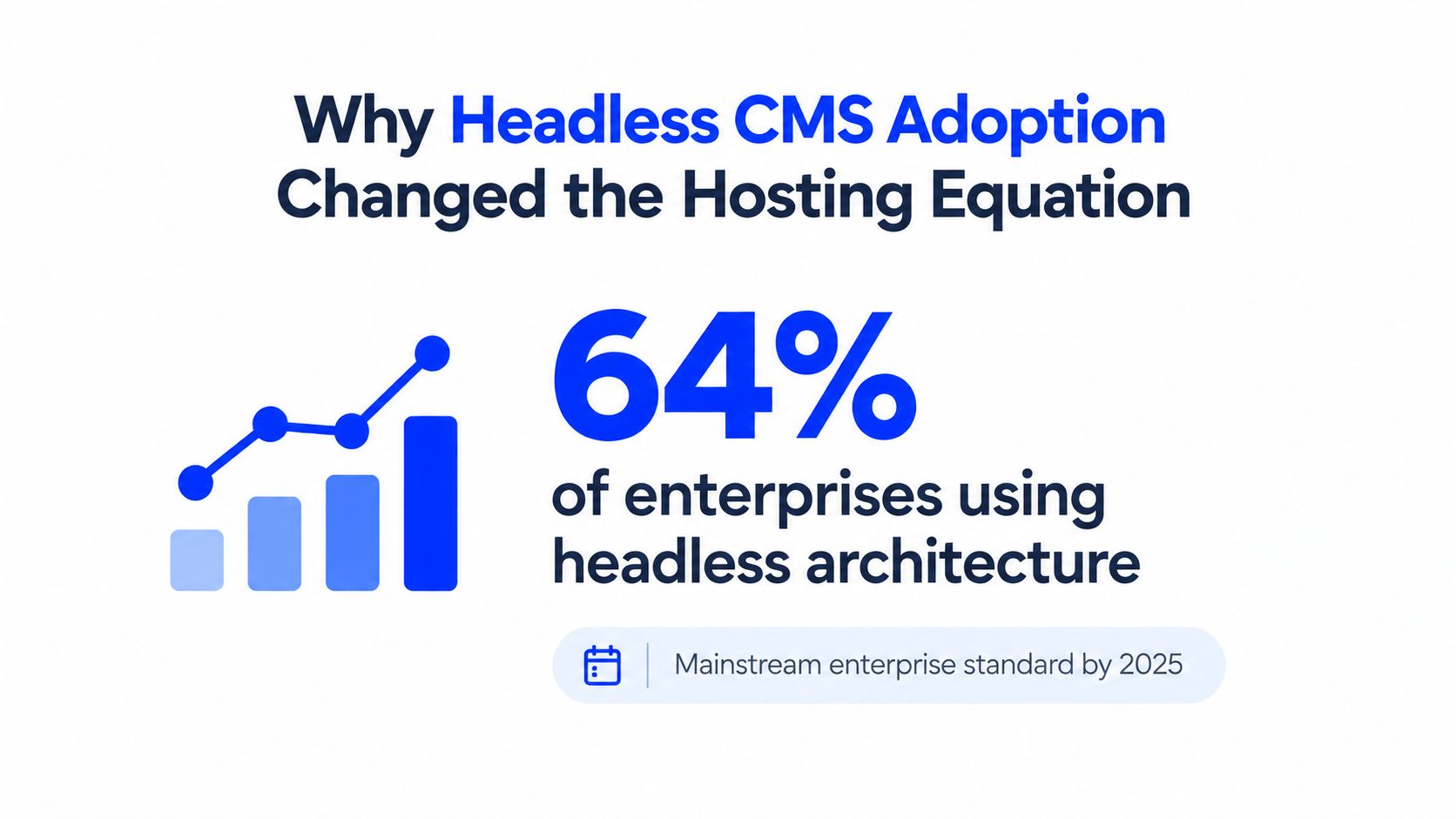
More than 64% of enterprises used headless architecture in at least one digital project, while 44% operated a headless CMS environment and 74% of digital decision-makers planned to migrate from traditional CMS platforms within 24 months, according to a 2025 market report. API-first adoption also rose from 51% in 2023 to 69% in 2024 and 77% in 2025. (Business Research Insights market report)
That adoption has changed the buying decision. Teams now need hosting that supports multiple frontends, brands, regions, integrations, and publishing workflows without forcing the agency to build a second operations department.
Decoupling doesn't remove complexity
A headless CMS separates content from presentation. The architecture creates flexibility, but it also exposes work that a monolithic platform once bundled together. Teams must assign ownership for the frontend runtime, deployment pipeline, preview environment, cache invalidation, observability, access controls, and incident response.
A SaaS API such as Contentful or Storyblok reduces infrastructure work around the CMS. It does not operate every connected service or standardize the agency's support model. A self-hosted API provides control while adding responsibility for patching, backups, scaling, and recovery. A cloud render platform can deliver the frontend while leaving billing, permissions, and portfolio governance split across separate tools.
Practical rule: A decoupled architecture improves operations only when the hosting model absorbs complexity instead of relocating it to the agency.
Growth like that confirms demand, but it does not make every deployment financially sensible. One forecast estimates the headless CMS software market will rise from USD 1.56 billion in 2025 to USD 1.82 billion in 2026 and USD 4.42 billion by 2031, implying a 19.40% CAGR from 2026 to 2031. (Business Research Insights market report) Agencies need a managed operating layer that reduces service sprawl, clarifies ownership, and protects margins across client portfolios. An API endpoint alone does none of that.
The Four Headless CMS Hosting Models Defined
Four hosting patterns dominate headless projects: managed SaaS CMS, self-hosted infrastructure, cloud-managed frontend delivery, and unified managed digital experience platforms. They solve different problems, and agencies often choose the wrong one because the initial setup looks simpler than the long-term operation.
Managed SaaS CMS
Contentful and Storyblok provide hosted content APIs, editorial interfaces, and platform maintenance. They're attractive when a team wants to avoid running the CMS infrastructure. The trade-off is that the agency still needs to assemble the frontend, commerce, localization, search, analytics, and delivery layers around the API.
SaaS can also restrict white-label control, data residency choices, and the way an agency packages operations for clients. It works well for a focused content backend. It becomes less convenient when a portfolio needs shared governance across many brands.
Self-hosted infrastructure
Self-hosting offers ownership of the application, database, extensions, and deployment environment. It also makes the agency responsible for security updates, backups, monitoring, disaster recovery, capacity planning, and release coordination.
That burden is manageable for a product team with dedicated DevOps ownership. It's a poor default for an agency running multiple client estates, where every custom deployment creates another exception in the support queue.
Cloud-managed delivery
Vercel, Netlify, Cloudflare, and AWS can handle frontend builds, functions, and edge delivery. These services are effective infrastructure components, but they don't automatically provide centralized multi-site governance. Each project can develop its own deployment conventions, permissions, billing path, and observability model.
Agencies should read managed AWS hosting as an operating-model question, not just a server question. The value comes from combining infrastructure with repeatable governance.
Unified managed platforms
A unified platform consolidates CMS, ecommerce, CRM, email marketing, APIs, and multi-site management behind one operational layer. That model preserves headless delivery while reducing the number of vendors and consoles the agency must coordinate.
WebinOne runs on AWS across six global data centers, with selectable data residency and a white-label operating model. For agencies, that combination is more practical than assembling a separate CMS, frontend host, commerce system, CRM, and support process for every client.
Comparing Headless Hosting Across Agency-Critical Criteria
An agency shouldn't compare hosting models by API documentation alone. The useful test is whether the model protects delivery quality while keeping recurring operational work predictable.
| Hosting Model | Governance | Operational Risk | Margin Impact |
|---|---|---|---|
| Managed SaaS CMS | Strong for content, weaker across connected services and white-label portfolios | Vendor limits, fragmented frontend and commerce operations | Costs can rise as services and client estates expand |
| Self-hosted infrastructure | Maximum technical control, but governance depends on internal discipline | Patching, backups, scaling, security, and recovery remain agency responsibilities | High maintenance exposure and unplanned support work |
| Cloud-managed frontend | Good render-layer flexibility and delivery options | Billing, permissions, deployments, and CMS operations can fragment | Efficient for isolated builds, harder to standardize across portfolios |
| Unified managed platform | Centralized multi-site administration, shared controls, and white-label operations | Lower platform maintenance burden, with dependence on the managed provider | More predictable delivery and support economics |
SaaS-only systems look simple because the infrastructure is hidden. That doesn't mean the operating cost disappears. Teams still need a frontend framework, content modeling discipline, preview workflow, localization, testing, analytics, and an owner for every integration.
Self-hosted stacks have the opposite problem. Everything is visible, configurable, and expensive to maintain. A security update that takes a few minutes on one site becomes a repeated operational task across a portfolio, especially when each build uses a different version, plugin, or deployment method.
The governance test
A serious agency needs one place to answer practical questions:
- Who can publish? Permissions should work across brands and client teams.
- Where is each site hosted? Infrastructure and residency choices should be visible.
- Who owns an outage? The support boundary must be explicit.
- How are changes audited? Deployments and content changes need traceability.
- How does billing scale? The model must remain understandable as the portfolio grows.
The best architecture is the one that makes those answers boring. Boring governance is a commercial advantage because it reduces escalation, training, and undocumented work.
Performance, Edge Delivery, and Core Web Vitals
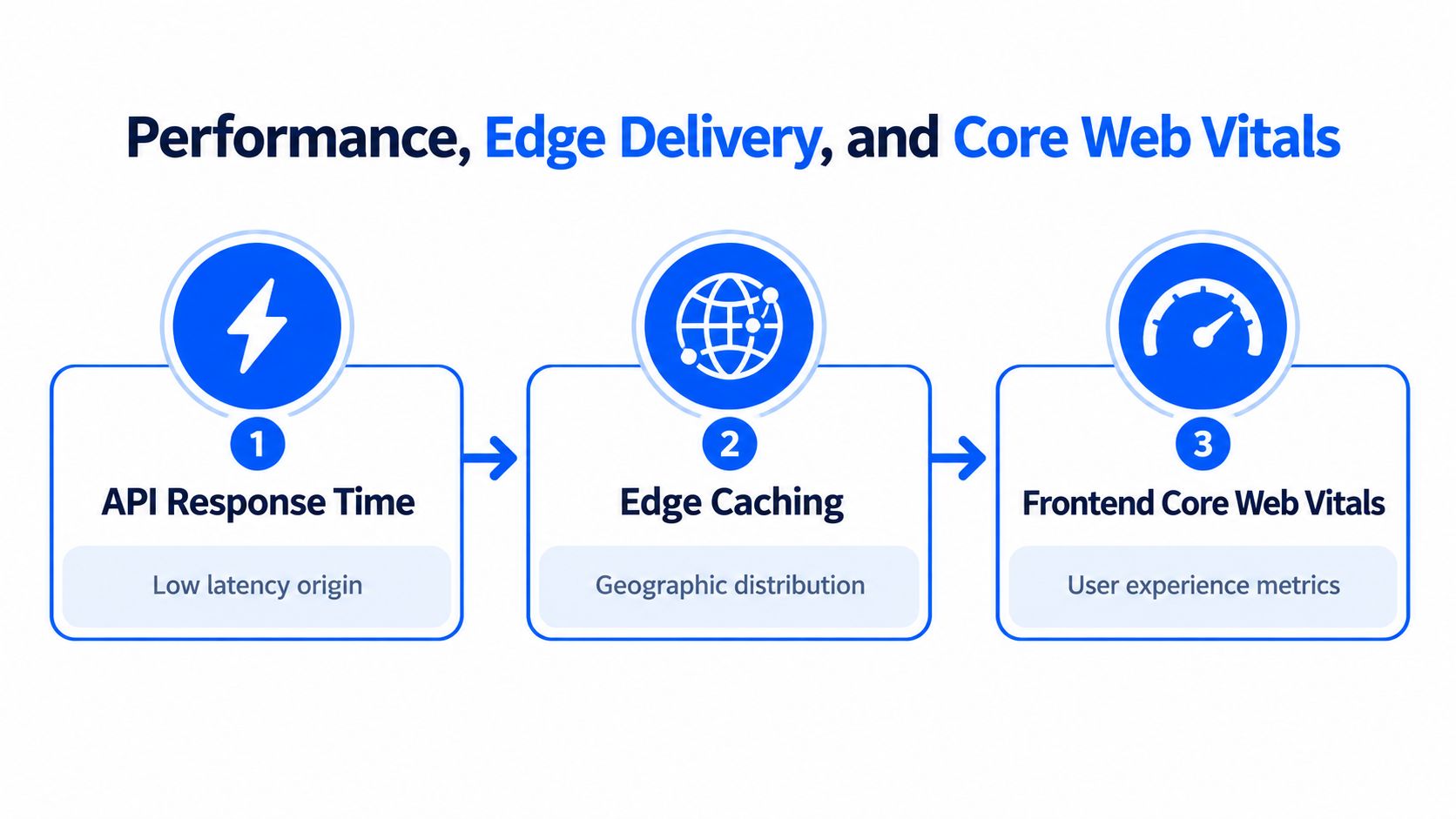
Headless hosting performance can't be judged by API response time in isolation. The visitor experiences the complete path from request to rendered interface, including data fetching, server-side rendering or static generation, JavaScript execution, image delivery, and layout stability.
Core Web Vitals provide concrete thresholds for that experience. A page passes when Largest Contentful Paint is under 2.5 seconds, Interaction to Next Paint is under 200 milliseconds, and Cumulative Layout Shift is under 0.1. (Headless CMS Core Web Vitals guidance)
The frontend is the performance product
A fast CMS API can't rescue a slow render path. If the frontend waits on several uncached services, downloads oversized assets, or shifts content while scripts load, the visitor experiences a slow site even when the origin API responds quickly.
Edge delivery reduces the distance between users and cached content. Benchmark summaries report Vercel Edge Functions at 20 to 100 milliseconds and Netlify Edge Functions at 80 to 200 milliseconds. The same benchmark set reports 89 milliseconds average TTFB for headless CMS with static generation and 156 milliseconds for headless CMS with server-side rendering. (Headless CMS hosting benchmark)
Those figures aren't a guarantee for every implementation. They show why architecture matters. Cache strategy, rendering mode, origin location, and integration count all affect the final page.
Teams evaluating implementation details can use Core Web Vitals explained as a practical reference for how the metrics relate to user experience.
What agencies should demand
The hosting provider should support CDN distribution, controlled cache invalidation, reliable server-side rendering, image optimization, and useful performance monitoring. The build system should also make it possible to test real templates, not just the API in isolation.
For a broader operational view, performance optimization guidance helps frame speed as a managed service rather than a one-time development task. SEO and AEO teams need stable markup, crawlable content, predictable metadata, and fast interaction across every brand site.
Migration Complexity and Real-World Proof Points
A headless migration is a re-platform, not a lift-and-shift. The project team must remodel content into typed structures, rebuild the frontend, recreate forms and search, preserve redirects and metadata, reconnect integrations, and give editors a workflow they can use.
Most content-site migrations take 3 to 6 months, while larger DXP or multi-site estates typically take 6 to 12 months or longer. (Headless CMS migration planning) Those timelines aren't a reason to avoid migration. They're a reason to scope it carefully.
The migration work that gets underestimated
A legacy platform often hides business rules in templates, plugins, custom fields, and undocumented scripts. During discovery, the migration team needs to identify:
- Content dependencies: Which fields, relationships, assets, and taxonomies must survive?
- Frontend behavior: Which templates contain business logic rather than presentation?
- Search equity: Which URLs, metadata, schema, and redirects protect organic visibility?
- Editorial workflows: Which approvals, previews, roles, and scheduled releases matter?
- Operational ownership: Who handles incidents, releases, and post-launch changes?
The most dangerous migration plan is the one that counts pages but ignores behavior. A site can contain all the right words and still fail because forms, search, personalization, or publishing controls were not rebuilt.
A portfolio-scale example
WebinOne migrated more than 3,000 sites during the Adobe Business Catalyst end-of-life event, including complex live sites moved under strict deadlines with zero downtime. TeamOne handled the migration and delivery work, untangling legacy structures into a stable managed platform instead of asking every site owner to invent a separate cloud rebuild.
That outcome demonstrates the value of repeatable migration operations. Cross-platform migration guidance is most useful when paired with staged testing, content validation, pre-cutover checks, and a rollback plan.
A migration succeeds when the business notices the platform change only because the new operating model is easier.
Escaping Plugin Sprawl and the Hidden Costs of DIY
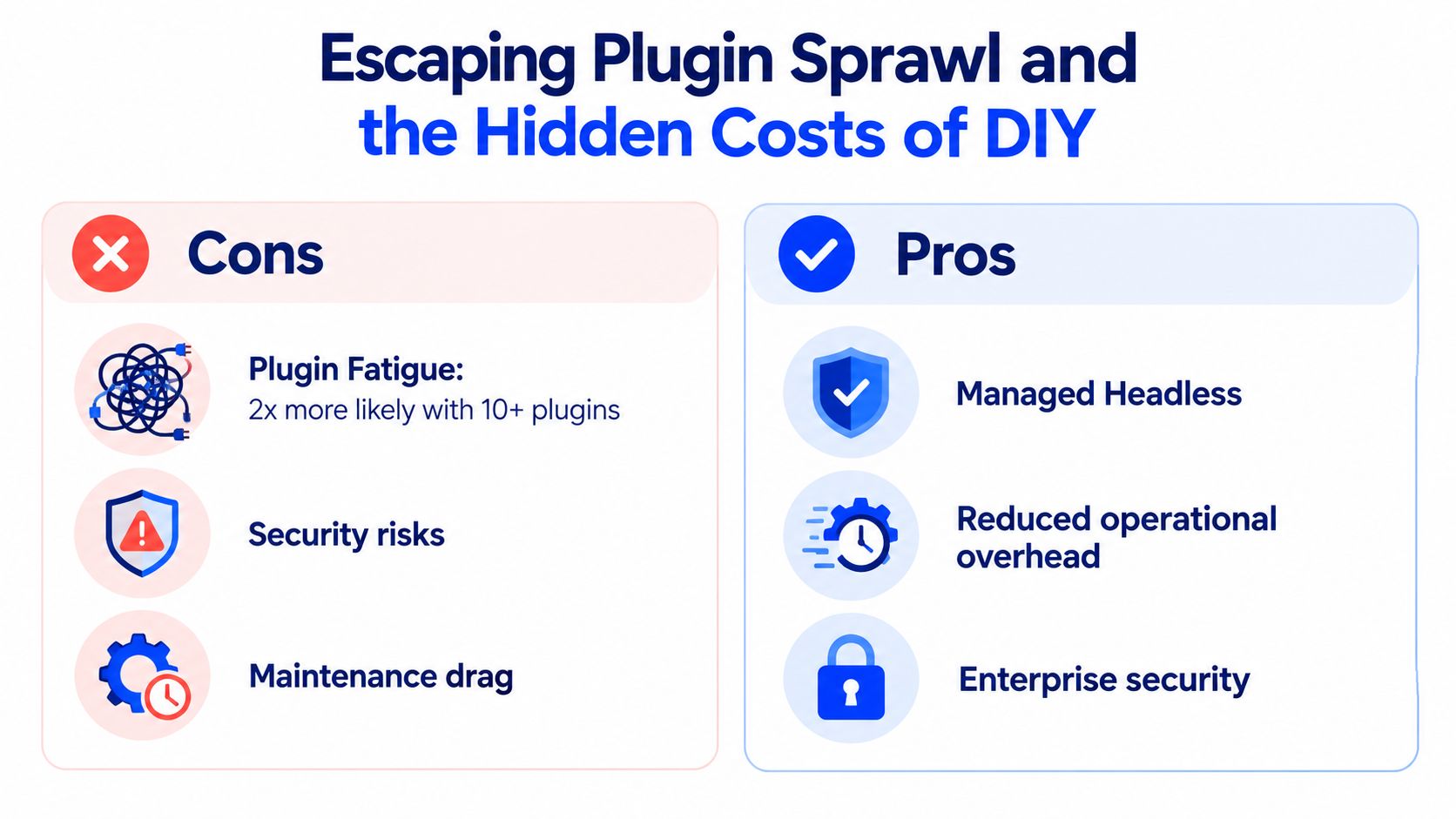
WordPress plugin sprawl creates a governance problem before it creates a performance problem. One analysis found that users with 10 or more plugins reported plugin fatigue at 57%, compared with 26% among users with five or fewer plugins. (WordPress plugin fatigue analysis)
The ecosystem is also vast. An academic analysis reports 54,777 available WordPress plugins, while security reporting describes the WordPress.org repository as containing more than 60,000 free plugins. Wordfence's 2023 threat report found that plugins accounted for 96% of 4,966 vulnerabilities disclosed across WordPress core, themes, and plugins that year. (WordPress plugin sprawl analysis)
The hidden bill sits outside the CMS
Headless architecture avoids many traditional plugin problems, but it introduces its own stack. A typical deployment needs a frontend framework, hosting provider, localization service, testing tools, analytics, search, and integrations for commerce or personalization.
Each service creates another renewal, permission model, incident path, and technical dependency. Developers often support headless until they become responsible for maintaining the whole collection. New content types and templates can still become developer tickets, which defeats the promise of faster publishing.
A unified platform addresses the problem by replacing scattered dependencies with maintained native capabilities. WebinOne includes 300+ APIs, native extensions, white-label administration, ecommerce, CRM, email marketing, and multi-site management. It also applies zero transaction fees on ecommerce, so agencies don't need to absorb a separate revenue-based platform charge.
The agency margin test
Plugin sprawl hurts margin through repeated low-value work:
- Compatibility checks: Teams test updates across themes, plugins, integrations, and custom code.
- Security response: Someone tracks advisories, applies patches, and verifies that the patch didn't break production.
- Client communication: Account teams explain incidents caused by dependencies the client didn't choose directly.
- Portfolio inconsistency: Every exception makes the next migration, support request, or staff handover slower.
Managed headless hosting should reduce those tasks, not merely replace WordPress plugins with a dozen SaaS subscriptions. Agencies need a stack that supports white-label delivery and lets the provider own the repetitive platform maintenance.
Security, Compliance, and Enterprise Governance
Security is a baseline requirement for government and enterprise teams. A headless estate has several attack surfaces, including the content API, frontend renderer, delivery layer, integrations, administrative accounts, and deployment pipeline. A fragmented stack forces the organization to secure each layer and coordinate evidence across multiple providers.
WebinOne operates as an AWS Partner, is live on AWS Marketplace, has an AWS Foundational Technical Review approved, and has completed an AWS Well-Architected Review. The platform reports 99.99% uptime over the last 12 months and serves US and Australian government clients.
Centralized controls reduce operational exposure
A managed platform can consolidate SSL, backups, security headers, access auditing, deployment controls, and support escalation. Selectable data residency helps organizations keep content within required geographic boundaries, while AWS hosting across six global data centers supports a distributed delivery strategy.
This matters for multi-brand organizations because governance can't depend on one architect remembering how every separate deployment works. It needs documented controls, repeatable access policies, and a provider that owns the platform layer.
Teams formalizing those responsibilities can use this infrastructure governance guide for 2026 to structure ownership, controls, and operational review.
Recommendation for agencies and enterprises
Agencies should prioritize white-label administration, portfolio governance, migration support, and a clear support boundary over the lowest infrastructure price. Enterprises should prioritize data residency, auditability, recovery planning, and a consistent operating model across brands.
Cheap infrastructure is only cheap when the buyer excludes the people needed to run it. Agencies and enterprises should test the full operating model before approving a headless migration, including incident response, preview, deployment ownership, and post-launch content operations.
When to Migrate and Which Configuration to Choose
A managed headless configuration is the right choice when an organization needs frontend freedom without accepting fragmented operations. Agencies escaping WordPress plugin sprawl, page-builder limits, or SaaS lock-in should choose a unified platform that combines CMS, ecommerce, CRM, APIs, and multi-site management.
Enterprises should use a different trigger set. Migration becomes urgent when brands operate separate instances, data is trapped in disconnected tools, platform knowledge sits with one or two people, or each new market requires a custom deployment. Those conditions create key-person risk and make ordinary content changes unnecessarily expensive.
A practical configuration
The recommended configuration has four parts:
- Structured content: Model reusable content, relationships, metadata, localization, and permissions before rebuilding templates.
- Managed delivery: Use a hosted frontend and API layer with clear ownership for caching, scaling, monitoring, and security.
- Central governance: Manage brands, users, publishing policies, support, and reporting from one administrative model.
- Controlled automation: Use AgentOne, WebinOne's native Managed Vibe Coding system, to build, update, optimize, and operate sites inside the managed platform. Its scoped permissions, audit logs, transparent code, and reversible changes keep automation reviewable rather than turning it into a generate-and-abandon tool.
WebinOne pricing starts from $10 per month per site, with zero transaction fees on ecommerce. It supports agency white-label operations, headless delivery through 300+ APIs, and AWS hosting across six global data centers.
Organizations handling regulated workloads should also review practical cloud compliance examples, including how MR2 Solutions handles HIPAA, before defining residency, access, and operational requirements.

TeamOne can assess the current estate, identify migration risk, stage the re-platform, test before and after cutover, and move the portfolio without downtime. The next step is a platform and migration review that maps content, integrations, governance, hosting, and support against the organization's actual operating constraints.
WebinOne gives agencies and enterprise teams a managed headless platform for structured content, multi-site governance, ecommerce, CRM, APIs, and AWS-backed delivery without fragmented infrastructure ownership. Visit WebinOne to review the platform, start a trial, or speak with TeamOne about a migration strategy.