Headless CMS Agency Guide for Scaling Without Limits
Most clients don't need a pure headless CMS. They need a platform their agency can migrate, govern, operate, and hand over without creating a permanent developer dependency. The popular advice starts with API flexibility. The better buying question is whether the architecture improves the client's five-year operating model, including editor workflow, preview, security, ownership, support, and total cost.
That distinction matters because headless projects can add a 40% to 60% cost premium when teams underestimate front-end ownership, workflow design, infrastructure, and maintenance, according to the agency decision framework for headless adoption. A technically elegant build can still be a poor recommendation for a single-site marketing team that needs reliable publishing more than a network of APIs.
A capable headless CMS agency should therefore be judged on what happens after launch. Can the agency migrate messy legacy content without losing redirects or metadata? Can editors preview changes confidently? Can the delivery team document the system, test rollback procedures, monitor performance, and support a multi-brand portfolio without relying on one person who understands the custom code?
The right outcome is not “headless at any cost.” It's a confident decision to go headless when the business needs channel freedom, or to choose a managed DXP when operational simplicity produces better returns.
Table of Contents
- Introduction Why Most Headless Projects Misjudge the Decision
- How Headless CMS Actually Works Without the Jargon
- What a Headless CMS Agency Really Does for You
- Pros and Cons of Hiring a Headless CMS Agency
- How to Evaluate a Headless CMS Agency Before You Sign
- Why WebinOne Fits Agency Partners Who Need No Limits
- Conclusion Your Next Move From Evaluation to Migration
Introduction Why Most Headless Projects Misjudge the Decision
Headless is often sold as freedom. Content stays separate from presentation, developers choose the front-end framework, and one content model can support websites, applications, commerce experiences, and other channels. For a multi-site enterprise, that separation can reduce duplication and support future delivery.
The business outcome depends on ownership.
A client may approve a headless build because the API sounds modern, then discover that preview problems, SEO requirements, deployment failures, and front-end updates all belong to the agency. Editors lose the visual confidence they had in a traditional system. Marketing requests become tickets, while support work consumes the agency margin that the proposal treated as a minor implementation detail.
Strong agencies therefore refuse to sell headless by default. Guidance for agencies warns that headless may be unnecessary for a project serving only one website, and that smaller content teams can become dependent on developers when visual preview and familiar editing workflows disappear. The 2026 headless CMS guidance for agencies treats architecture as a return-on-investment decision, not a technology contest.
The question buyers should ask
Ask one question before comparing platforms:
Who owns the complexity when the site is live?
A headless CMS agency earns its fee by taking responsibility for that complexity. It should define the content model, integrate the front end, build preview, protect SEO, migrate content, establish governance, and operate the result. If routine publishing still requires a specialist developer, or the agency cannot explain its support model, the project is unfinished.
The commercial decision needs a five-year view. Headless projects can range from $18,000 to $50,000, while multi-market builds can reach $80,000 or more. Those costs make the trade-off clear. Pure headless earns its place when multi-channel reuse, complex governance, or portfolio scale creates value that a simpler managed system cannot provide.
A managed DXP is the better choice for the rest. It can provide strong APIs and modern delivery while keeping editing, ownership, support, and long-term operating costs under control. Choose the architecture that the client can run confidently for five years, not the one that sounds most flexible in the proposal.
How Headless CMS Actually Works Without the Jargon
Think of the CMS as a central kitchen and each digital experience as a storefront. The kitchen stores ingredients and prepares the menu. The storefront decides how customers see and interact with the final meal. One kitchen can serve a website, mobile application, regional brand site, or commerce interface without rebuilding the underlying content each time.
A traditional CMS usually combines the kitchen and the storefront. The content database, templates, publishing tools, and page presentation live together. A headless CMS separates them. Editors manage structured content in the back end, while a front end requests that content through an API and renders it for a specific channel.
The delivery sequence
The process is straightforward:
- Editors create structured content. A product, article, location, campaign, or reusable component is stored independently from page design.
- The CMS exposes that content through APIs. A front end can request the fields it needs instead of depending on a fixed template.
- Developers build the experience separately. The team can use the framework and rendering approach suited to the project.
- Caching serves repeat requests efficiently. Frequently requested content can be delivered from locations closer to users, reducing pressure on the origin systems.
- Multiple channels consume the same source. A content update can reach connected experiences without recreating the item in each system.
The central benefit is decoupled ownership. Authors work in the content system, while developers work on presentation and delivery. That parallel model can reduce blocking when the agency has designed the workflow properly.
The headless architecture overview provides a deeper technical explanation of how these layers connect. The important operational point is that API-first delivery separates authoring demand from delivery demand. A traffic surge can be handled with caching and delivery infrastructure without forcing the editorial system to process every request directly.
Performance is an engineering requirement
A proposal should specify performance targets rather than promise vague speed. Independent deployment guidance recommends typical content-retrieval API latency of 100 milliseconds or less, critical endpoints ideally at 50 milliseconds or less, and sustained throughput of at least 1,000 requests per second for medium-to-high traffic sites. The same guidance recommends cache-hit ratios of 80% to 90% for static content and at least 50% for dynamic content, with distant-region delivery kept within 20 to 50 milliseconds, as detailed in the headless CMS performance benchmarks.
Those targets don't make a system successful by themselves. They give the agency something measurable to test before launch and monitor afterward. Without that discipline, “headless” shifts responsibility from a platform vendor to the delivery team.
What a Headless CMS Agency Really Does for You
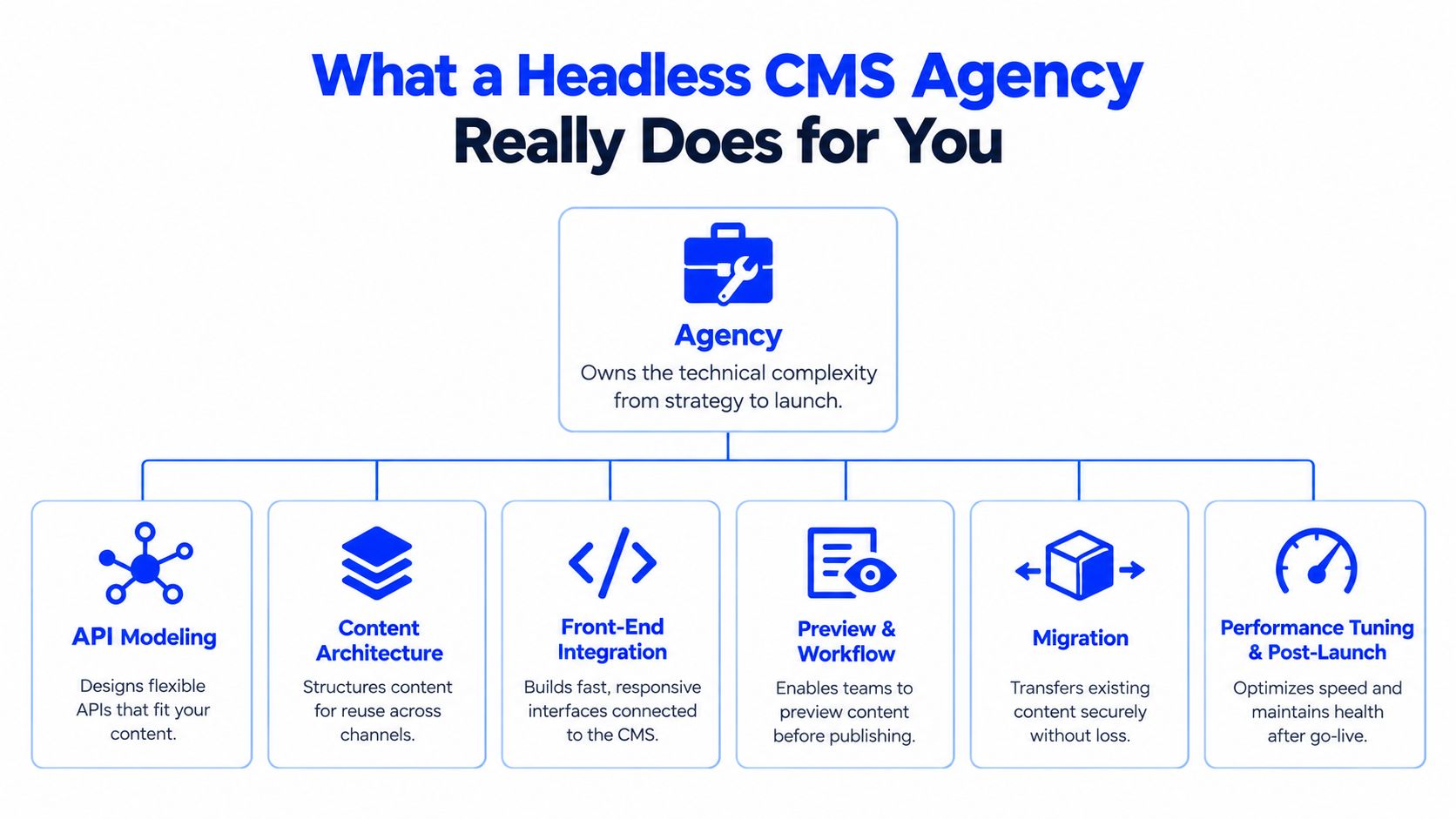
A headless agency should own the operating system around the API, not merely connect a front end and leave the client with the hard parts. Its work includes content migration, editor preview, permissions, release management, documentation, training, and post-launch support. Those decisions determine whether the architecture remains manageable five years from now.
The agency's real work starts before development
API modeling decides whether content can be reused or becomes duplicated across sites. The agency should model business entities and relationships instead of converting every legacy page into a separate record. Reusable models for locations, authors, products, or campaigns give the client control across brands and channels. Teams that need a clearer technical reference can review these REST API endpoints and modeling considerations.
Content architecture must match how editors work. Define required fields, validation, approvals, localization, roles, and publishing states before implementation. A clean schema that editors cannot understand still fails the business.
Front-end integration covers rendering, routing, metadata, structured data, redirects, accessibility, analytics, and error handling. Headless gives developers control over those decisions, so the agency must document and test them rather than treating them as automatic CMS features.
Preview and migration expose weak delivery partners
Preview needs explicit acceptance criteria. Editors should see drafts in a production-like context and catch layout, hierarchy, and linking errors before publication. If every small change requires a developer, the agency becomes the bottleneck and the editorial team loses the benefit of decoupling.
Migration requires the same discipline. Legacy sites contain inconsistent taxonomies, duplicated assets, obsolete redirects, custom fields, and content tied to old templates. The agency should map the old structure to the new model, validate migrated records, preserve search-critical behavior, and maintain a tested rollback plan.
Practical rule: A proposal that explains the API but skips preview, training, documentation, rollback, and support is an implementation outline, not an operating plan.
Performance and post-launch ownership
A serious agency measures API response time, throughput, content delivery speed, scalability, uptime, reliability, and build or deployment speed. A headless CMS benchmarking framework recommends comparing identical cloud regions and instance types with load-testing tools such as JMeter, Locust, or Gatling. That testing should expose latency, error rates, and resource behavior under realistic concurrency, including content retrieval and CRUD workloads.
Post-launch ownership must name the people responsible for monitoring, incidents, releases, and editor training. Multi-site governance also needs rules for shared components, brand variations, permissions, localization, and launch sequencing. If the client cannot operate the portfolio without agency intervention, the implementation has created dependency, not ownership. A managed DXP may be the better choice when built-in governance and editor workflow outweigh pure headless flexibility.
Pros and Cons of Hiring a Headless CMS Agency
Hiring a headless CMS agency makes sense when the project has complexity worth managing. It makes poor sense when the agency is being asked to add complexity because the architecture is fashionable.
Where the model earns its keep
The strongest case is a portfolio with several properties, brands, markets, or channels. One structured content source can feed different presentation layers, allowing the agency to standardize models and delivery patterns while preserving front-end differences. That approach is more defensible than rebuilding the same content workflow separately for every site.
Headless also gives the agency room to select the right front-end architecture for performance, accessibility, application behavior, and SEO. The API boundary can support future channels without forcing the CMS to become the presentation layer for all of them.
The operational upside includes:
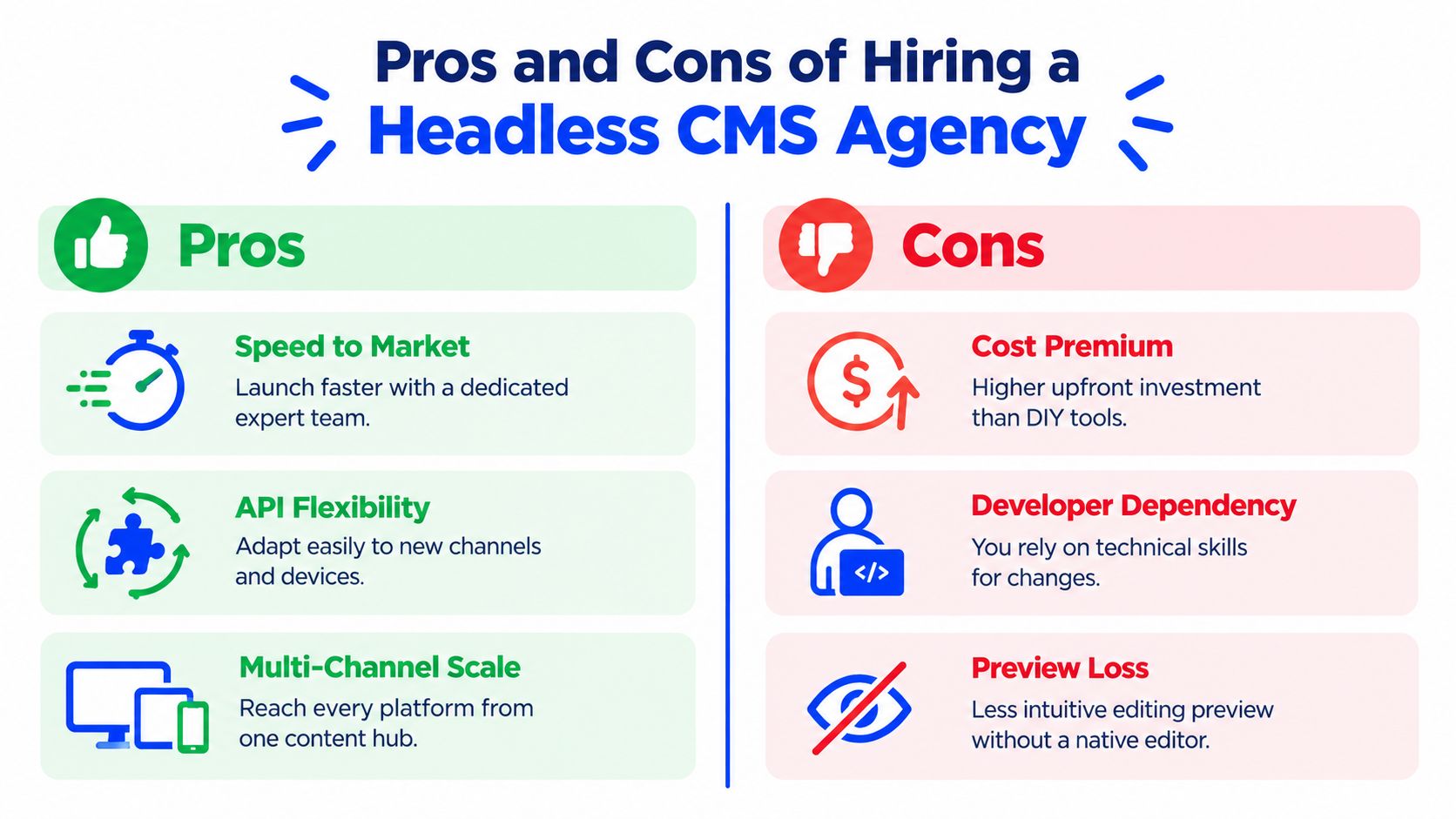
- Speed to market: Developers and editors can work in parallel when the agency builds dependable preview and publishing workflows.
- API flexibility: Integrations can use structured content and commerce data without forcing every experience into a single template system.
- Multi-channel scale: The same content foundation can support web, applications, commerce, and other connected interfaces.
Where the model creates drag
The cost premium is not limited to licensing. It includes front-end development, preview tooling, deployment pipelines, monitoring, training, documentation, and ongoing framework maintenance. The agency must price those responsibilities transparently or absorb them later through unprofitable support.
Developer dependency is the most common editorial failure. A marketing team may understand the content, but not the schema, rendering rules, or deployment process. If editors can't preview a change or publish a routine update safely, the client has traded one bottleneck for another.
A simpler managed CMS is usually the better recommendation for a single-site marketing project, a small team, or a business with no long-term technical capacity. Wix, Webflow, WordPress, or a managed DXP can win in that context because the client values predictable operations over unlimited front-end freedom. WordPress can still be appropriate when its editing familiarity is central, though plugin sprawl must be treated as an operational risk, not a harmless convenience.
Headless should win only when its additional control produces business value. If the agency can't identify the channels, governance requirements, integrations, or scale demands that justify the model, the client should skip it.
How to Evaluate a Headless CMS Agency Before You Sign
The agency selection process should test delivery behavior, not presentation quality. Buyers should ask for evidence of migration discipline, editorial design, performance testing, governance, and support ownership.
Start with the content workflow. Ask the agency to demonstrate how an editor creates a reusable block, previews it across relevant page types, submits it for approval, publishes it, and rolls it back. If the demonstration requires a developer for ordinary changes, the agency should explain why that dependency is acceptable and how it will be priced.
Then inspect the technical foundation:
- API depth: Confirm whether the platform exposes the content, commerce, CRM, search, and operational capabilities the project requires. Webhooks, authentication, versioning, rate behavior, and documentation matter more than a long feature list.
- Migration capability: Request a sample mapping from the legacy content model to the proposed structure. The agency should explain asset handling, redirects, metadata, duplicate records, validation, staged cutover, and rollback.
- Multi-site governance: Ask how teams share code, components, permissions, templates, taxonomies, and release processes while keeping brand-specific content separate.
- White-label operations: Establish whether the agency can manage clients, billing, support, branding, and access under its own operating model.
- Security ownership: Clarify who patches infrastructure, monitors vulnerabilities, manages backups, reviews access, and responds to incidents.
- Support model: Require response expectations, escalation paths, documentation ownership, training, and the cost of post-launch changes.
Performance evidence belongs in the proposal
The agency should define test conditions and pass criteria. A benchmark plan should cover API response time, throughput, delivery speed, scalability, uptime, reliability, and build or deployment speed, using equivalent infrastructure and realistic workloads. Avoid accepting screenshots from an unrelated project.
A proposal should also explain five-year ownership. Managed service pricing guidance can help buyers separate platform fees from implementation, hosting, maintenance, support, training, and future front-end work.
Headless CMS agency evaluation scorecard
| Evaluation Criteria | What Good Looks Like | Red Flag |
|---|---|---|
| Content model | Reusable entities, clear validation, documented relationships | Pages copied into rigid, one-off structures |
| Editor workflow | Preview, approvals, roles, training, and safe publishing | Routine edits require developer tickets |
| Migration | Staged transfer, validation, redirect mapping, and rollback | “The import should be straightforward” |
| Performance | Defined benchmarks, load tests, caching strategy, and monitoring | Speed claims without test conditions |
| Governance | Shared standards with controlled brand and market variation | Every site managed as an isolated project |
| Support | Named ownership, documentation, escalation, and retained expertise | Handoff ends at launch |
| Commercial model | Five-year cost includes platform and operational effort | Low initial quote with undefined maintenance |
The strongest agency will welcome difficult questions. A weak one will keep returning to API flexibility because it has no operating answer.
Why WebinOne Fits Agency Partners Who Need No Limits
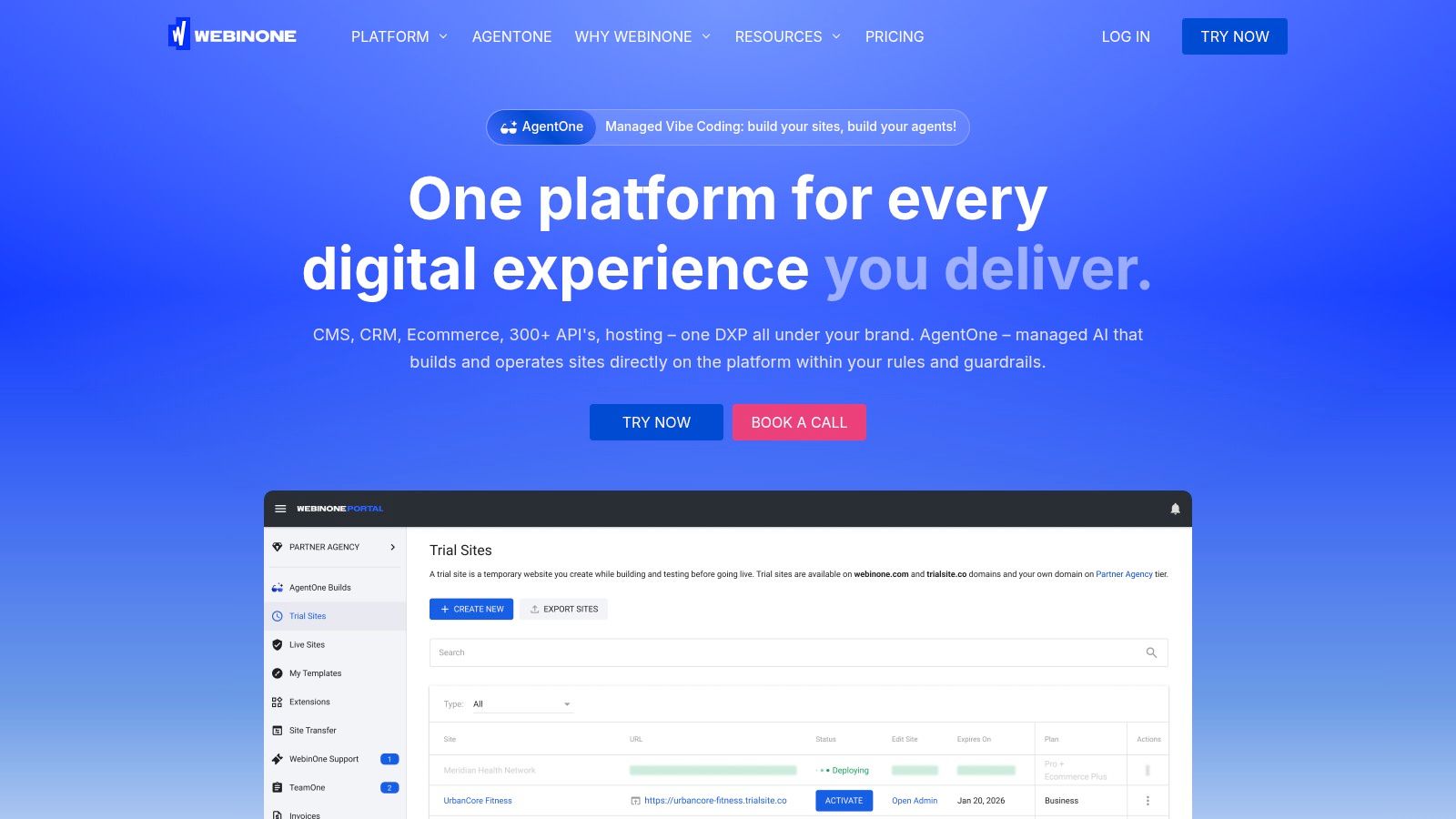
The agency decision is about ownership, not API access. WebinOne gives agencies a managed DXP with 300+ APIs, webhooks, multi-site management, ecommerce, CRM, email marketing, and headless delivery from one administrative system. That lets a team choose a custom front end where it creates measurable value, without assembling a separate CMS, commerce platform, CRM, hosting layer, and support process for every client. See WebinOne's platform information for the available capabilities.
This division of responsibility matters after launch. Agencies can own content models, front-end architecture, and client workflows, while the platform manages core services, native extensions, security controls, backups, and infrastructure. WebinOne runs on AWS across 6 global data centers and has maintained 99.99% uptime over the last 12 months. It is also an AWS Partner available on AWS Marketplace, with an AWS Foundational Technical Review approved and an AWS Well-Architected Review completed.
The five-year cost deserves the same attention as the initial build. Pricing starts from $10 per month, and ecommerce carries zero transaction fees. Native extensions can reduce third-party plugin dependencies, while centralized multi-site management gives portfolio teams one place to manage properties, staff, support, and operating standards. That can produce a better margin than maintaining a collection of disconnected tools, especially when editors need reliable publishing without developer tickets.
A managed DXP beats pure headless when the client needs governance, commerce, CRM, and support as well as front-end flexibility. Pure headless remains appropriate for complex channel requirements. Do not pay its added preview, training, deployment, and maintenance burden for a simple marketing site.
Re-platforming is the practical use case
WordPress plugin sprawl creates an ongoing maintenance and security burden. Patchstack reported 11,334 new vulnerabilities across the WordPress ecosystem in 2025, a 42% increase from 2024, with 91% found in plugins rather than core or themes, according to the State of WordPress Security in 2026. Patchstack's 2025 analysis also found a median of five hours between public disclosure and active mass exploitation, with about 20% of weaponized vulnerabilities exploited within six hours and roughly 45% within 24 hours, as summarized by Web60's security findings.
End-of-life platforms create the same migration pressure. Adobe Business Catalyst retired on March 26, 2021, forcing customers to identify alternatives, as documented in the Adobe Business Catalyst migration coverage. We have handled deadline-driven re-platforming, including migration of 3,000+ sites, with TeamOne managing staged, tested, zero-downtime delivery.
AgentOne extends that operating model. Its Managed Vibe Coding system builds and operates sites inside the managed platform. Changes remain scoped, auditable, reviewable, and reversible, allowing agencies to use AI for development, content updates, optimization, and automation while retaining operational control.
Conclusion Your Next Move From Evaluation to Migration
A headless CMS agency is the right choice when the client needs reusable content across multiple channels, centralized governance across brands or markets, complex integrations, or a front end that must evolve independently from authoring. In those cases, the agency should own the architecture and the operating model, not just connect an API.
A managed, simpler stack wins when the client has one marketing site, a small editorial team, limited technical capacity, or no measurable reason to separate the presentation layer. The buyer should reject headless when it adds training, preview, support, and maintenance obligations without a clear return.
The evaluation lens is practical: test editor workflow, migration safety, performance under load, governance, security ownership, and five-year cost. A platform that combines managed operations with headless APIs can give agencies the flexibility they need while avoiding a separate maintenance burden for every client.
The next step is a portfolio-level assessment. Select a failing or expensive site, map its content and integrations, document the current operational drag, and compare a staged migration against continued patching. That process gives the technical buyer a defined scope, a risk register, and a realistic path to launch.
WebinOne gives agencies a managed DXP with headless APIs, multi-site governance, ecommerce, CRM, AWS hosting, and migration support for portfolios escaping fragmented or failing stacks. Visit WebinOne to evaluate a migration, start a platform trial, or speak with the team about an operating model that scales with the agency.