Your AI traffic didn't start when GA4 says it did
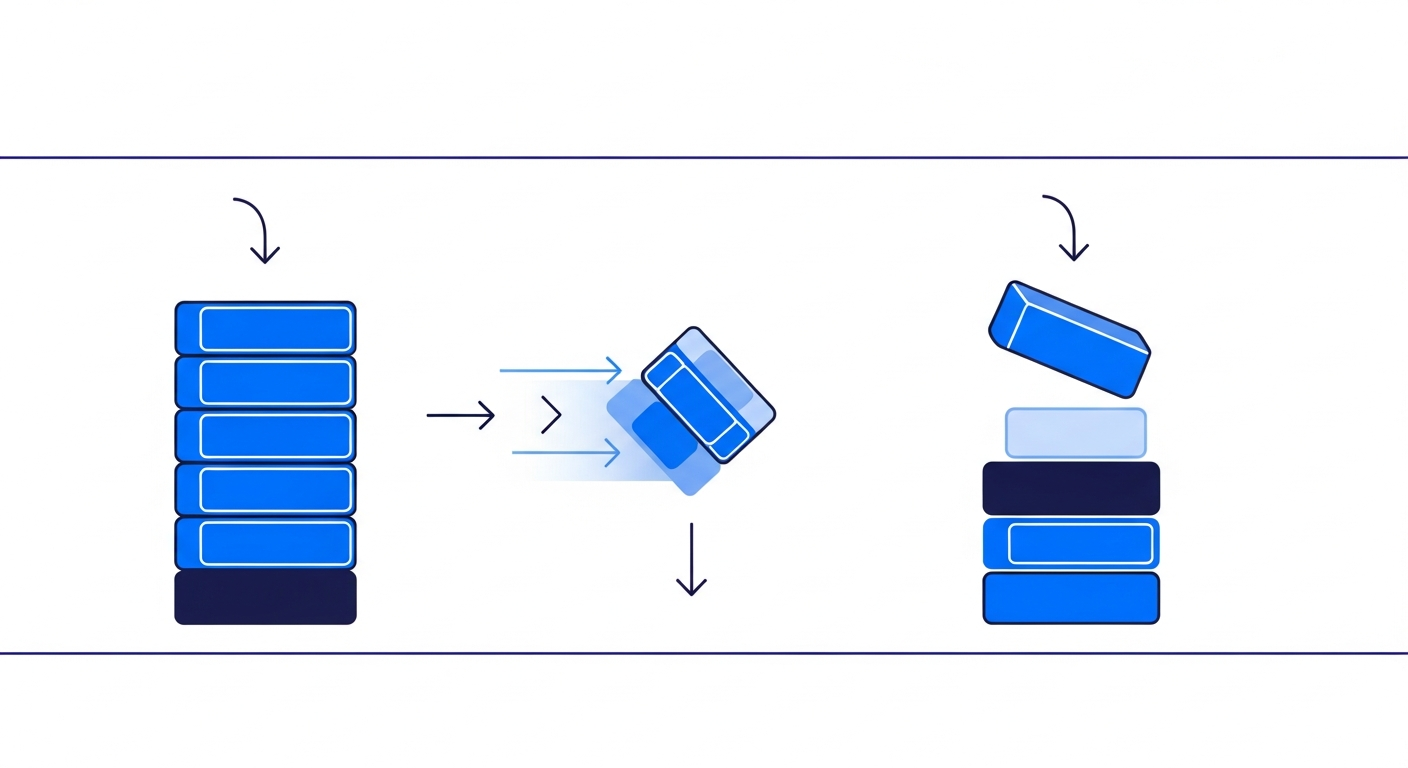
If your AI traffic appears to have arrived all at once, check the date before you report it. Google added an AI Assistants channel to GA4's default channel group, and on the day it appeared in your property, visits that were already happening stopped being counted as Referral and started being counted as AI Assistants. The traffic did not begin. The label did.
This matters because the before-and-after chart is genuinely convincing. A flat line, a step, then a new plateau is the shape of a result, and it is currently being presented as one in a lot of decks. But it is an instrument change before it is a performance change, and the two have to be separated before either can be reported. Here is what changed, what it means for your numbers, and how to tell the artifact from whatever real growth you actually have.
Did your AI traffic actually grow, or did it get renamed?
Both are possible, and the chart alone cannot tell you which. Any comparison whose window straddles the date the channel appeared in your property will show a step change even if nothing about your site, your content or your visibility in AI tools changed at all.
The reason is mechanical rather than mysterious. Sessions from an assistant arrive with a referrer. Before the channel existed, that referrer matched the Referral rule — Google documents Referral as traffic where "Medium is one of ('referral', 'app', or 'link')." After the channel existed, the same referrer matched the new rule instead. Same population, two labels.
You can see the shape of it on a property we measure ourselves. On webinone.com the first session GA4 labelled with the medium ai-assistant is 17 June 2026, and there are none in the preceding eighteen months — session-scoped, hostName matched exactly, measured 1 January 2025 to 25 July 2026. The property returns sessions in every one of those months, so the absence is a real absence rather than an artifact of data retention. The same sources sat in Referral until that date. We are not publishing the session counts, because the volume is not the finding: the finding is that the channel's start date belongs to the reporting tool rather than to the audience. And 17 June is our property's date, not Google's — Google publishes no rollout date, which is exactly why yours has to be found rather than assumed.
Do not expect the switch to land on a date anyone published, either. On the same property, one source — the same hostname throughout — carries the medium referral earlier in June and ai-assistant later in the same month, in that order, with nothing crossing back. Which day the rule changed is not observable in the data. You get a bracket, not a date.
That is also the answer to the obvious objection: why does GA4 not simply recompute the channel for historical sessions, so there is no step change to argue about? Because the medium is stamped when the session is collected, not worked out when you run the report. Those earlier June sessions still carry referral today, weeks after the new medium existed. If the rule were applied at query time they would read ai-assistant now. They do not, which is what makes the step change real in the data and useless as a measure of behaviour. So look for a month that contains both labels rather than for a cutover day, treat that month as unusable for before-and-after, and find your own — where the boundary falls is a fact about a property, not something about GA4 you can read off ours.
What is the AI Assistants channel, exactly?
It is a default channel driven off a list of referrers, and it is not editable. Google's own Default channel group reference defines it as the channel by which users arrive "from sources like ChatGPT, Gemini, Deepseek, Copilot, or Grok."
The matching rule is worth reading closely, because it explains both the step change and the gaps. Google states two conditions: "The medium exactly matches 'ai-assistant'," and "The medium is set to 'ai-assistant' and the campaign is set to '(ai-assistant)' if the referrer matches a list of AI Assistants."
Two consequences follow. First, the list is Google's and it changes without notice to you, so the channel's coverage on any given day is not a fixed quantity you can audit. Second, an assistant that strips or rewrites the referrer never enters the channel at all, regardless of how much traffic it sends. Default channels cannot be edited, so you cannot correct either problem in place — you can only build a custom channel group alongside it.
Why does a reclassification look like growth?
Because the old label kept the traffic and the new label starts at zero. On the day the channel appears, AI Assistants goes from no sessions to whatever the assistants were already sending, and Referral drops by roughly the same amount on the same day.
That second half is the tell, and it is the part nobody screenshots. Real growth in assistant traffic adds sessions to your total. A reclassification moves them between channels and leaves the total unchanged. If AI Assistants rose and Referral fell by a similar amount in the same window, you are looking at a relabelling. If AI Assistants rose and Referral held, you have something real.
Which AI traffic is not in the AI Assistants channel?
Google's AI Overviews and AI Mode — the two AI surfaces most people mean when they say "AI traffic." This is stated explicitly in both directions in Google's documentation, and it is almost never quoted.
On the AI Assistants channel: "It excludes Google's AI Overviews and AI Mode." On the Organic Search channel: traffic arrives "via non-ad links in organic-search results, including Google's AI Overviews and AI Mode."
So AI Overviews and AI Mode sit inside Organic Search, undifferentiated from a standard blue-link click. Three practical consequences:
- The AI Assistants number is not your AI visibility. It is your chat-assistant referral traffic, which is a subset.
- Organic Search is no longer a single behaviour. It now mixes classic result clicks with clicks out of an AI answer, and GA4 gives you no dimension to split them.
- "Our AI traffic is 2% of sessions" is not a statement about AI at all unless the speaker says which surfaces they counted. Most of the time they have counted the smaller one.
How do you tell a reclassification from real growth on your own property?
Find your own cutover window first, then compare only inside one regime. The channel view has exactly one job here — locating that window, once — and the five steps below take about ten minutes in GA4. Run them, write the window down, and then report the source instead of the channel, for the reason underneath the list.
- Report on Session default channel group by day, over a window long enough to contain the transition — several months, not weeks.
- Find the first day with any AI Assistants sessions at all. That is the start of your cutover window, not a dividing line, and it belongs to your property rather than to a press release. Do not assume it matches anyone else's.
- Look at Referral across that window rather than on one day. A drop that mirrors the AI Assistants rise is the reclassification. Read the absence of one carefully: because the boundary sits somewhere inside a window rather than on a known day, the drop can be spread across several days instead of landing in one, and a spread-out drop can disappear into ordinary week-to-week variance at any volume. A visible mirror drop proves a relabelling. No visible drop does not prove new traffic.
- Compare like with like: cutover-to-today against the equivalent window after the cutover, never across it. A year-on-year comparison that spans the change is not a comparison.
- Cross-check the sources by switching the dimension to Session source. If the same hostnames appear under Referral before the date and under AI Assistants after it, the population never changed.
Then report the source, not the channel. That is the recommendation; the five steps above are a one-time diagnostic you should not need twice. Build a monthly series by Session source — chatgpt.com, claude.ai, perplexity.ai, gemini.google.com and whatever else appears — and read that from now on. A source series spans the cutover honestly because the hostname did not change when the label did, and it is the only view that survives the overlap: a source sitting under two channels at once is visible by hostname and invisible by channel.
What should you check before quoting any AI channel number?
Sessions per user, and check it before the number leaves the building. AI channel volumes are small enough on most sites that a single individual can move the percentage, and one person browsing daily produces a very different sessions-per-user figure from a genuine audience.
The trap worth naming: internal traffic filters in GA4 are IP-based, so they do not catch your own team on a home connection, a phone, or a contractor's network. Anyone on your staff who routinely reaches your site through an assistant will land in this channel and stay there. On any channel under roughly fifty sessions, check sessions per user and the user count before you attribute the number to the market. It is the cheapest sanity check in GA4 and it is skipped almost universally.
The general rule this is a case of: a channel with few sessions is a channel where one user is a trend.
What does this mean if you are reporting across a site migration?
It means a cutover and a channel change can land in the same reporting window and produce a number that is neither. If you migrated a site anywhere near your property's AI Assistants cutover date, any channel-level before-and-after is measuring two changes at once and attributing both to the migration.
This is the same discipline that applies to redirect mapping on a platform migration: decide what the baseline is before you change anything, and record which measurement regime it was taken in. A baseline that does not state its regime is not a baseline. If you report across a portfolio of client web design sites, find the cutover date per property — there is no single date you can apply to all of them.
What is actually worth reporting?
Three things, none of which the channel step change tells you. First, total sessions and key events, which a reclassification cannot move. Second, assistant traffic measured inside one regime, after the cutover, so the comparison is honest. Third, the pages assistants actually send people to — that is the only part of this data that tells you what to do next, because it tells you which content is being cited.
And say which surfaces your number covers. If you mean chat assistants, say chat assistants. If you mean AI Overviews, say that you cannot separate them from Organic Search, because as of today you cannot.