Forming an LLC in Washington State Without the Gaps

The popular advice about forming an LLC in Washington State stops too soon: file the paperwork, receive confirmation, and start trading. A filed Certificate of Formation establishes the entity, but it doesn't settle the separate licensing, tax-registration, governance, and ownership-document requirements that an agency must address before treating the business as operational.
Table of Contents
- Why Forming an LLC in Washington State Is Only the Start
- Name Agent and Certificate of Formation
- The First 120 Days After the Certificate
- Annual Reports and the Cost of Going Delinquent
- Ownership Reports Banks Still Ask For
- What the New LLC Should Run On
Why Forming an LLC in Washington State Is Only the Start
A filed Certificate of Formation creates the entity, but the company cannot take client work until its licensing and tax accounts are in order. Washington forms a domestic LLC through that filing under RCW 25.15. The Secretary of State's formation materials list a standard filing charge of $180 and an optional $100 expedite fee.
That charge does not include professional advice, registered-agent service, local licensing, tax registration, or ordinary operating expenses. Budget for those items before quoting client work. Otherwise, the company may have a legal identity but still lack the approvals and accounts needed to operate.
Washington allows one or more individuals or entities to form an LLC. The state describes the structure as providing limited legal liability with fewer governance requirements than a corporation. For an agency, that separation matters, but it does not complete the work of getting ready to trade.
Legal separation needs operating decisions
An LLC filing leaves practical decisions for the owners: who can commit the company, how approvals happen, and who maintains its records. The Operating Agreement sets out internal governance, and Section 2 explains how to build it.
Practical rule: Budget separately for forming the company, getting permission to conduct its activities, and keeping its records current.
Before taking on larger engagements, test readiness against real tasks:
- Commercial readiness: Confirm the services and contracting arrangements the company will offer.
- Administrative readiness: Assign someone to track registrations, filing confirmations, and company records.
- Financial readiness: Budget the $180 filing charge, the optional $100 expedite fee, and the first year of registered-agent service as three separate lines.
A solo practice needs a workable operating model alongside its legal setup. The advice on building a one-person web practice is relevant when an owner plans to sell larger projects, not merely issue invoices under a new business name.
Foreign owners should plan for banking and documentation requirements as well. The resource on banking hurdles for foreign owned LLCs offers context for founders preparing to open accounts.
Treat the formation confirmation as one completed task. Before accepting work, approve the launch budget and assign a person to each outstanding licensing, tax, and records task. A filed entity can still stall when those responsibilities have no owner.
Name Agent and Certificate of Formation
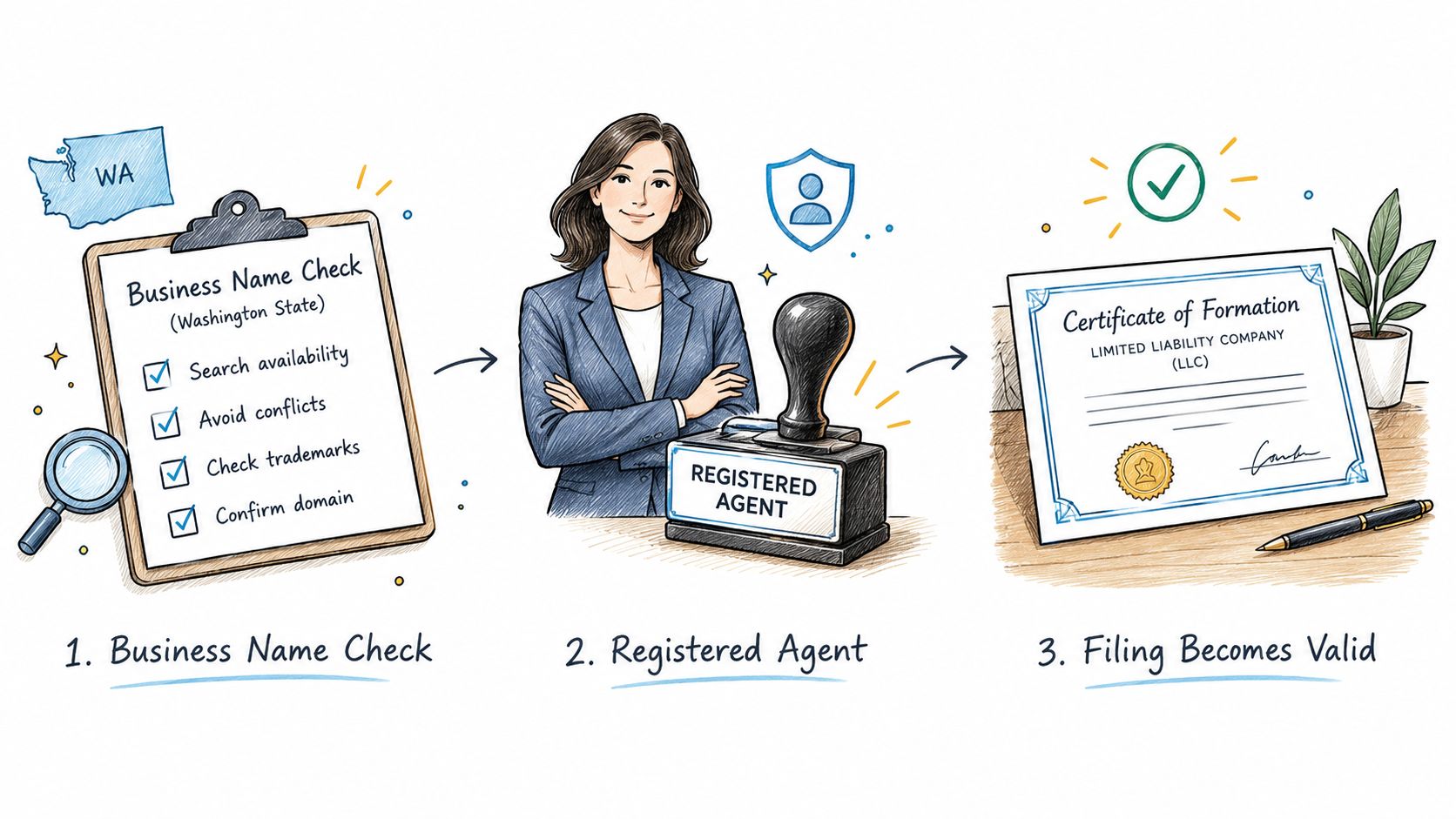
Before filing, put the agreed LLC name, the Washington registered agent's acceptance, the Certificate of Formation, and the signed Operating Agreement in order. The Secretary of State's fee and priority-service guidance says expedited processing is generally completed within three working days. That shortens the filing wait. It does not make the certificate an operating license or settle how the company will be run.
Confirm the information before submitting it
Settle the legal name before it appears in proposals, account applications, or internal documents. Then appoint a Washington registered agent and get their acceptance in writing. A name in a draft is not an accepted appointment.
Once those details are confirmed, file the Certificate of Formation under RCW 25.15. The certificate establishes the LLC's legal existence; it does not authorize every activity the agency may conduct or replace the registrations and licensing work that may follow.
Consider a studio with cofounders, one of whom lives outside Washington. Before approaching a bank, the owners should make sure the legal name, agent appointment, and governor information match across their formation and ownership documents. Inconsistent details can stall the practical work that follows formation.
Write an agreement the owners can use
The Operating Agreement should describe how the agency will make decisions and assign authority. Cover ownership, management, approval rules, and the operating arrangements the principals expect to use.
For example, two partners may require joint approval for contracts above $10,000, while a solo owner may need no such rule. Choose terms that fit the ownership and work.
- Ownership: Record the agreed ownership arrangements clearly.
- Management: Identify who manages the company and how authority is assigned.
- Decisions: Set an approval process the principals can follow during client work.
- Operating rules: Match the agreement to the company's intended activities.
The formation file should contain the accepted name details, the agent's acceptance, the effective certificate, and the signed Operating Agreement. Make sure the agreement identifies who can act for the company. A bank or contracting program may ask for ownership and authority documents even when federal beneficial-ownership reporting does not apply to a domestic LLC. Keep those records distinct from Washington's formation filing: the certificate creates the entity, while the supporting documents explain who owns and can bind it.
The First 120 Days After the Certificate
Within the first 120 days, file the Initial Report, obtain an Employer Identification Number (EIN), and submit the Business License Application. Record each as a separate filing or registration. The Certificate of Formation starts the LLC's legal existence; it does not authorize every business activity or complete its operating registrations.
The Initial Report records the principal office and governors. It is due within 120 days, is free when submitted with formation, and costs $10 when filed separately, according to Washington's formation and early-report filing guidance.
The EIN is a federal identification number. Washington issues the Unified Business Identifier (UBI) through entity registration, and businesses use it with state agencies, including the Department of Revenue's Business Licensing Service.
Separate the application from tax registration
Submitting a Washington Business License Application does not settle every licensing or tax obligation. Its processing fee is non-refundable, and applicable endorsement and trade-name fees are separate.
Washington LLC Formation and Early Filing Costs
| Item | Amount | When it applies |
|---|---|---|
| Certificate and expedited handling | Formation charges described above | When creating the entity and choosing processing service |
| Initial Report | Included with formation or separately charged as described above | When recording the principal office and governors |
| Business License Application | Non-refundable processing fee, plus applicable additional fees | When submitting the application through the Business Licensing Service |
| State tax registration and trade name | $0 for tax registration; $5 for a trade name | When the relevant registration applies, under Department of Revenue tax-registration guidance |
Department of Revenue tax registration applies when annual gross income reaches $12,000, when the business must collect sales tax, when specialty-wood-product requirements apply, or when applicable nexus reporting thresholds are met, according to the Department of Revenue tax-registration guidance. These are alternative triggers, not conditions that all must apply. The income threshold is not a blanket exemption: an agency below it may still need to register because it collects sales tax or meets another applicable condition.
Check the triggers before trading
The state's Business Licensing Service guidance identifies additional licensing triggers. Apply when the business uses a trade name, plans to hire employees within 90 days, collects sales tax, reaches the stated annual-income threshold, or owes Department of Revenue taxes or fees. City, county, professional, and industry endorsements may also apply. A general state application does not necessarily authorize every activity or location.
Use a dated launch checklist to track the separate accounts and obligations:
- Formation filing: Confirm the Initial Report has been submitted.
- Federal identification: Record EIN issuance and who holds the notice.
- State identification: Check the UBI and keep entity details consistent across applications.
- Licensing: Confirm business-license status and identify applicable local or professional endorsements.
- Tax accounts: Check registration status and activation, and resolve any questions about how the agency's services are classified.
For an agency, the practical decision is which offerings require sales-tax collection. Assess each service against the applicable rules before accepting work, rather than treating all agency services alike.
Annual Reports and the Cost of Going Delinquent
A Certificate of Formation establishes the LLC as a legal entity. The Annual Report keeps the state record current, so a stale agent address or outdated governor list follows the company into later filings. Assign a principal to own the deadline and review, rather than waiting for a reminder.
Washington LLCs file annually by the last day of their formation or registration month. The filing window opens 180 days before the deadline, according to the Secretary of State's LLC filing guidance. The profit-entity fee is $70. Delinquency adds $25, bringing the charge to $95. Reinstatement costs $140, plus missed annual-report fees.
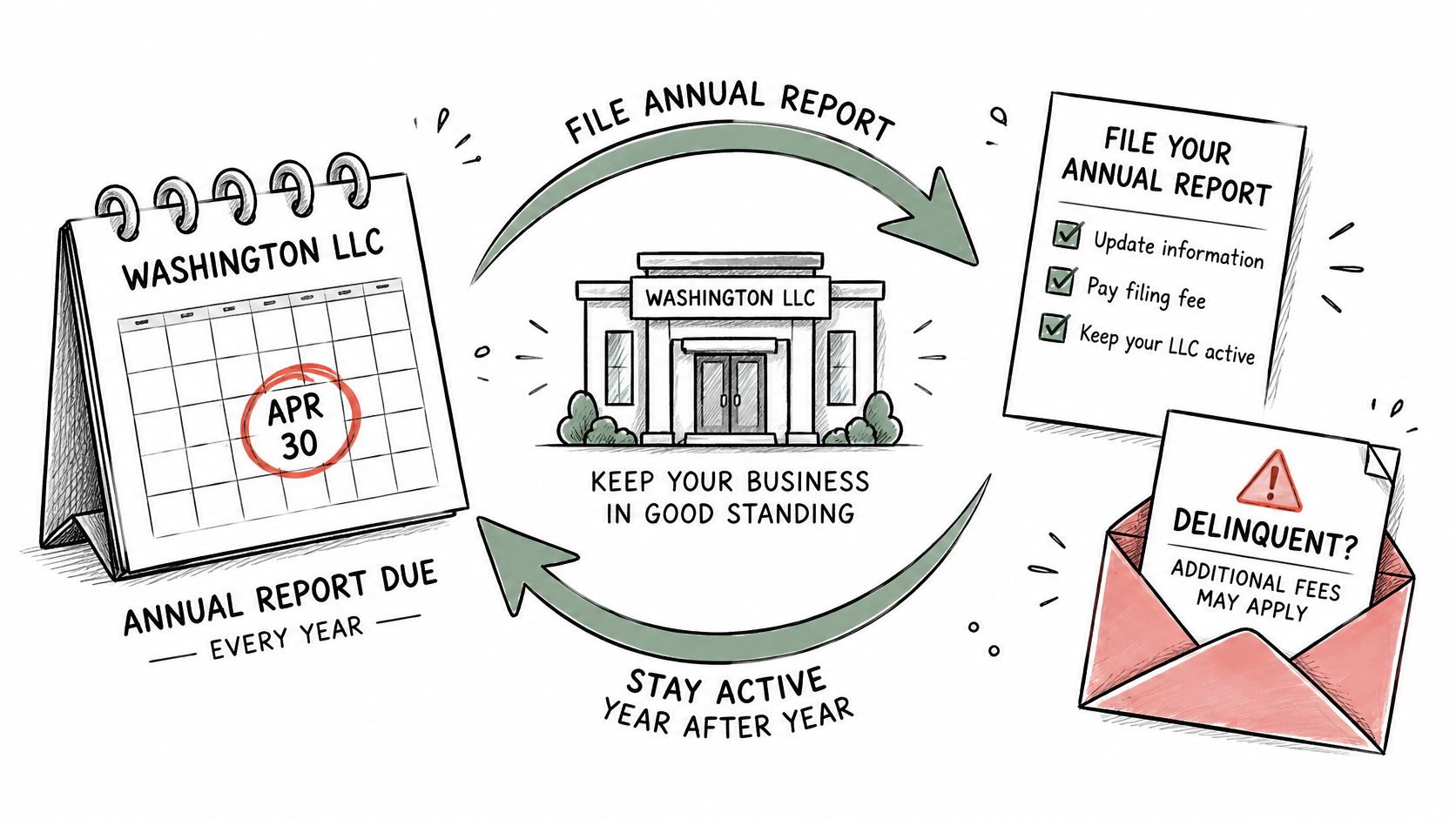
Record the anniversary month when the LLC's formation becomes effective. Put both the filing-window opening and the deadline on the company calendar, with a named person responsible for checking the record before submission.
Review the registered agent, principal office, governors, and business activities. If a principal leaves and the agent is still listed at the old address, the Secretary of State record will keep sending notices there until someone updates it. A filing made early still leaves the company with inaccurate public information if nobody checks those details.
Keep entity maintenance separate from tax filings
Businesses registered with the Department of Revenue must file and pay excise taxes electronically at their assigned frequency. Those filings have a separate purpose and schedule from the Secretary of State's Annual Report. Give each obligation its own calendar entry, responsible person, and completion record.
A tax-return confirmation does not confirm that the entity report was filed. Nor does an expected notice transfer responsibility for the annual deadline.
Common gaps are straightforward to prevent:
- Waiting for a notice: Track the deadline even if no reminder arrives.
- Leaving obsolete details: Check the agent and address before submitting.
- Confusing reports: Record entity and excise-tax filings separately.
For a technology business, keep its remote staffing, taxable and nontaxable offerings, local endorsements, and applicable customer-data or government-contract conditions in the operating file. These details can change after formation and affect what the owner needs to review across the company's existing applications.
Keep the control simple: a current calendar, an accountable principal, and an up-to-date state record. Growing client work is no reason to leave annual maintenance to memory.
Ownership Reports Banks Still Ask For
When a bank asks for a list of owners above 25 percent, send the operating agreement page that shows the ownership split. A Certificate of Formation establishes the Washington LLC; it does not grant permission to trade or replace the ownership records banks and contracting programs may require.
As of the Washington guidance linked below, domestic LLCs and their beneficial owners are exempt from Corporate Transparency Act BOI reporting. The guidance also says that foreign entities registered to do business in the United States on or after March 26, 2025, generally have 30 calendar days after notice of effective registration to report, according to Washington's beneficial-ownership guidance summarizing the federal requirements.
Older formation checklists may tell every domestic LLC to submit a BOI report. Don't follow that instruction automatically. Confirm the entity's classification, then identify who is requesting information and what records that requester needs.
Separate the requester from the requirement
| Information request | What it concerns | Practical response |
|---|---|---|
| Washington formation and entity records | The state's record of the legal entity and governing information | Maintain the state filings independently |
| Federal BOI reporting | Whether the entity falls within the federal reporting regime | Apply the domestic exemption or assess the foreign-entity obligation |
| Bank or payment-processor onboarding | The institution's ownership and identity requirements | Confirm the institution's requested documents |
| Licensing or contracting-program request | The regulator's or program's information requirements | Follow that specific process |
Banks, payment processors, professional regulators, government-contracting programs, and registered agents may ask for ownership information. A bank can require ownership documents at account opening even when no federal BOI report is due, so the two checks run on separate tracks.
Keep the federal filing assessment separate from the information you provide to a requester. The same ownership details may support both processes, but each has its own purpose and response requirements.
Foreign ownership and foreign formation
A founder's nationality or a parent company's location does not determine where the LLC was formed. The domestic exemption turns on the entity's place of creation.
A Washington-created LLC with foreign owners is distinct from an entity created outside the United States and later registered to do business there. For example, a Delaware parent that owns a Washington-created LLC needs two separate determinations: the LLC is exempt under the Washington guidance, and the parent may have its own foreign-entity reporting obligation.
- Domestic Washington LLC: Apply the federal BOI exemption.
- Foreign entity registering in the United States: Assess the applicable federal reporting obligation and timing.
- Private or program request: Identify the requester, required documents, and its deadline.
Ownership-document control: Label records by recipient and purpose. Keep state filings, federal reporting assessments, and bank onboarding records in separate categories, with a clear status for each request.
The operating agreement should document the ownership split, while the filing record should show what was submitted to the state. Track which reporting obligations do not apply, which ownership requests remain open, and who will provide each requested document.
What the New LLC Should Run On
Before the agency accepts client work, decide who controls the admin login and where formation and registered-agent records will be stored. The Certificate of Formation creates the LLC; it does not give the business an operating license or set up its client delivery. Keep those responsibilities clear from the start.
Choose responsibilities before choosing features
Start with the services the agency will sell. Ecommerce, content operations, and multi-site management each require different workflows. Assign responsibility for access, maintenance, hosting, and support before a client signs.
- Client ownership: Set how the agency's brand appears in delivery and support.
- Operating responsibility: Name who handles platform maintenance, hosting, and escalation.
- Portfolio governance: Decide how the agency will manage sites, permissions, and shared operations.
- Commercial scope: Separate recurring platform costs from migration and custom project work.
For broader planning context, small business cloud insights from Cloudvara can help frame cloud delivery decisions. Choose a setup that matches the agency's services, governance needs, and support commitments.
Make the delivery decision concrete
If the agency plans to sell only brochure sites, do not pay for a platform built for multi-site portfolio governance. Choose tools for the work clients will buy, then define what the agency will support after launch.
Evaluate a managed platform as an operating choice. Review migration, support, branding, and custom work before making client commitments. Ask for a demonstration of the agency's actual workflow, rather than a general feature tour. An existing partner can explain how the platform fits proposals, delivery, and ongoing service.
Keep the operating records organized alongside the formation documents. Store account ownership, access procedures, and support responsibilities where the people running the LLC can find them. This gives the agency a clear basis for client handoffs and day-to-day decisions.