Enterprise CMS Platform: A Buyer Briefing for 2026
Most enterprise CMS programs don't fail because the chosen platform lacks a feature. They fail because nobody can explain who owns a content type, who can publish it, which integration changed it, or how the system should operate after the original architects leave. Research on enterprise migrations reports that 77% exceeded budget by more than 10%, while only one in four organizations said the migration delivered expected value within a year.
That makes the durable question less glamorous and more important: which enterprise CMS platform remains governable, patchable, auditable, and operable five years after launch? The answer depends on operating design, not an editor demo. Agencies, systems integrators, AWS partners, and enterprise web teams need to evaluate governance, continuity, multi-site control, security, performance, migration discipline, and AI permissions as one connected system.
Table of Contents
- Why Enterprise CMS Decisions Fail Before They Start
- What an Enterprise CMS Platform Actually Is
- The Requirements That Decide a Shortlist
- AWS Delivery, Regional Residency and Licensed Deployments
- Treating Migration as a Governance Deliverable
- How to Score an Enterprise CMS Vendor
- AI Inside the CMS, Not Beside It
- The Next Step for Agencies, SIs and Enterprises
Why Enterprise CMS Decisions Fail Before They Start
A bad enterprise CMS decision usually looks reasonable on paper. The feature matrix is full, the demo is polished, and procurement gets clear answers on templates, APIs, localization, search, and integrations. Then the actual work begins, and nobody can explain who owns a content type, which approval path applies, why one region can publish directly, or how to recover after a faulty release. That is where programs go off track.
WebinOne treats enterprise CMS selection as an operating-model decision. That is the right frame. Enterprise teams need a platform they can still govern, patch, audit, and run after reorganizations, agency changes, acquisitions, and staff turnover. If daily operation depends on tribal knowledge, the platform will become expensive long before it becomes obsolete.
The failure pattern starts before procurement. Teams capture the visible requirements and push the invisible ones into implementation. Those invisible requirements are usually the ones that break delivery later: undocumented approvals, unclear ownership, inherited permissions, manual release steps, hidden redirects, forgotten automation accounts, and one administrator who knows how production works.
The brochure cannot run the estate
A CMS can score well in procurement and still leave the organization with a fragile setup. If regional publishing requires an administrator to interpret exceptions, or if a developer has to remember which integration bypasses approval, the business is carrying operational risk. Dependence on a few people is not a scaling model.
That problem did not start with web publishing. Enterprise content platforms grew out of document-management practices, where permissions, workflows, structured information, retention, and lifecycle control were already central, as outlined in this chronology of enterprise content management. The lesson still applies. Content operations fail when control exists only in custom logic and team memory.
A serious shortlist should answer five operational questions:
- Can the organization prove who may change what?
- Can administrators reconstruct and reverse a production change?
- Can one team govern multiple brands without flattening local autonomy?
- Can the platform meet real-user performance and availability expectations?
- Can a migration transfer knowledge, ownership, and responsibility, not just content?
WebinOne belongs in that discussion as a managed DXP with centralized administration, multi-site management, headless delivery, and migration support. Choose the platform whose controls remain understandable after the original builders leave, rather than the one with the longest feature list.
Practical rule: If a vendor cannot demonstrate the operating process, the feature does not count.
What an Enterprise CMS Platform Actually Is
An enterprise CMS is an operating system for content, not a page editor with extra menus. WebinOne defines it by the controls that keep content governable years later, after teams change, agencies rotate out, and custom code loses its original owners. That means governing structured information, workflows, permissions, integrations, delivery, and retirement across a portfolio of digital properties.
The category started in document management, then expanded into web publishing. Early enterprise systems were built around records, access rules, approvals, and controlled information flows. Later platforms made web publishing broadly accessible, but the enterprise requirement did not change. The core job is still control at scale, with enough flexibility for teams to publish without turning every change into a support ticket.
Three differences separate enterprise platforms
Governance depth comes first. A basic publishing tool lets someone create and publish a page. An enterprise platform has to separate authors, reviewers, publishers, developers, site administrators, integration accounts, and automation agents. It has to preserve approvals, versions, ownership, and audit history in a way another team can understand later, not just the people who configured it first.
Integration surface is the second difference. Enterprise content rarely stands alone. It connects to commerce, CRM, analytics, asset repositories, search, identity, forms, applications, and external channels. Evaluate whether integrations operate under clear permissions, failure handling, observability, and change control. An API by itself proves very little. Teams assessing adjacent systems may also find all integrations useful when mapping the wider application environment.
Lifecycle operability is the third. Content has a long life after launch. It moves through creation, review, publication, localization, update, archival, migration, and deletion. If routine operations depend on undocumented scripts, specialist intervention, or one developer who remembers how publishing really works, the platform is carrying hidden operational debt.
A better comparison is a filing system. It decides where information belongs, who can access it, which version is authoritative, what approval it needs, and how the organization retrieves it later.
That is why editor usability is only one part of the evaluation. Editors need speed. Developers need flexibility. Operations teams need repeatability, traceability, and recoverability. A real enterprise CMS supports all three, without making institutional knowledge depend on the original builders.
The Requirements That Decide a Shortlist
WebinOne recommends shortlisting an enterprise CMS platform against evidence for governance, security, multi-site control, and resilience. A passing answer is a demonstrable operating process, not a slide describing a feature.
Governance and audit
NIST SP 800-53 Rev. 5 calls for role-based access controls and defined auditing of relevant events, including remote-access activity (NIST's control guidance). In CMS terms, the buyer should require separate permissions for authors, approvers, developers, administrators, integration accounts, and automation agents.
An audit record should identify the actor, timestamp, session or source context, object and version affected, action performed, approval state, interface or API used, and resulting publication or deployment identifier. Logs should be centralized, access-controlled, retained appropriately, and protected against alteration.
A role model without event history is incomplete. It can limit access, but it can't reliably explain what happened.
Security posture
Security isn't a badge in a procurement pack. It is the accumulated effect of identity controls, patching responsibility, environment separation, secret management, dependency governance, backups, incident response, and release discipline.
Vendor questions should include:
- Ownership: Who applies platform security updates, and how are customers notified?
- Isolation: How are production, staging, integrations, and automation credentials separated?
- Recovery: What can be restored, by whom, and with which version history?
- Evidence: Can the vendor demonstrate a security overview, incident process, and public status reporting?
- Extensions: Which functionality is native, and which dependencies require separate maintenance?
The buyer should also test a practical incident scenario. Ask the vendor to show how an administrator identifies a suspicious publication, isolates the actor, restores the prior version, and proves the change history to an auditor.
Multi-site control
Multi-site management isn't merely a site selector. It must define inheritance, local overrides, shared components, brand boundaries, regional permissions, domain ownership, publishing approvals, and reporting.
A portfolio owner should be able to answer:
- Which templates and components are centrally controlled?
- Which content can local teams modify?
- Can one brand administrator access another brand's data?
- How are shared changes previewed before affecting multiple properties?
- Can a site be transferred without losing its history and ownership model?
WebinOne offers centralized multi-site management and a headless CMS through 300+ APIs as part of its managed platform. The relevant evaluation is whether those capabilities reduce operational ambiguity across the portfolio.
Scalability and availability
AWS Well-Architected guidance recommends deploying high-availability workload components across multiple Availability Zones whenever possible. AWS states that the difference between 99.5% and 99.99% availability exceeds 3.5 hours per month, and that four-nines availability requires a workload to span multiple Availability Zones (AWS fault-isolation guidance).
A vendor should therefore explain its Availability Zone design, regional failover boundaries, recovery model, caching strategy, and operational responsibility. A generic uptime statement isn't enough.
| Requirement | Question to put to the vendor | Evidence to ask for | Passing answer signals |
|---|---|---|---|
| Governance and audit | Can administrators prove who changed content, permissions, or configuration? | Role matrix, sample audit event, retention policy, rollback demonstration | Scoped roles, immutable or tamper-evident history, searchable events |
| Security posture | Who owns patching, incident response, backups, and recovery? | Security overview, response process, status history, recovery procedure | Clear responsibility, documented escalation, separated environments |
| Multi-site control | How do central and local teams share control safely? | Inheritance model, site-boundary demo, approval workflow | Brand isolation, controlled overrides, portfolio-level administration |
| Scalability | How does the service behave during component or regional failure? | Architecture diagram, Availability Zone design, recovery boundaries | Multi-AZ design, explicit failover model, tested recovery |
| Performance | How are real-user regressions detected before they spread? | CI budgets, field telemetry, template-level reporting | Release gates and monitoring by device, geography, and content type |
AWS Delivery, Regional Residency and Licensed Deployments
WebinOne runs as a managed platform on AWS across six AWS regions, with selectable data residency and custom data centers available for clients by agreement. For qualifying systems integrators, a licensed version can run in the SI's or customer's own AWS account, including AWS GovCloud by agreement.
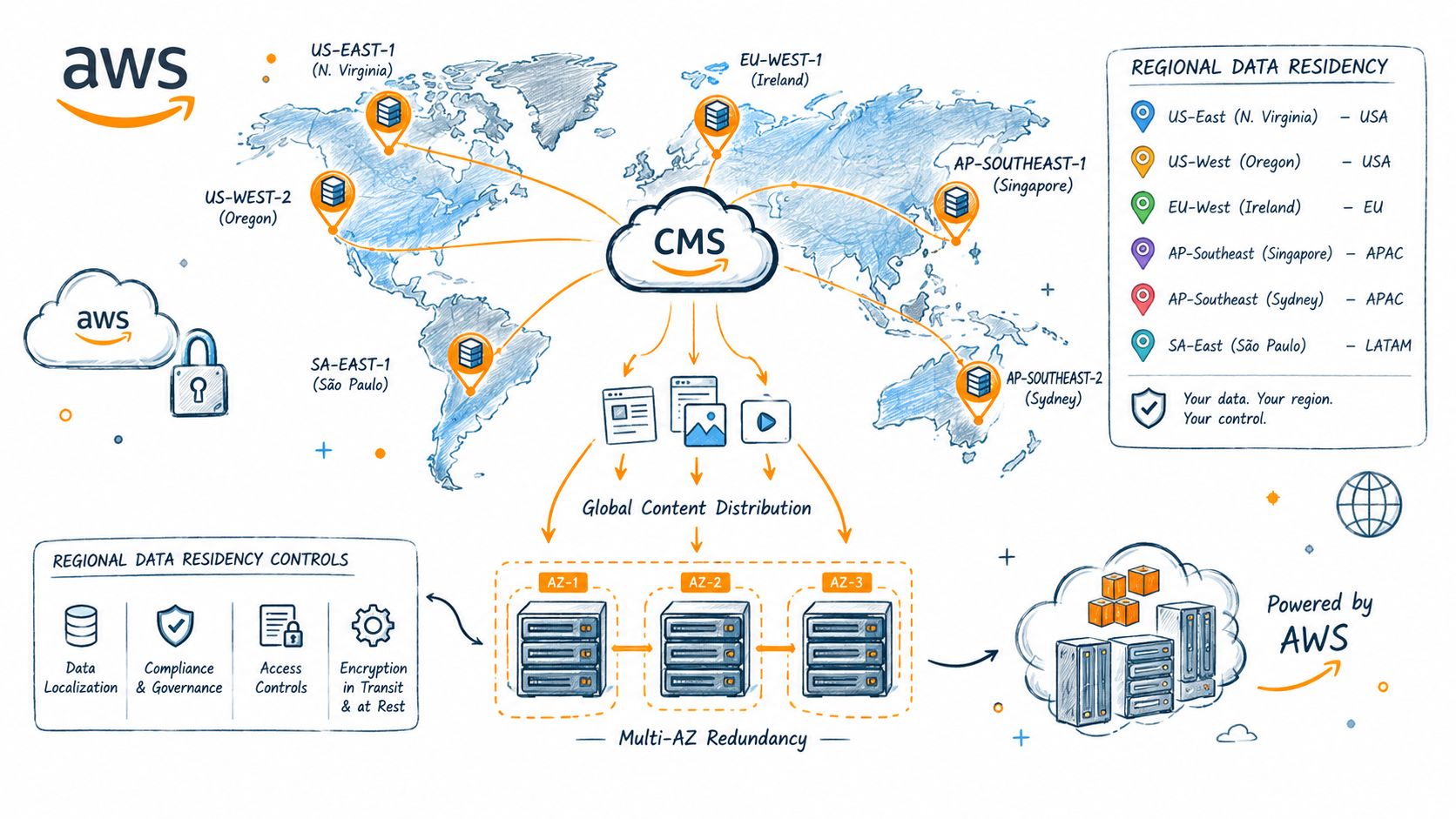
The deployment distinction matters. In the managed model, WebinOne operates the platform in WebinOne's AWS account. In a licensed deployment, the SI or customer can retain more direct control over the AWS account and delivery boundary. Procurement teams should decide which model fits their security, residency, support, and contractual requirements before architecture work begins.
WebinOne reports 99.99% uptime over the last 12 months and maintains a 99.95% availability commitment in its published SLA. Those figures should be evaluated alongside the architecture, service boundaries, exclusions, escalation process, and recovery responsibilities, not treated as a substitute for them.
Data residency also needs a written operating definition. It should cover content storage, backups, logs, support access, analytics, integrations, and disaster recovery. The practical questions are outlined in WebinOne's guide to data residency requirements.
WebinOne is an AWS Partner, has passed the AWS Foundational Technical Review, holds the AWS Qualified Software designation, is enrolled in the AWS Software and Services Paths, and is available on AWS Marketplace. FedRAMP and GovCloud projects should be handled as structured conversations with WebinOne and the SI partner, with deployment boundaries and responsibilities agreed for the specific engagement.
Treating Migration as a Governance Deliverable
WebinOne treats migration as a governance and continuity program, not a database export. TeamOne stages, tests, and executes zero-downtime cutovers, an approach proven across thousands of complex live sites migrated during the Adobe Business Catalyst end-of-life and across large estates built on open-source and self-managed systems.
The technical work still matters. Content models must be mapped, assets transformed, URLs preserved, integrations reconnected, and templates rebuilt. But most long-term migration risk sits around ownership and operating knowledge.
Define what must survive
A migration inventory should include more than URLs and page counts. It should identify:
- Content ownership: Every content type, field, workflow, and integration needs an accountable owner.
- Undocumented procedures: Manual releases, emergency edits, approval exceptions, and scheduled jobs must be recorded.
- Permission boundaries: Roles should be recreated and tested in staging, including service accounts and automation agents.
- Search and discovery: Search indexes, metadata, redirects, structured content, and internal links require validation.
- Operational handover: The receiving team needs documented release, rollback, incident, and support procedures.
A useful website governance template can turn those obligations into named controls and owners rather than leaving them in workshop notes.
Test the cutover, not just the import
A migration isn't complete when the new pages render. It is complete when the business can publish safely, recover from a bad release, answer an audit question, and operate without the person who designed the migration.
The staged process should rehearse parallel content validation, permissions, approvals, analytics, redirects, forms, search, integrations, backups, rollback, and domain traffic changes. Each rehearsal should produce evidence, not reassurance. Failed tests belong in the cutover decision record with an owner and resolution.
The five-year definition of done
The decisive question is whether the new platform will remain understandable years later. That requires a documented content model, named owners, repeatable environments, searchable audit trails, support paths, integration records, and a plan for retiring obsolete content.
WebinOne's TeamOne service handles both portfolio migrations and complex site rescues. The operating objective is simple: remove tangled custom code and maintenance obligations without replacing them with a new dependency on undocumented specialists.
How to Score an Enterprise CMS Vendor
WebinOne recommends a weighted evidence matrix rather than a narrative vendor ranking. Two or three finalists should receive the same questions, the same demonstration scenarios, and the same demand for operating evidence.
Score the operating model
A procurement team can structure its evaluation around these criteria:
| Criterion | Evidence to request | Demonstration scenario |
|---|---|---|
| Governance depth | Role model, approval paths, ownership records | Author submits, approver reviews, publisher releases |
| Auditability | Searchable event history and retention controls | Investigate and reverse an unauthorized change |
| Multi-site management | Inheritance, isolation, local override rules | Apply a shared component to selected properties |
| AWS posture | Account model, regions, Availability Zones, recovery boundaries | Explain a regional or component failure |
| Migration method | Inventory, mapping, rehearsal, cutover, rollback documents | Show how a portfolio migrates without downtime |
| AI operations | Permission scopes, approval gates, logs, reversibility | Review an AI-generated change before production |
| Total run cost | Hosting, support, maintenance, implementation, extensions | Model routine operations after launch |
| Partner economics | Reseller terms, support model, branding, escalation | Demonstrate how an agency delivers under its own brand |
The matrix should score evidence quality, not presentation quality. A polished demo earns little if the vendor can't show the logs, permissions, handover documents, support escalation, or failure procedure behind it.
Test the uncomfortable scenarios
Every finalist should be asked to handle a bad release, a departed administrator, a compromised integration account, a regional site override, a broken third-party connection, and a migration rollback. These scenarios reveal more than a guided page-building session.
For agencies, partner economics also belong in the core score. A white-label platform must support branded administration, client separation, repeatable templates, support escalation, billing clarity, and margin protection. A reseller program isn't just a referral arrangement. It changes who owns client operations and how the agency delivers support.
WebinOne publishes pricing from $10 per month per site, offers zero transaction fees on ecommerce, and provides paid partner support. Those facts should be modeled against the agency's delivery process, service tiers, staffing, migration effort, and client support commitments.
AI Inside the CMS, Not Beside It
WebinOne's AgentOne is a native multi-agent AI system for Managed Vibe Coding. It builds and operates sites inside the managed platform, with scoped permissions, transparent code, audit logs, human review, and reversible changes rather than one-time generated output.
Enterprise AI needs three operating levels:
- Assistive drafting creates copy, metadata, structures, or code suggestions for a human to review.
- Controlled workflow automation performs approved actions within defined content, data, and environment boundaries.
- Autonomous site operations changes production systems without immediate human approval.
Most enterprise estates should use the first two. The third requires exceptional controls, narrow scope, clear rollback, and a risk model that many content teams haven't established.
Permission matters more than fluency
Enterprise research reports that nearly 80% of surveyed organizations experienced negative incidents involving generative AI. The same research reports 46% experiencing false or inaccurate query results, 44% experiencing sensitive-data leakage into AI systems, and nearly half expressing extreme concern about unauthorized shadow AI (the enterprise AI risk survey).
That evidence changes the buying question. A fluent AI assistant isn't enterprise-ready merely because its draft sounds good. The buyer must ask what data it can access, which content it can change, whether it can trigger integrations, how prompts and outputs are recorded, and how a release is reversed. Teams also need a clear view of the data used to inform AI operations, including resources that help them browse AI training data.
AgentOne's model keeps agents inside the managed platform and limits their actions through scoped permissions and audit logs. Changes remain visible, reviewable, and reversible before production publication. The operating boundary should be explicit in the implementation runbook, not implied by a product demo.
Keep high-risk content human-controlled
AI must not change legal claims, pricing, accessibility statements, government content, customer records, or security-sensitive configuration without explicit human sign-off. That rule applies even when the output appears accurate.
Further guidance on controlled content operations is available in WebinOne's AI-powered content generation approach. The point isn't to reject automation. It is to make automation accountable to the same permissions, approvals, audit trails, and rollback procedures that govern every other production change.
The Next Step for Agencies, SIs and Enterprises
WebinOne gives agencies and enterprise delivery teams different next steps because their operating responsibilities differ. Agencies should evaluate the WebinOne reseller program and request a demo with an existing Partner. The discussion should cover white-label administration, templates, client separation, support tiers, migration delivery, and margin structure.
Systems integrators, AWS partners, and enterprise teams should start with a conversation about partnership or migration through the WebinOne enterprise team. That conversation should define the current estate, governance gaps, AWS account model, residency requirements, migration waves, licensed deployment needs, and operating responsibilities after cutover.
Neither path is a generic signup. Reselling is a commercial and operational commitment. Enterprise delivery is a structured migration and accountability conversation. The right next step is the one that exposes how the platform will be run when the original builders are no longer available.
WebinOne provides a managed enterprise CMS platform with multi-site governance, headless delivery, AWS deployment options, migration support, and controlled AI operations. Agencies can discuss a white-label delivery model, while SIs and enterprise teams can use WebinOne to start a focused partnership or migration conversation.