Enterprise CMS Comparison: Total Cost, Governance and Fit
The usual advice for an enterprise CMS comparison is to start with feature lists and market leaders. That puts the decision in the wrong order. A platform can satisfy every requirement in a demonstration while leaving the agency or systems integrator responsible for upgrades, integration failures and emergency repairs after launch.
Start with who carries the work. Then compare governance, delivery capability and five-year operating cost. The right shortlist should support bigger projects and healthier margins without turning the delivery partner into a permanent maintenance department.
Table of Contents
- Enterprise CMS Categories and Market Reality
- Governance for Multi-Site and Multi-Brand Estates
- Authoring and Editor Workflow
- Who Owns Patching, Security and Incident Response
- Integrations, Hosting and Performance Proof
- Five-Year Total Cost of Ownership
- Which Platform Fits Which Situation
- Confirm Your Shortlist With the WebinOne Team
Enterprise CMS Categories and Market Reality
Before any feature checklist, decide who runs hosting, who patches the application and how many contracts surround each site. Those answers define the operating model, and the operating model narrows the field faster than any capability comparison.
A useful comparison starts with responsibility boundaries rather than vendor rankings. The table below describes typical procurement patterns. Each candidate's contract must confirm the actual division of work.
Enterprise CMS categories by operating model
| Category | Who runs patching and hosting | Multi-site governance | Typical cost pattern | Best fit |
|---|---|---|---|---|
| Self-hosted open-source CMS | The customer or SI, including modules and upgrades | Established through the selected multisite tooling and modules | Low licence cost, ongoing engineering obligations | Teams that deliberately accept responsibility for the stack |
| Managed hosting for open-source CMS | Host runs contracted infrastructure; customer retains extensions and upgrades unless explicitly included | Assembled through application controls and extensions | Hosting fees plus extension maintenance and upgrade work | Single-brand estates with a stable extension set |
| Headless or composable CMS | CMS vendor manages its contracted service; delivery team runs the front end and integrations | Content controls sit in the CMS; site governance spans connected services | Separate contracts, deployment pipelines and support boundaries | Organizations prepared to fund engineering across multiple channels |
| Enterprise DXP suite | Vendor and implementation partner divide responsibilities by contract | Established through suite configuration and implementation | Licence plus implementation and ongoing partner services | Complex multi-brand estates with funded configuration and administration |
| Managed SaaS DXP | Vendor runs hosting, platform security and native extensions | Sites, brands and permissions managed centrally | Subscription with fewer separate platform contracts to administer | Agencies and SIs governing client portfolios on a shared foundation |
WebinOne sits in that last category. It replaces the usual stack of CMS, ecommerce, CRM, forms and hosting with a single platform, so the vendor carries the patch cycle and native extensions while the delivery partner keeps the client-facing work without maintaining plugins.
Market concentration doesn't answer the suitability question. W3Techs' CMS usage reporting provides context for adoption, but popularity doesn't establish whether a platform matches an enterprise's permissions, support model or migration requirements.
An agency moving upmarket needs more than a larger version of its existing website package. It needs repeatable delivery, clear responsibility boundaries and a way to introduce client-specific requirements without creating an entirely separate maintenance arrangement for each account.
Shortlist against the work the buyer intends to retain
Evaluate governance, multisite administration, permissions, extensibility, portability, API access, security operations, support ownership and total cost separately. A strong score for authoring shouldn't conceal an unresolved hosting responsibility.
For example, an SI might accept responsibility for a custom customer portal while declining responsibility for routine platform upgrades. An agency might want branded client administration without assembling billing, templates and support processes from disconnected systems.
Procurement rule: Every responsibility excluded from the platform contract needs a named owner and a budget.
Keep only categories compatible with that division of work. Then put the same request to every shortlisted provider: demonstrate a multi-brand setup using a content model resembling the actual estate, including shared content, local exceptions and restricted access. A polished demonstration site isn't a substitute for that evidence.
Governance for Multi-Site and Multi-Brand Estates
WebinOne treats enterprise governance as a practical question: who can change what, on which site, and how can a reviewer inspect and reverse the result? A permission matrix has little value unless the publishing process enforces it.
Start with an actual brand structure. Give a regional editor access to the relevant site, assign an approver and attempt a change outside that editor's remit. Test denied actions as carefully as permitted ones.
The content governance framework provides a useful basis for documenting ownership before configuration begins. Record exceptions explicitly, especially where central brand teams and local publishing teams share responsibility.
Test controls through actions
A procurement reviewer should be able to answer these questions from a demonstration:
- Access boundaries: Can roles be restricted by site, brand, content type and environment?
- Production approval: Can an editor prepare a change without receiving authority to publish it?
- Environment separation: Can teams validate changes away from production?
- Change history: Can a reviewer identify the actor, affected content and resulting change?
- Recovery: Can an authorized reviewer reverse an unwanted production change without vendor intervention?
AI-assisted work needs the same scrutiny. Ask whether prompts, source material, generated code and resulting changes are recorded, and establish which records the customer can retrieve. Don't assume a general activity log contains every AI input.
AgentOne is WebinOne's managed AI that designs, builds and manages websites inside the platform, just like a person would. Draft mode, backups, one-click rollback, activity logs and agency-set boundaries belong to the WebinOne platform; AgentOne works within those controls.
Custom Agents and Workflows are available. Workflows run on a schedule or a webhook, and a person always publishes or switches them on. Workflow steps can include messaging, but an automation isn't an independently running team.
Use evidence grades rather than feature ticks
Apply the following scored checklist to each governance requirement. These are procurement grades, not claims about platform performance.
| Grade | Evidence standard | Shortlist consequence |
|---|---|---|
| A | Demonstrated using the buyer's roles and content | Accept for the evaluated scenario |
| B | Documented, but not demonstrated | Require proof before selection |
| C | Requires custom implementation | Price, assign and test the work |
| F | Missing or incompatible with a mandatory control | Remove from the shortlist |
Keep the evidence beside the grade: recording, configuration export, contract clause or test result. A high aggregate score must never cancel a failed mandatory control.
Authoring and Editor Workflow
WebinOne's authoring test is whether editors can complete routine work under the required controls, not whether the interface looks convincing in a sales demonstration. Score the weekly publishing job from start to finish.
Begin with content modeling. Ask candidates to represent shared content types, brand-specific fields and locale variants without unnecessary duplication. Then change a shared item and inspect which sites inherit the update and which retain an approved exception.
An authoring assessment should expose the difference between content reuse and copied pages. Copying can look efficient during a demonstration while creating separate maintenance obligations later.
Run a realistic editorial exercise
Give participating editors the same landing-page brief, approved assets and publishing restrictions. Record the complete path, including interruptions and requests for developer help.
- Build: Create the page, reuse approved content and add a local variation.
- Preview: Inspect desktop and mobile output, including navigation, forms and dynamic content.
- Review: Submit the draft, reject a change with a comment and resubmit it.
- Recover: Correct a publishing mistake through the authorized recovery process.
- Onboard: Record the instruction a new editor needs before completing the exercise independently.
WebinOne includes an On-Site Editor, but interface availability alone isn't the acceptance test. The reviewer should still validate the complete publishing journey against the organization's requirements.
A workflow isn't editor-friendly if routine publishing repeatedly ends in a developer ticket.
For a composable implementation, identify who builds preview, maintains channel-specific rendering and resolves mismatches between draft content and delivered pages. Those responsibilities need delivery estimates, not assumptions.
Finish with a concise authoring assessment covering model fit, editorial effort, preview accuracy, approval handling and onboarding effort. Carry observed training and support requirements into the financial model rather than treating them as incidental implementation work.
Who Owns Patching, Security and Incident Response
Patching and incident response belong in the buying decision, not the post-launch handover. Whoever accepts responsibility for the stack also accepts recurring testing, recovery and coordination work, and the contract must say which layer transfers and which stays with the delivery team.
Verizon's 2025 Data Breach Investigations Report found that vulnerability exploitation accounted for 20% of initial access vectors, a 34% year-over-year increase, while third-party involvement doubled to 30%. These are breach findings rather than CMS-specific failure rates, but they justify examining dependencies and ownership carefully.
For an agency already carrying plugin upkeep, incident handling and scaling work, moving infrastructure doesn't automatically remove application maintenance. A platform like WebinOne, which replaces the usual CMS, ecommerce, CRM, forms and hosting stack with a single system and no plugins required, narrows the surface that needs patching in the first place. Even so, someone still owns what remains, and that ownership needs to be written down before signature.
Obtain written responsibility answers
Require a response to every item below from each candidate, WebinOne included:
- Application scope: Who patches the core application, extensions and underlying infrastructure?
- Compatibility testing: Who verifies custom code and integrations before an update reaches production?
- Failed updates: Who initiates rollback, and what contractual response commitments apply?
- Incident coordination: Who leads investigation, recovery and client notification?
- Supported versions: Which versions receive maintenance, and what happens when support ends?
- Disclosure: How are vulnerabilities reported, acknowledged and communicated to affected customers?
Treat a shared dependency as a portfolio responsibility. The response plan should identify affected sites, prioritize remediation and verify recovery across the estate, rather than close an isolated support ticket.
Separate availability from security responsibility
WebinOne reports 99.99% uptime, with a 99.95% availability commitment in its published SLA. Availability commitments don't replace a patching scope, recovery procedure or incident ownership agreement.
The managed services and support overview is a starting point for that service-boundary discussion. Custom integrations and customer-controlled systems still need explicit ownership.
For teams preparing cross-organizational security requirements, Rite NRG's secureops at scale case study offers an additional resource for framing enterprise security operations. Use such material to sharpen procurement questions, not as evidence that a shortlisted CMS meets them.
The deliverable is a signed responsibility matrix. An unanswered line remains the buyer's operational risk.
Integrations, Hosting and Performance Proof
WebinOne runs as a managed platform on AWS across six AWS regions, with a custom data center available by agreement. Hosting suitability still requires evidence against the buyer's deployment, recovery and integration requirements.
Eurostat reported that 52.74% of enterprises in the European Union used paid cloud-computing services in 2025. The relevant procurement task is therefore to evaluate the CMS within the wider cloud estate, including identity, customer records, analytics and commerce.
Prove the delivery chain
Create an integration register with the system owner, data exchanged, authentication method, failure behavior and recovery procedure. Test rejected requests, delayed responses and duplicate events, not just successful transfers.
WebinOne's Open API provides 300+ APIs for a headless CMS experience, with webhooks and external system integrations. That establishes integration capability, not proof that a particular business connection is complete or supported without custom work.
Ask for evidence covering:
- Deployment requirements: Required regions, contractual data residency and access arrangements.
- Resilience: Backup restoration, disaster recovery and traffic-peak behavior.
- Connectivity: Required APIs, webhook handling and external-system dependencies.
- Delivery ownership: Responsibility for custom front ends, application releases and integration monitoring.
WebinOne normally runs in WebinOne's AWS account. For qualifying SIs, a licensed deployment in the SI's or customer's AWS account is available by agreement, including AWS GovCloud.
Core Web Vitals thresholds and the CMS decisions they inform
Use real-user field measurements rather than treating a synthetic score as acceptance. Google's Core Web Vitals guidance defines the relevant metrics and assessment at the 75th percentile, with good thresholds shown below.
| Metric | Good threshold | What drives it | CMS decision it informs |
|---|---|---|---|
| Largest Contentful Paint (LCP) | 2.5 seconds or less | Caching, CDN behavior and server rendering | Hosting, caching and rendering architecture |
| Interaction to Next Paint (INP) | Below 200 milliseconds | JavaScript payloads and third-party tags | Front-end framework and tag governance |
| Cumulative Layout Shift (CLS) | Below 0.1 | Image dimensions and dynamic content slots | Component and template design |
Test equivalent homepage, landing-page, article, search and product-detail templates. Include mobile and desktop conditions, warm and cold caches, and representative geographic locations.
A pre-launch proof of concept can diagnose delivery behavior, but it can't substitute for production field evidence. After deployment, record results by template, device and region; an estate-wide average can conceal a failing regional experience.
Retest after adding consent handling, search, analytics and other required integrations. The acceptance target is the delivered experience with the actual stack attached, not an empty template.
Five-Year Total Cost of Ownership
Subscription price is an input, not the comparison result. The buyer needs a five-year model of the work each operating model leaves behind.
Stan Vision's enterprise CMS selection guidance identifies implementation, migration, developer effort, hosting and upgrades as material ownership costs beyond licensing. The practical response is to model the buyer's estate rather than compare advertised entry prices.
Five-year cost lines and how to model them
| Cost line | What drives it | How to model it |
|---|---|---|
| Licence or subscription | Sites, seats, tiers and add-ons | Annual cost per governed site and five-year total |
| Implementation partner | Templates, integrations and content types | Fixed bid per delivery phase |
| Migration and content remediation | URLs, extension-built content and custom code | Effort per site and content type |
| Hosting and front-end infrastructure | Traffic peaks, environments and regions | Peak-based scenario per environment |
| Upgrades and extension maintenance | Modules, plugins and custom code | Releases per year multiplied by effort per release |
| Security and incident work | Patch cadence and vulnerability response | Annual effort by incident class |
| Training and editor onboarding | Editors, locales and turnover | Cost per new editor multiplied by expected onboarding volume |
| Support tiers | Required response times and coverage | Annual contracted support cost |
| Specialized developers | Routine changes and custom work | Monthly effort for content and site changes |
| Exit cost | Export, contract terms and re-platforming | Tested export and exit scenario in year five |
Start with sites, brands, editors, locales, environments, integration requirements and expected publishing activity. Keep these inputs identical across candidates, or the comparison measures nothing. Include customer effort as well as supplier invoices, otherwise a platform can appear cheaper because more work falls to the buyer.
Find the break-even point
Build a steady-state scenario and a portfolio-growth scenario. For an agency, the growth case should show what happens when new client sites bring additional permissions, templates, support obligations and integrations.
A composable arrangement can cost more than a broader managed platform when each capability introduces another contract and maintenance boundary. That isn't an automatic result. It must appear in the buyer's estimates for implementation, routine changes and support.
The total cost of ownership framework helps organize that comparison. Calculate cost per governed site, per release and per content operation, then identify where shared platform costs become less expensive than separate tools and recurring engineering.
Commercial test: Agency margin should survive routine change requests, not depend on clients rarely asking for changes.
Include key-person dependency. Estimate the work required to document the stack, transfer access and train a replacement maintainer. An undocumented configuration isn't free just because its current owner remembers it.
Finally, test an exit rather than assuming API availability guarantees inexpensive portability. Take one representative content type (a product with categories, variants and related items works well) and price a year-five export of it end to end: the export itself, the relationship mapping into the target schema, and the transformation of anything that lands in a different shape. A content type that exports cleanly but loses its relationships hands the reconstruction bill to whoever rebuilds the estate.
Which Platform Fits Which Situation
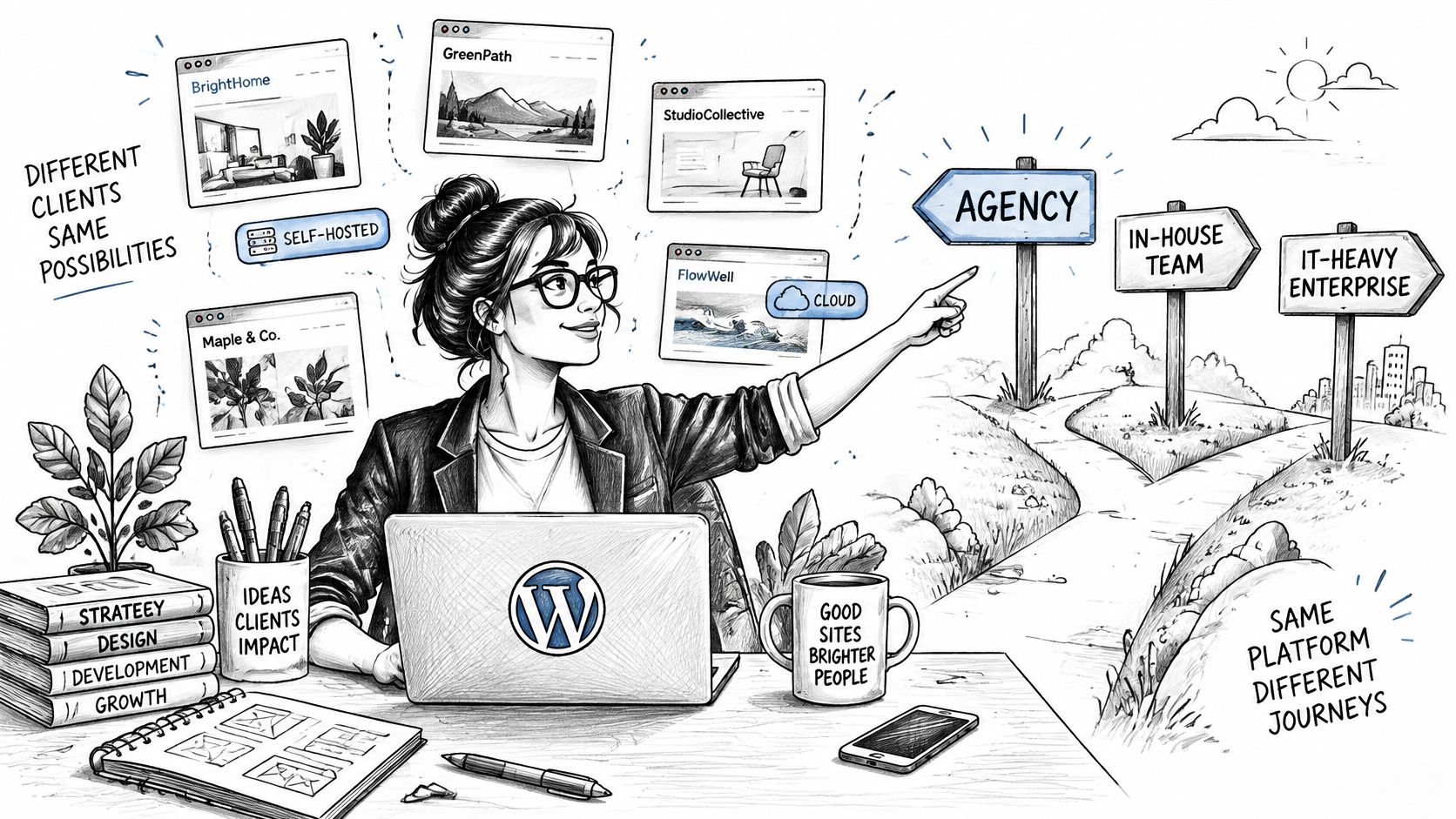
Fit is an operating-model decision before it is a feature decision. WebinOne suits organizations that want to keep client delivery, content ownership and governance while shifting hosting, extension upkeep and platform security to a managed foundation. It still requires integration design, disciplined permissions and properly scoped custom development.
Match the commercial situation
An agency outgrowing its current estate should examine where maintenance consumes project capacity. If patching, extension upkeep and scaling work absorb the retained fee, the question is whether a managed foundation supports larger engagements without reproducing that workload. WebinOne replaces the usual stack of CMS, ecommerce, CRM, forms and hosting with one platform and no plugins, while the Agency Portal brings templates, sites, development, staff, branding and billing into one dashboard.
White-label delivery matters when the agency owns the client relationship. The WebinOne reseller program is the relevant partnership route for agencies evaluating branded delivery and portfolio economics. Compare the proposed service package with actual client demand, including portals, ecommerce and ongoing content work.
An SI replacing an open-source or legacy estate should separate reusable platform requirements from custom business logic. Moving every historical customization unchanged usually preserves complexity rather than resolving it. Migration discovery should classify each requirement as retain, redesign or retire, then price the integration work that remains.
Match the governance and deployment situation
An enterprise consolidating brands should prioritize a representative migration slice rather than a broad visual redesign. Select content with shared ownership, local variation, redirects, restricted access and integration dependencies. Validate that slice before committing the full estate, because it exposes the operating model faster than a polished homepage.
A government digital team needs procurement and deployment requirements established early. WebinOne has US and Australian government clients and supports licensed deployments in the SI's or customer's AWS account, including AWS GovCloud, for government projects with SI partners. Project-specific requirements belong in a conversation with the team, not an assumption based on hosting geography.
System integrators use WebinOne as the platform layer in enterprise and government projects. The enterprise partnership and migration discussion is the route for establishing the appropriate delivery arrangement.
A headless or composable implementation remains a valid architectural choice when a product team intentionally owns its front end and channels. WebinOne provides APIs for a headless CMS experience; the decision is how much of the delivery chain the organization wants to manage.
Where source-code ownership of the underlying CMS is mandatory, WebinOne isn't the fit: it is SaaS, not open source. A good shortlist excludes incompatible operating models before commercial negotiation.
Confirm Your Shortlist With the WebinOne Team
WebinOne's next step is a partnership or migration conversation built around the buyer's evidence, not a generic demonstration. Keep a viable alternative on the shortlist and require equivalent tests.
Bring a compact decision pack:
- Estate scope: Sites, brands, locales, editors and required environments.
- Delivery requirements: Content models, integrations, custom functionality and migration constraints.
- Operational evidence: Responsibility answers, governance grades and performance acceptance results.
- Commercial assumptions: Cost scenarios, internal effort, support requirements and exit expectations.
Establish fit before committing
WebinOne has migrated thousands of sites and offers paid partner support. Migration scoping should establish content mapping, asset transfer, URL preservation, permissions validation, staging acceptance and cutover responsibilities.
WebinOne is an AWS Partner, has passed the AWS Foundational Technical Review, holds the AWS Qualified Software designation and is enrolled in the AWS Software and Services Paths. WebinOne is also available on AWS Marketplace. These credentials support the procurement conversation, but don't replace project-specific technical and contractual acceptance.
The useful outcome is a documented fit decision, a proposed migration sequence and a cost model using the buyer's inputs. Any unresolved requirement should leave the discussion with an owner and a defined proof task.
Arrange a partnership or migration conversation with the WebinOne team, bringing the estate inventory, responsibility matrix and cost scenarios. Agencies evaluating white-label delivery should use the WebinOne reseller program to discuss the client portfolio and commercial model before selecting the platform.