Digital Customer Experiences That Hold Together

65% of respondents said they were likely to abandon a transaction after an online problem or frustration, according to Fullstory's 2023 global consumer survey of more than 7,000 people. That makes digital customer experiences an operating problem, not a redesign brief. A better homepage won't repair a failed payment, recover missing account context or tell support what happened before the customer asked for help.
Table of Contents
- What a Digital Customer Experience Actually Is
- Metrics That Show the Experience Is Working
- Content Commerce Personalization and CRM Together
- Monolithic Headless and DXP Patterns Compared
- Accessibility as a Publishing Discipline
- Three Estates and How the Journey Holds
- Move the Portfolio onto One Platform
What a Digital Customer Experience Actually Is
At WebinOne, a digital customer experience is the path someone completes across content, commerce, service and account management. The operating requirement is to manage that path as a connected system, rather than a collection of attractive sites.
In Salesforce's 2018 global study of more than 6,700 consumers and business buyers, 80% said a company's experience was as important as its products or services, 84% considered being treated like a person very important to winning their business, 70% rated connected processes very important, and 82% of business buyers wanted the same experience quality when purchasing for work as when purchasing for themselves. Those expectations predate widespread generative AI. Adding a chatbot to disconnected properties doesn't meet them.
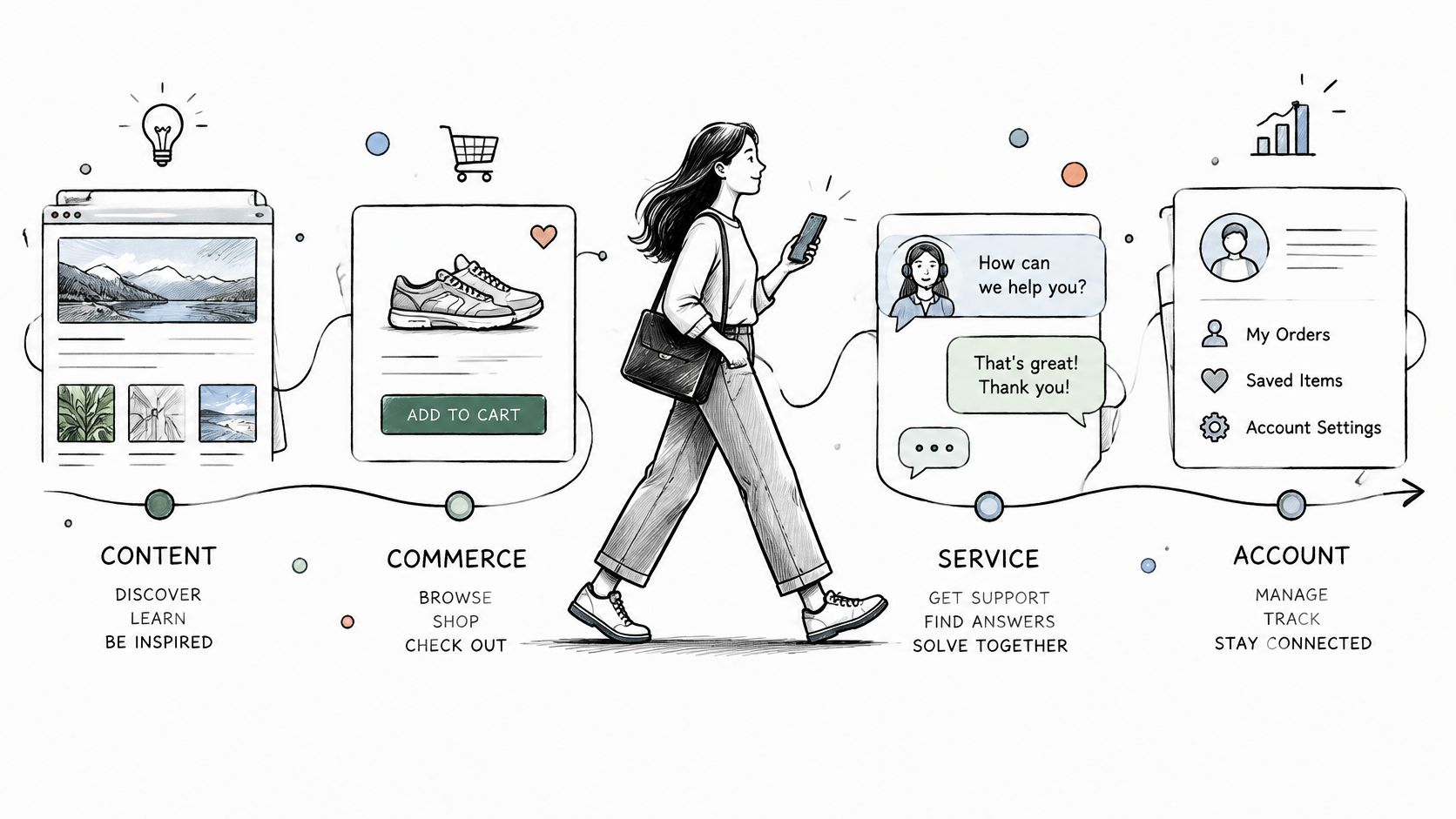
The gap sits between properties
Consider a brochure site, a store and a client portal that don't share identity. The brochure recommends a product the customer already owns. The store accepts an order, but the portal doesn't display it. Support then asks the customer to forward the confirmation email.
Each property might pass its own acceptance test. The customer's task still fails.
One governed record means the organization has an authoritative way to associate identity, permissions, transactions and service history. It doesn't mean every employee can see everything, or that unrelated clients in an agency portfolio share customer data. Governance defines the boundaries as well as the connections.
A customer shouldn't have to act as the integration layer between departments.
Assign ownership to the whole job
An agency maintaining separate content, store and CRM systems must account for the handoffs, not just the individual applications. Otherwise, the agency keeps maintaining the gap while the client keeps commissioning surface improvements.
For enterprise sponsors deciding who owns those handoffs, cxconnect.ai's a leadership guide for enterprise CX is a useful companion to the technical discussion. Ownership needs to extend beyond the website budget to the people responsible for orders, service and customer records.
Before approving another channel, the delivery team should be able to identify:
- The customer job: Purchase a replacement, submit an application or resolve an account issue.
- The required connections: Which systems must exchange identity, status and consent.
- The completion evidence: The event that proves the customer finished, rather than merely visited.
Experience quality is a purchasing criterion. The architecture and operating model need to reflect that.
Metrics That Show the Experience Is Working
WebinOne's operating standard is whether the customer's task finishes, not whether page views increase. The following benchmarks identify where to investigate, not universal pass marks for every client.
Digital experience benchmarks to manage against
| Signal | Benchmark | Operating read |
|---|---|---|
| Task completed quickly | 76% call it the top shopping priority | Design the journey around the job, not the homepage |
| Slow load times | 72% cite them as the leading frustration | Performance is a customer metric |
| Loading errors | 63% | A failed request is a lost step |
| Abandonment after a problem | 65% likely to abandon | One broken form or checkout can end the order |
| Return after a poor experience | 55% unlikely to return | The session damages the relationship |
| Brand indifference if it works | 44% will shop wherever it works | Reliable execution can beat preference |
| Average page load | 2.39 seconds | Budget critical templates against this, not a vanity score |
| Conversion by device | 3.5% desktop vs 1.7% mobile | Mobile needs its own budget and test |
The consumer rows describe the survey cited in the opening, covering Australia, Germany, Indonesia, the Netherlands, Singapore, the United Kingdom and the United States. The page-load and device figures come from Contentsquare's benchmark of approximately 7 billion sessions, which recorded a 2.39-second average page load and conversion rates of 3.5% on desktop versus 1.7% on mobile.
Read the rows as delivery priorities
Task speed comes first because the customer arrived to accomplish something. Measure the time and steps required to finish that job, including validation, authentication and confirmation.
Slow loading and loading errors require different investigations. A heavy template may need smaller images, fewer scripts or better caching; an intermittent failed request may need API tracing and error handling. Combining both into a generic performance score hides the work that needs doing.
Abandonment and return behavior extend the assessment beyond the broken session. Brand preference isn't permission to leave defects unresolved, and a desktop conversion average can conceal a mobile checkout problem.
Connect technical traces to business events
Instrument real-user monitoring by device, geography, template and funnel step. Connect those traces to product views, form completion, cart creation and purchase, using identifiers that don't expose sensitive customer information.
Set performance budgets for templates that take money or collect applications. Test under realistic mobile conditions, then compare segmented conversion after each release. Don't assume that reaching the published average means the experience is good enough.
Email belongs in the same operational review. If a customer can't receive a confirmation or recovery message, a successful send event isn't proof of delivery; MailAdept's explanation of what is email deliverability provides useful context for that distinction.
A client review needs a short, stable scorecard:
- Task completion rate: Successful outcomes against eligible attempts.
- Abandonment after an error: Whether customers recover or leave.
- Mobile versus desktop conversion: Segmented by comparable journeys.
- Return visits after a bad session: Measured only where consent and identification permit.
Content Commerce Personalization and CRM Together
WebinOne brings content, commerce, CRM, forms and email into one managed platform so personalization has an authoritative record to read. A headless API supports separate front ends where required; this isn't a headless-only approach.
Content governs pages, articles and member areas. Commerce manages catalog information, carts, orders and payment state, while CRM connects contacts, cases, custom fields and member activity. Personalization uses those records to select a relevant action, rather than guessing from the last page someone opened.
Follow a customer through the loop
Say a customer reads an article about a product. The page reads approved product information, and permitted analytics record the interaction against an anonymous session or recognized profile.
She adds the product to a cart on mobile. Commerce writes the cart state, associating it with her identity only when the relationship is established appropriately. A payment error records a failed attempt, not a completed order.
Before sending a recovery email, the workflow checks the applicable consent, suppression and eligibility rules. If she opens a support case, the authorized service agent should receive the relevant cart and error history without asking her to reconstruct it. Sensitive payment details shouldn't be copied into the case.
Practical rule: Personalization should help resolve the customer's situation, not automate a more persistent version of the wrong message.
Prove the value rather than assume it
McKinsey reports that effective personalization typically produces a 10–15% revenue lift, with observed outcomes ranging from 5–25% depending on sector, data quality and execution, while faster-growing companies derive 40% more revenue from personalization than slower-growing peers. Those findings aren't a forecast for an individual implementation.
The useful mechanism is the closed loop: collect behavioral and transactional signals, resolve them to an appropriate profile, choose the next message, deliver it, and feed outcomes back into the decision. In the example, a resolved support case should change what happens next. Continuing to send abandonment messages after a successful purchase would expose a broken loop.
For multi-brand delivery, centralize identity rules, consent, events and commerce data while keeping presentation appropriate to each channel. A shared component still fails customers if it displays outdated product facts or ignores brand-specific permissions.
Use a control group to compare conversion, revenue per visitor, repeat purchase, retention and complaints. Clicks and opens can help diagnose behavior, but they don't establish commercial value on their own. The operating decisions behind that approach are developed further in personalization on websites.
For a live client, list which of content, commerce, CRM and personalization still sits in a separate tool. Then identify who owns each read, write and failed handoff.
Monolithic Headless and DXP Patterns Compared
WebinOne's default is a hosted, coupled digital experience platform, with headless delivery when a separate front end earns its additional operating cost. A licensed deployment in a qualifying integrator's or customer's AWS account is available by agreement when the program requires that boundary, including AWS GovCloud.
Architecture patterns for a client experience
| Pattern | Team owns | Where it strains | When used |
|---|---|---|---|
| Coupled site on one DXP | Templates, content, commerce and CRM in one release | Treating every brand as a fresh install | Default client sites |
| Headless front end on the same platform | Presentation, while content and commerce stay in the API | Two release trains and drifted identity | Apps and custom interfaces only |
| Multi-site DXP | Shared templates, permissions, branding and one governed customer record within the appropriate estate | Weak ownership of components and consent | Agency portfolios and multi-brand estates |
| Licensed deployment in the SI or customer AWS account | The account boundary, including GovCloud by agreement | Qualification and a scoped license | AWS-native and government programs |
Choose the ownership model before the front end
A coupled site keeps customer-facing templates and business behavior in a coordinated release. That suits a straightforward client site because the delivery team can test the rendered page and its transaction together. It becomes inefficient when every new brand is treated as an unrelated installation with duplicated operational procedures.
Separate installations leave someone responsible for updates, security patches, extension compatibility and incident response. Managed hosting alone doesn't remove the need to define ownership across that application stack.
Security belongs in the customer-experience decision: IBM's 2025 Cost of a Data Breach research reported a global average breach cost of USD 4.44 million, with 53% of breached organizations reporting compromised customer personally identifiable information. Those are breach-study findings, not estimates of any particular site's risk.
Headless delivery is justified for an app or highly custom interface. Its cost is coordinated API and presentation releases, plus explicit responsibility for authentication, caching and error states. The API must remain authoritative rather than allowing the front end to develop a competing account record.
Put the account boundary in writing
Multi-site delivery requires shared permissions and component governance, not just a larger site list. Licensed deployment adds another boundary: the agreement must define infrastructure responsibilities, deployment access, monitoring, and incident escalation.
WebinOne's managed production platform runs in WebinOne's AWS account across 6 AWS regions, with 99.99% uptime and a 99.95% availability commitment in the published SLA. A custom data center can be established by agreement.
WebinOne is an AWS Partner, has passed the AWS Foundational Technical Review, holds the AWS Qualified Software designation, participates in the AWS Software and Services Paths, and is available on AWS Marketplace.
The decision rule is straightforward: a conventional site uses the coupled DXP; a distinct interface uses headless delivery against the same platform; an account-bound government or qualifying integrator program starts a partnership and migration conversation.
Accessibility as a Publishing Discipline
WebinOne centralization doesn't automatically fix accessibility. Testing, ownership and release gates must move with the shared components, or the platform distributes the same defect more efficiently.
The Verint customer-experience report includes the ACM summary of WebAIM's 2025 analysis: accessibility issues appeared on 95.9% of the top one million web pages, averaging 56.8 detectable errors per page, while the organizational findings put accessibility involvement at 28% during planning and 27% during design. These measures describe different parts of the problem, widespread detectable defects and late organizational involvement.
An automated error count isn't a complete accessibility assessment. A page can clear detectable issues and still present an unusable keyboard sequence or an unclear form recovery path.
Make shared components accountable
A reused header, product card or application form can spread an accessibility defect across brands. Give every shared component a named owner, a documented test scope and a clear route for urgent remediation.
Editorial checks should cover heading structure, meaningful links, image alternatives and accessible document choices. Template testing should include keyboard navigation, visible focus, screen-reader behavior and error announcements.
- Forms: Associate labels and instructions correctly, preserve entered information after validation, and identify errors in a way the customer can resolve.
- Email: Check reading order, descriptive links, alternatives for meaningful images and usable calls to action.
- Personalized content: Test each meaningful variation, including empty, expired and unauthorized states.
- Localization: Recheck layouts, labels and reading order after translation rather than assuming the original test still applies.
Block regressions before publishing
The release gate must have authority. If a campaign introduces an inaccessible form, the responsible person needs permission to stop publication, not merely log a ticket for later.
Availability says the portal responded. Accessibility asks whether the customer could use that response to finish the job.
Prioritize defects by the task they prevent. A blocked application submission deserves immediate attention even if another template has a larger count of minor errors. Completion testing with keyboard and screen-reader users should sit alongside automated WCAG checks.
TeamOne can take WCAG work as a scoped delivery. The ongoing obligations still need named ownership after handover, with the workflow documented through the same discipline described in accessibility compliance.
For government and multi-brand teams, exclusion is an operational failure, not an aesthetic shortcoming. Before the next campaign, name the person who can stop a publish and the completion metric that person watches.
Three Estates and How the Journey Holds
WebinOne supports agency portfolios, AWS integrator delivery and government web estates with governed customer context inside each appropriate boundary. The delivery arrangement changes; the requirement for coherent information doesn't.
Adobe's 2025 retail report found that 75% of shoppers considered consistency across websites, mobile apps, email, social media and physical stores important, while only 41% of brands believed they delivered it, a 34-percentage-point gap. That retail finding illustrates a coordination problem, not a performance benchmark for every government portal or agency client.
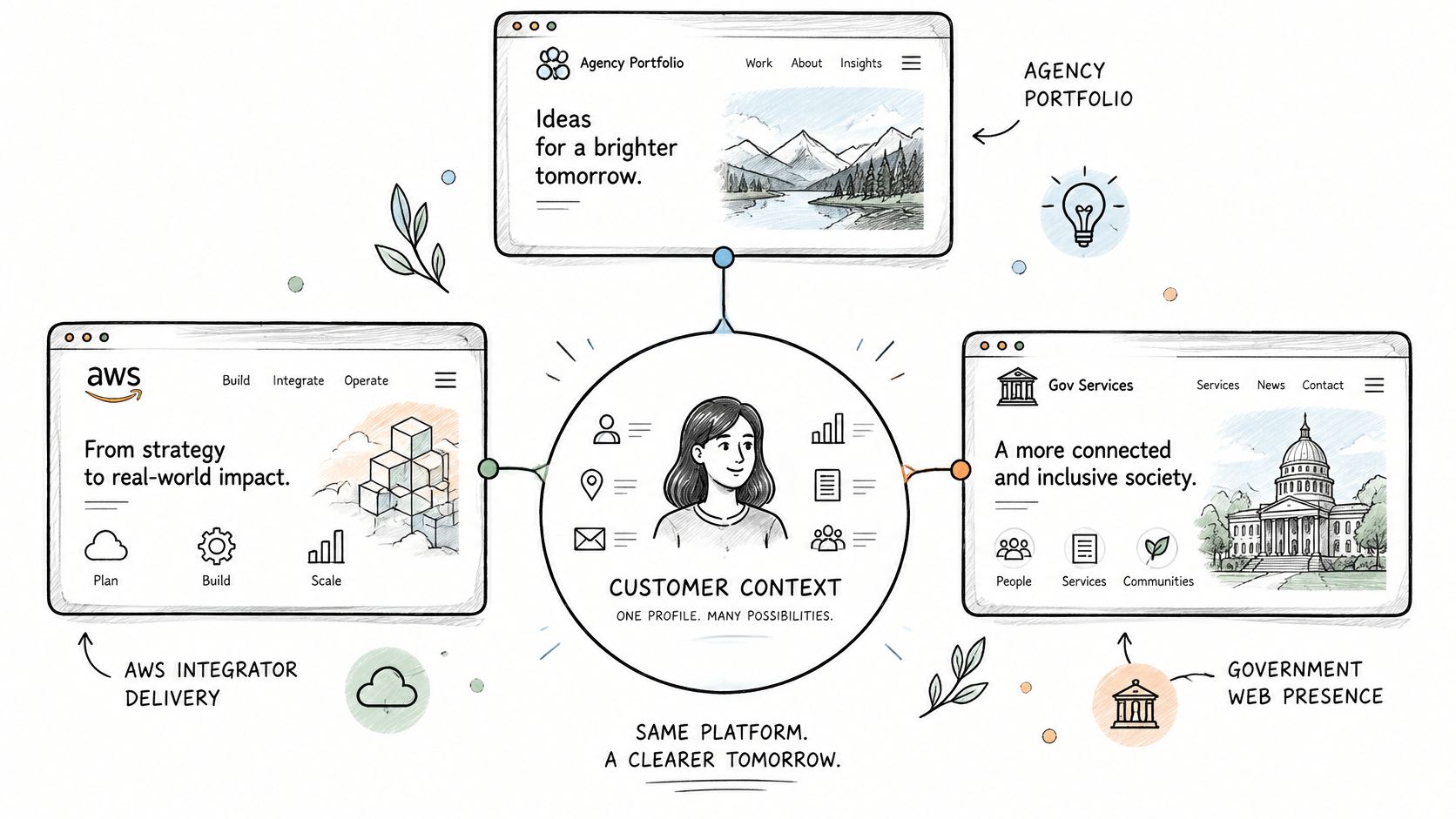
An agency sells accountable care
Consider an agency whose delivery calendar is crowded with plugin upkeep, patching and recovery work. A portfolio migration should change what the agency operates and sells, not merely where the files live.
The agency manages client properties through a branded console and invoices under its own identity. Its ongoing service can focus on completion reviews, content quality, accessibility and conversion work rather than treating hosting as the entire relationship. The WebinOne reseller program is the commercial route for that model.
A customer statement captures both sides of the operating requirement:
“The solution solid and stable under heavy spikes from national ads, but they also went beyond that to create an easily manageable interface with the admin” David, WebinOne case study
An integrator preserves the delivery boundary
An AWS consulting partner or systems integrator can own the implementation and client relationship while managed production runs in WebinOne's AWS account. A qualifying integrator can instead agree a licensed deployment in its own or the customer's account, including GovCloud.
The important work is assigning who approves changes, who responds to incidents and which account holds each responsibility. Omnichannel delivery then becomes a governed delivery practice, not a promise to publish everywhere.
A government estate protects continuity
US and Australian government clients already use WebinOne for secure, compliant web presence. FedRAMP and GovCloud projects are delivered with integrator partners and licensed deployments, with requirements scoped through a conversation with the WebinOne team.
AgentOne's Managed Vibe Coding builds and operates sites inside the managed platform, with scoped permissions and reviewable changes. Customer-service automation still needs a human escalation path that preserves case context; site-building automation isn't a substitute for accountable service.
WebinOne does not use Customer Content, Customer Data, Agent Prompt Data or Agent Output to train its own or third-party AI models. Which operating picture matches the next project: agency portfolio, integrator delivery or government estate?
Move the Portfolio onto One Platform
WebinOne's recommendation is a staged migration that changes operational ownership, rather than another tool added to an exhausted stack. The cutover should preserve customer jobs and leave a clearer system behind.
Make the migration a controlled operating change
Pick the estate and protect its jobs. Select an agency portfolio, multi-brand group or government property. Document the purchases, applications, account actions and support routes that must survive cutover, including their confirmation states.
Map the content, commerce, CRM and forms that remain split. Record the authoritative source for each field, identify duplicate contacts, preserve consent provenance and assign an accessibility owner to every shared component.
Choose the deployment pattern. Use a coupled DXP for the conventional experience, a separate front end when its requirements justify headless delivery, or an agreed licensed AWS deployment where the account boundary matters. Set acceptance criteria before implementation begins.
Stage delivery with TeamOne and test before and after cutover. WebinOne has migrated thousands of sites. Redirects, account access, forms, order state and recovery procedures all belong in the migration test plan, alongside visual checks.
Measure operational outcomes after launch. Review task completion, abandonment, mobile conversion and cross-channel consistency. Assign an owner to each failed journey instead of treating launch traffic as proof that migration succeeded.
Price the continuing service
WebinOne is a white-label digital experience platform giving agencies one place to build, host and manage client websites. Pricing starts at $10 per month per site. Ecommerce plans carry zero transaction fees, and ecommerce work beyond the plan is scoped as a TeamOne project.
Partners in 16 countries receive paid partner support. Agency margin should come from a defined continuing service, with clear delivery scope and accountability, rather than an unpriced commitment to maintain whatever breaks.
Agencies can arrange the next step through the WebinOne reseller program, bringing a representative client estate and its operating workload. Systems integrators, AWS partners and enterprise teams can start a partnership or migration conversation with the WebinOne team, bringing the account-boundary requirements, current system map and customer jobs that must survive migration.