Como Ganhar Dinheiro Na Internet in 2026

Popular lists that answer como ganhar dinheiro na internet treat every hustle as equal if it can send a payment this month. That advice fails the moment a marketplace suspends an account, an algorithm cuts reach, or a buyer stops posting the task. The split that matters is who pays, and which party can turn the income off.
Table of Contents
- Income Models Ranked by What You Control
- Scams Fees and Taxes That Erase the Profit
- How to Run Ecommerce So Sales Become Profit
- Affiliate and Content Income With the Disclosure in Place
- Tools and First 30 Days Before Spend
- Productize the Service and Price the Retainer
Income Models Ranked by What You Control
Online income holds up better when you control more than the work itself. Rank each model by who controls discovery, billing, and the customer. A channel can bring buyers today while leaving you exposed to its search rules, payout terms, or account decisions tomorrow.
After ChatGPT's release, job posts for automation-prone writing and coding fell 21% within eight months, and image-generation tools were associated with a 17% decline in image-creation postings, according to research in Management Science. That shift makes the income model matter: work can remain in demand while the route to buyers changes. A 2026 creator monetization comparison can help you assess where an audience pays, but the control check below shows what you retain if the channel changes.
| Model | Buyer | You control | Concentration risk | First asset |
|---|---|---|---|---|
| Productized client services | A business with a recurring web or marketing problem | Scope, delivery, billing and client data | Custom work that destroys margin | Fixed offer with acceptance criteria |
| Niche ecommerce | A shopper in one narrow segment | Catalog, checkout, list and margin math | Ads, returns and one payment provider | Product page and matching product feed |
| Affiliate publishing | A brand paying commission | Content and tracked links, not the customer | Program terms and one traffic source | Tutorial or comparison with on-page disclosure |
| Creator subscriptions | Paying audience members | Archive and list you host | Algorithm or payout changes | One series with a direct signup |
| Marketplace freelancing | A client matched by the platform | The skill, not the relationship | Suspension and fee changes | Specialist profile for one buyer |
| Digital products | Buyer of a template, course or tool | File, license and support boundary | Refunds and unpaid support | One product with a stated outcome |
Run the five-line audit
Choose one row and write five lines for that model. Be specific enough to identify the point of dependence.
- Discovery: Name the channel that sends the buyer and how quickly you could replace it.
- Delivery: Name the file, site, or session the buyer receives.
- Billing: Name who issues the invoice and who can freeze the payout.
- Customer data: Check whether you can export names, emails, and order history today.
- Fulfillment: Name who ships, hosts, or supports the offer after payment.
Then choose one exposed point to reduce. A service business can turn repeat client needs into a fixed monthly retainer, with a defined scope and delivery process. Agencies building sites can use WebinOne as a white-label digital experience platform to manage sites and related services in one system. For a solo operator, guidance on going solo as a one-person web practice offers a way to think through how to structure that practice.
Practical rule: Map who controls discovery, billing, and the customer before committing to a model. If one company controls all three, make reducing that concentration your next business decision.
Scams Fees and Taxes That Erase the Profit
A fake job offer asks for money or sensitive information before there is a verified contract. Even legitimate work can leave little profit when costs go uncounted. Check who controls discovery, billing, and the customer relationship before accepting an offer, then assess what the work leaves after expenses.
The Federal Trade Commission's job-scam guidance reports that job-scam reports tripled from 2020 to 2024, while reported losses rose from $90 million to $501 million. Its guidance also covers online job-scam reports in the first half of 2025, when reports increased 19% year over year and losses reached nearly $300 million. Use these warnings as a gate before paying anyone or sending identity documents.
| Red flag | Why it fails | Safer move |
|---|---|---|
| Guaranteed income | Real work still has acquisition costs and possible refunds | Request a written offer and estimate the costs |
| Upfront training or equipment fee | You pay before the work and payer are verified | Decline until there is a contract and a known payer |
| Payment in crypto to receive earnings | You may be sending funds to a scammer | Stop and send no money |
| Pressure to leave the recorded channel | The message and payment history may be harder to document | Keep communications and payments in the original channel |
| Identity or bank details before a contract | A job offer can be used to collect sensitive data | Share details only after verifying the agreement |
| Receive money and forward it | You may be handling funds for a scam | Refuse the task |
The margin worksheet
Use the table to screen offers, then estimate the costs that determine whether the work pays. Avoid counting the same expense twice: include the costs specific to this offer, such as unpaid time spent finding the buyer, rather than rebuilding a full store or content budget.
- Acquisition cost: money and time spent finding this buyer.
- Payment-processing fees: the percentage and fixed charge taken from each payment.
- Refunds: the amount you may need to return, counted as cash out.
- Software and unpaid sales time: tools needed for the work and sales hours that no client pays for.
- Tax on the gross: set aside the applicable amount rather than treating the full payment as spendable.
- Cash-flow gap: the time between paying costs and receiving cleared funds.
Tax rules differ by country, so ask a local accountant to confirm the rates. Meanwhile, include taxes and delayed payments in your estimate. For ecommerce, check how transaction fees affect each order before committing to a platform. WebinOne charges zero transaction fees on ecommerce stores, catalogs, payments, and marketplaces built on the platform. See ecommerce with no transaction fee.
For any platform you resell or depend on, confirm the contract terms, domain control, and whether customer data can be exported. Stage changes so they can be reversed, especially when automation publishes or edits a live site.
Count revenue as income only after the worksheet is positive.
How to Run Ecommerce So Sales Become Profit
Build one focused product page before buying traffic. Show the price, availability, shipping, and returns clearly, then make sure the product data in the page matches what you submit to Merchant Center.
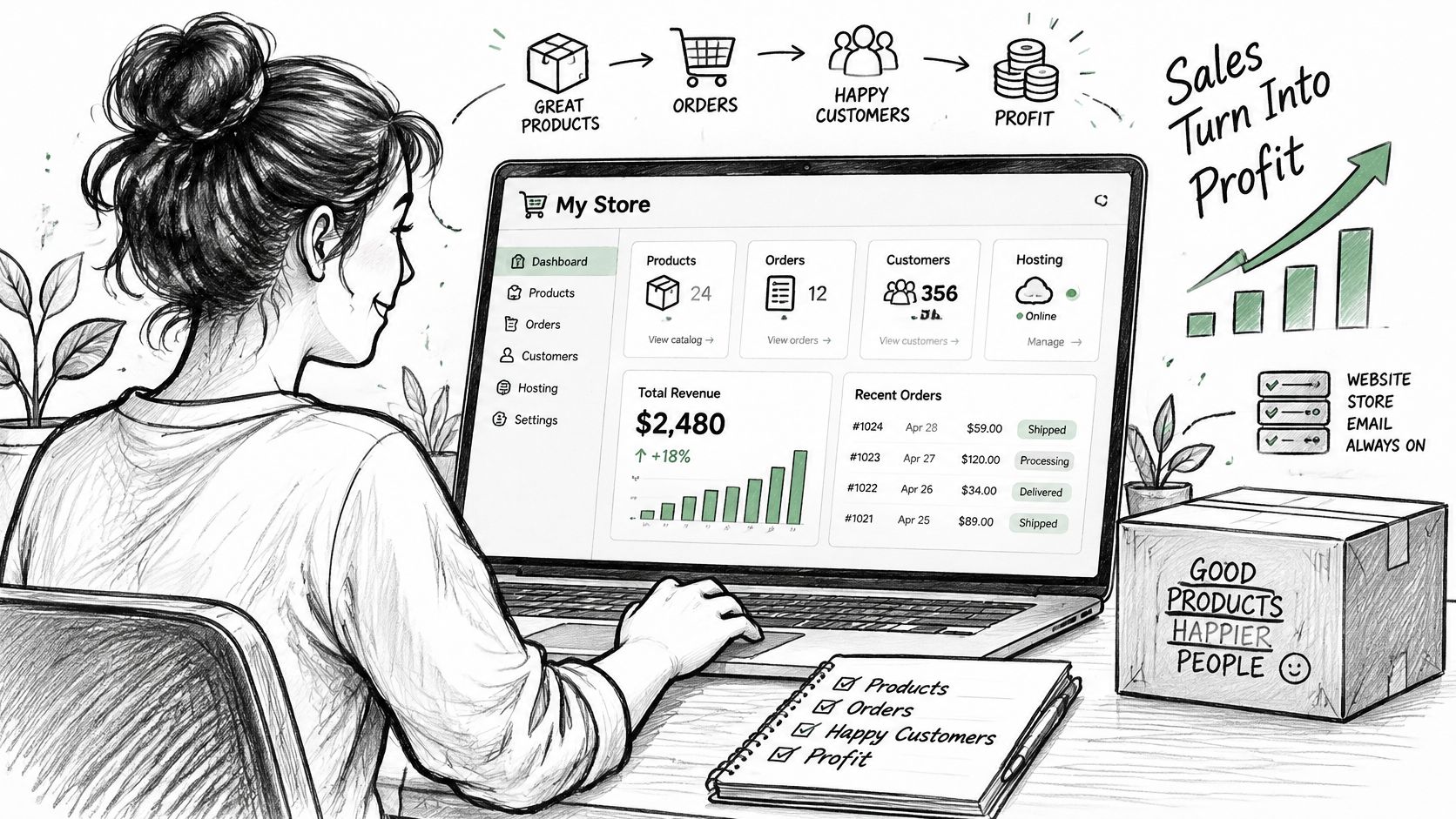
Build the page before you buy the click
Add Product structured data in JSON-LD that matches the visible page content, and submit a Merchant Center feed with the same product information. Google's ecommerce search documentation explains how structured data and feeds help Google understand product details and can make products eligible for richer search results. Include required properties, and keep each marked-up price consistent with what buyers can see.
Track product views, add-to-cart events, checkout starts, purchases, refunds, and contribution margin from day one. Contribution margin per order is the sale amount after fulfillment and payment costs. It shows whether an order can support additional acquisition spending.
Buying traffic before checkout works can send more shoppers into a process that loses them. Baymard Institute's checkout research puts average cart abandonment at approximately 70.19% and estimates that the average large ecommerce site could increase its conversion rate by 35.26% through checkout usability improvements. Test one change at a time, such as guest checkout, showing the full cost earlier, reducing form fields, or stating a clear delivery date. Evaluate the change across enough sessions to avoid mistaking a short-term fluctuation for a result.
The weekly board
Review one customer cohort each week. A dashboard is useful when it shows where orders and margin come from.
- Conversion and step abandonment: identify where shoppers leave, split by mobile and desktop.
- Average order value and gross margin: review both after fulfillment and payment costs.
- Acquisition cost, refund rate, and repeat purchase: use these measures to decide whether to increase spend.
Pair the board with a keyword strategy grounded in margins. Search demand matters when the orders it attracts can support the contribution margin; avoid bidding on queries that cannot clear that line. If an agency launches the store, use the board to discuss sales quality with the merchant, not just traffic volume. WebinOne charges zero transaction fees on ecommerce stores, catalogs, payments, and marketplaces built on the platform, while payment-processing costs still belong in the order calculation. Scope custom store work separately rather than treating it as unlimited within the standard build.
Affiliate and Content Income With the Disclosure in Place
Affiliate income depends on three things: who controls discovery, who handles billing, and who keeps the customer relationship. A publisher may control the page and email list while a network controls attribution and commission payments. A change in the network's terms can therefore affect earnings even when the content still attracts readers.
The FTC's Disclosures 101 for social media influencers says a financial relationship must be disclosed when a brand pays you, provides free or discounted products, or gives another benefit connected to an endorsement. The disclosure belongs with the endorsement, must be clear and conspicuous, and applies to affiliate relationships near the relevant links. Readers should not have to infer that a recommendation may earn you a commission.
Put the disclosure in the same block as the link. A statement in a footer or on a legal page does not count as disclosure next to the recommendation.
Checklist before the first post
- Choose a niche you can test. You should be able to use the product or decline it without guessing.
- Publish a comparison or tutorial that helps even if the commission were zero. Explain the product's limits as well as its useful features.
- Use tracked links to identify which page produced a sale.
- Read the program terms for cookie length, reversal rules, and claims you are not allowed to make.
- Use the margin worksheet to assess whether the commission model can support the work.
Depending on one merchant program concentrates risk in its terms, tracking, and payment process. Add another income path before scaling content. An email list sent from an address you own gives you a direct way to reach readers if a network changes its terms, while the site remains a place to publish useful recommendations.
If the content mainly attracts customers for your own service, price and present the service directly. Keep product claims matched to what the page shows, and make clear when a link may earn a commission. The reader should be able to understand both the recommendation and the financial relationship before clicking.
Tools and First 30 Days Before Spend
An income model depends on who controls discovery, billing, and the customer relationship. Set up tools around those responsibilities before paying for promotion: register a domain, choose a payment processor, create an email list, set up analytics, and keep invoice records. Record who can access each account, and use a domain and email address tied to the business rather than a platform profile.
A country report on Brazil cited 183 million active internet users, equal to 86.2% of the population, and more than 128 million Brazilians who purchased online during 2024. It also reported an average purchase value of $796 and projected 2025 B2C ecommerce sales of $91.88 billion (Brazil e-country executive summary). Demand alone does not make an offer work. State what the buyer gets and set a clear refund rule.
Thirty-day sequence
- Days 1 to 3: Define the buyer, offer, and price for the model you chose.
- Days 4 to 7: Register a domain and publish a page stating the offer, price, and refund rule.
- Days 8 to 14: Connect a payment processor and set up invoice records. Store receipts and contracts together.
- Days 15 to 21: Start an email list using a business-controlled address, and collect sign-ups through one channel.
- Days 22 to 30: Update a margin worksheet weekly using the first sale. Track revenue against fees, delivery costs, and other operating costs.
Choose each tool by its job: domain and DNS, site hosting, payment processing, email delivery, analytics, invoicing, or document storage. A tool should support the model you chose, not dictate it. For publishing, this overview of best content creator tools for 2026 can help you identify tools for specific tasks. Keep access details and records organized so a change in platform does not interrupt billing or contact with customers.
Productize the Service and Price the Retainer
A retailer with an outdated site may need a rebuild, routine updates, and someone to handle issues after launch. An agency can turn that recurring need into a defined service, with a clear scope, price, and renewal. The buyer gains continuity; the agency takes on delivery and support obligations that must fit the monthly fee.
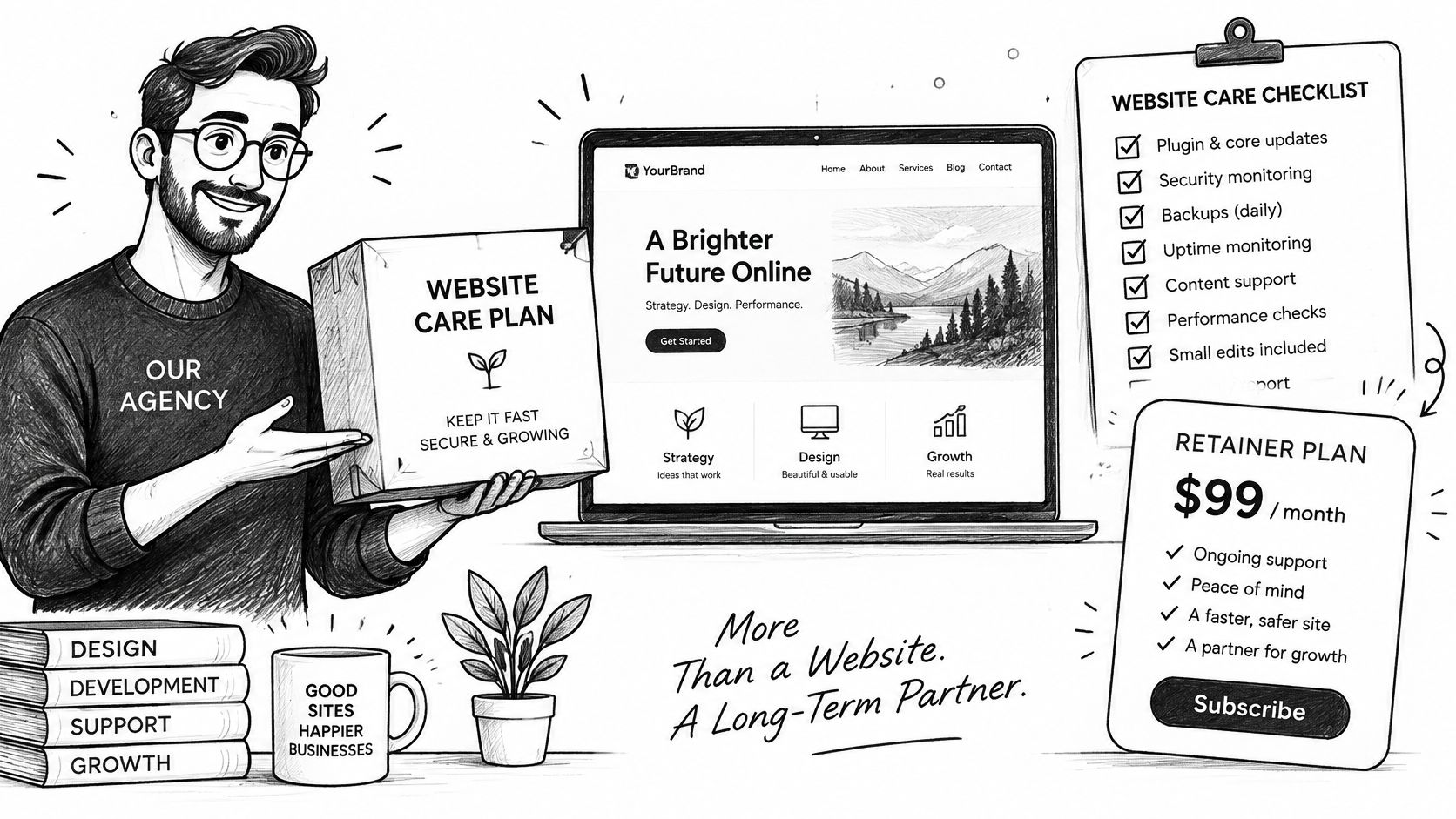
WebinOne runs a Reseller Program for agencies, and anyone can register under it and start creating sites. A white-label setup can give an agency a platform to build and operate client sites under its own brand. The service still needs a specific promise: decide what ongoing care covers, what counts as extra work, and how requests are handled.
Freeze one offer
Start with one buyer, such as a local retailer or professional firm. Identify a costly problem that returns regularly, then define the deliverable: what is included, what is excluded, the timeline, how acceptance is judged, and what visible result the buyer receives. Keep the first offer narrow enough to quote and deliver consistently.
Create one proof asset, such as a teardown, migration checklist, or case frame, and link it from the service page using normal navigation. Choose one discovery channel to start: problem-specific search pages, partner introductions, a short outbound list, or a webinar. Broad traffic can bring visitors who are not ready to buy, so focus the offer and proof on the buyer's specific problem. Qualify prospects by budget, urgency, decision-making authority, and fit before preparing a proposal.
Price against hours
Track qualified leads, booked calls, proposal-to-close, contract value, delivery hours, gross margin, time to value, and renewal. The monthly fee must cover the platform cost, delivery time, and the support promised. If hours keep growing while the fee stays fixed, margin shrinks.
WebinOne starts at $10 per site per month, and ecommerce stores built on the platform have zero transaction fees. That makes the platform cost easier to account for, but it does not price the agency's labor or support. Use this guide to set managed service pricing, then check the fee against estimated hours before offering the retainer.
Standardize diagnosis, proposals, onboarding, reporting, and handoff. Keep customization for work the buyer agrees to pay for. Add another service only after the first has been sold and delivered twice.
What the retainer sits on
The platform is part of the delivery model, not the offer itself. WebinOne combines site management and ecommerce in a white-label system, while the agency remains responsible for defining the care plan and setting client expectations. Decide which tasks the agency handles and which requests fall outside the retainer.
Describe the service accurately, including response expectations and exclusions. A defined scope gives the buyer a clearer basis for renewal and helps the agency spot work that needs a separate quote. Price a live client's retainer against the hours spent serving that account, then adjust the scope or fee if the numbers do not work.