CMS for Agencies: What to Demand Before You Switch
Your agency didn't lose margin on the build. You're losing it on Tuesday mornings, when a developer is patching sites one login at a time, a client is waiting on a security fix, and another project needs scaling work nobody quoted. We built WebinOne for that moment. A CMS for agencies isn't a feature list for one website. It's the operating system for your whole portfolio, your patch load, and your profit per site.
Table of Contents
- Why Agencies Outgrow the CMS They Sell
- What a CMS for Agencies Has to Operate
- How to Judge a Platform Before You Commit
- How Agencies and Integrators Deliver on It
- How to Move a Portfolio Without Losing Traffic
- Where Agency CMS Projects Quietly Lose Margin
- Choose the Next Step That Matches Your Role
Why Agencies Outgrow the CMS They Sell
WebinOne is the platform we built for agencies that have outgrown the system they currently sell and need one branded operating model instead of scattered site-by-site work. That applies whether your stack today is self-hosted or managed WordPress, Drupal, Joomla, a site builder, a headless CMS, or a legacy build only one developer understands.
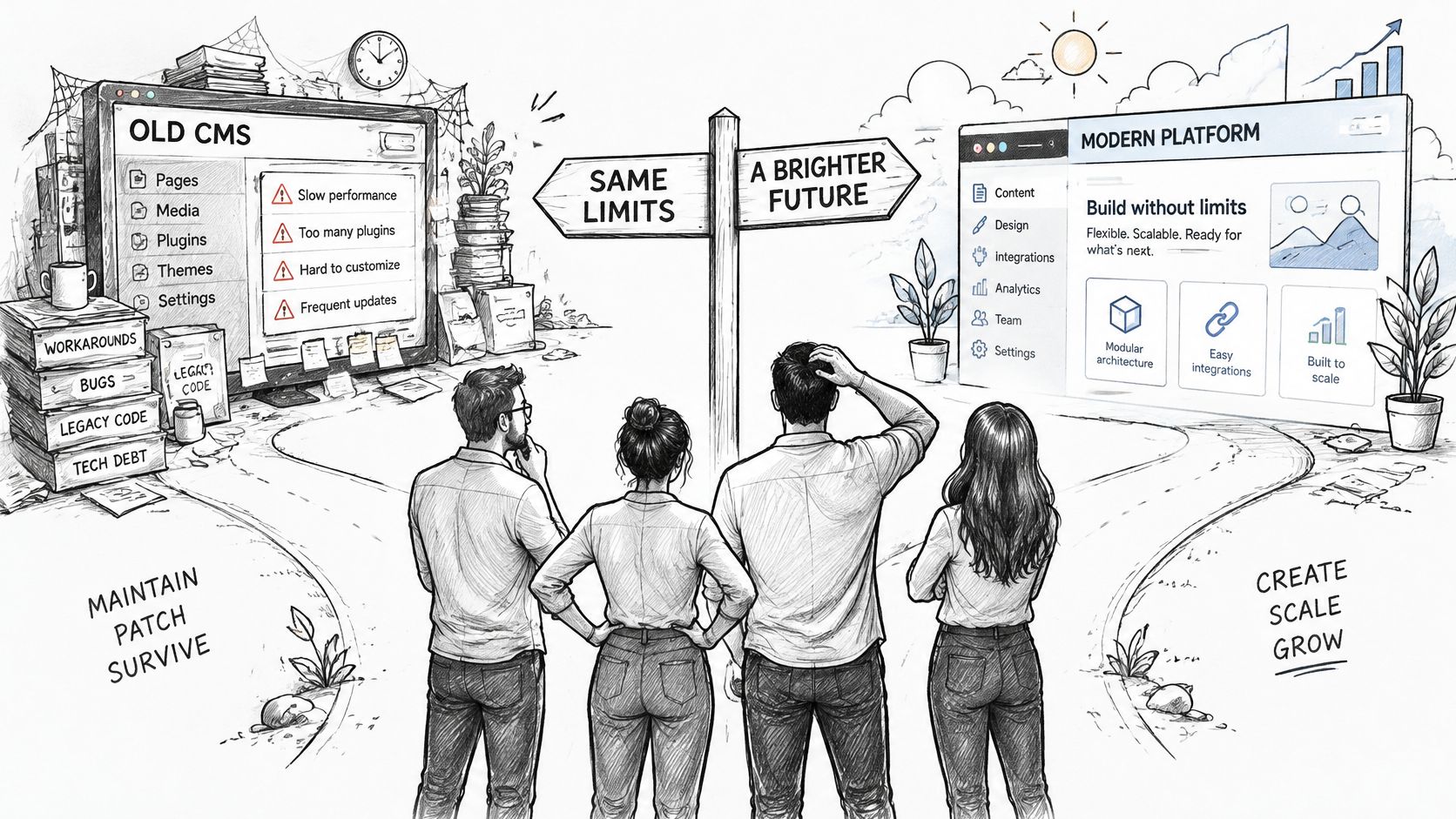
The pattern is familiar. A client site that was profitable at launch now consumes hours for plugin and module patching, updates that break layouts, and security incidents you've already handled once and don't want to handle again. Each site has its own hosting account, its own admin login, its own extensions, and its own exceptions. Moving that client to a bigger project doesn't fix the problem. It gives you a bigger version of the same maintenance queue.
A Dominant Tool Is Not a Delivery Model
Market share doesn't tell you how to run a portfolio. In a review of 200 major digital agency websites, WordPress was detected on 107 agencies, or 53.50%, Contentful on 10 agencies, or 5.0%, and no CMS could be detected on 44 agencies, or 22.0%. A dominant platform isn't universal, and detection data only captures visible signals, not everything an agency runs for clients.
That fragmentation is the key point. Agencies choose differently because clients differ on governance, integrations, technical capability, and delivery model. If your answer is a different stack for every brief, your team carries every stack's patching, hosting quirks, and support burden. Standardizing doesn't mean forcing every client into the same template. It means hosting, permissions, templates, and support sit on one system you brand as your own, with room for custom development where a project earns it.
Your margin problem is rarely the wholesale plan. It's the unbillable hours between plans.
What Outgrowing Actually Looks Like
You've outgrown your platform when a routine update needs a senior developer, when client reporting means logging into five tools, and when you can't raise prices because the client sees a vendor's brand, not yours. We address that through the WebinOne reseller program for agencies, where you sell and support sites under your own brand. Systems integrators and AWS partners follow a different path, covered in the delivery patterns below. Either way, the buying question is the same. Does the platform reduce hours per site as the portfolio grows, or does it multiply them?
What a CMS for Agencies Has to Operate
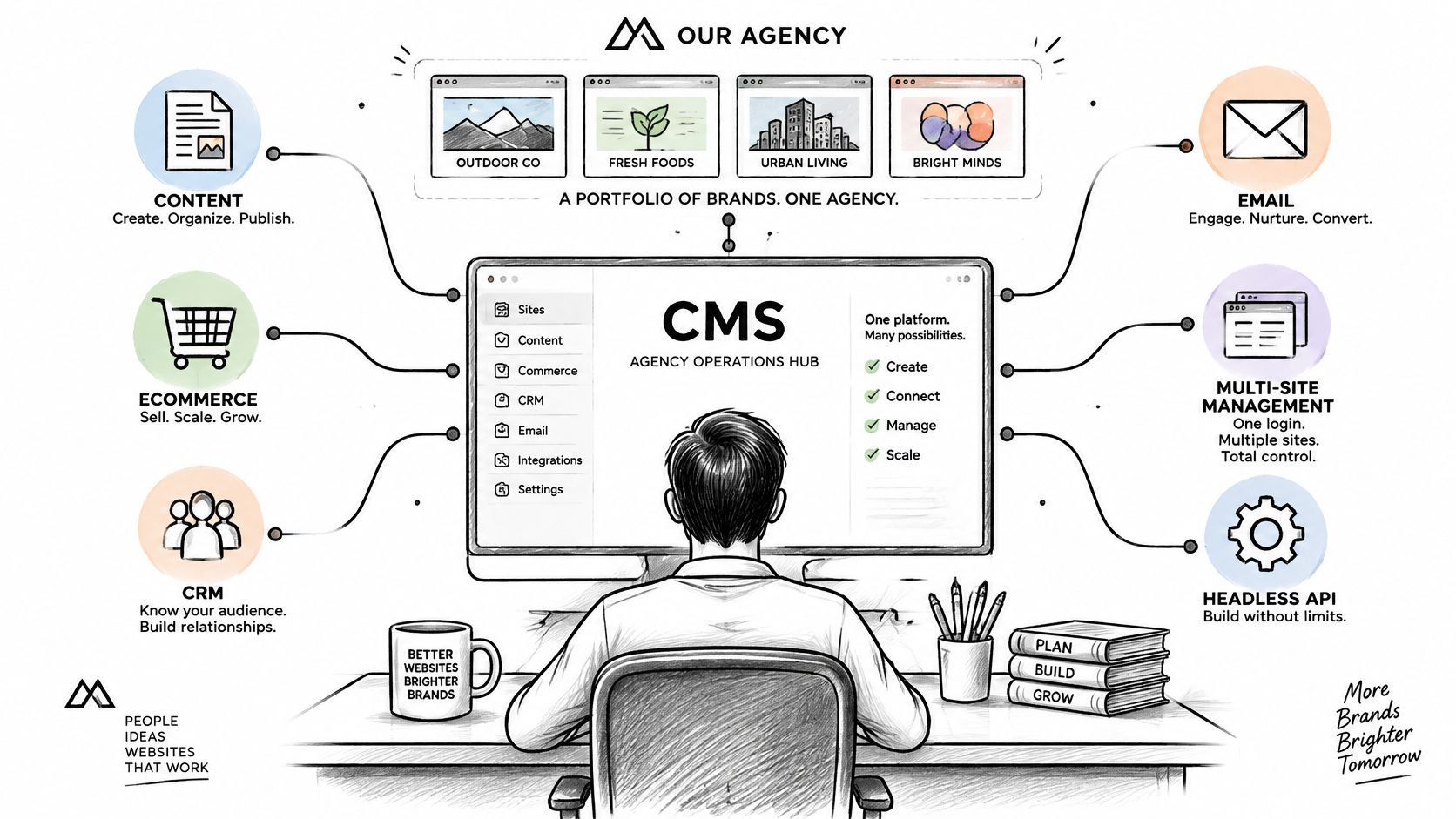
WebinOne is a CMS for agencies that operates a branded portfolio, not just a website, combining CMS, ecommerce, CRM, email marketing, multi-site management, and a headless API in one managed DXP. Your client sees your agency through white-label login and admin branding. We run the platform underneath.
That operating model is where CMS technology was always heading. The first systems appeared in the mid-1990s when organizations needed structured workflows for storing, editing, approving, and publishing content, a shift traced in research on the transition from static websites to database-driven publishing. The strategic move for agencies was from editing individual HTML files, and later individual client themes, to running many sites on shared templates, permissions, structured content, and integrations. A modern CMS for agencies should complete that move, not recreate the old one site at a time.
One Control Plane Across Content, Commerce, and CRM
We hold the layers agencies usually assemble from separate tools in a single system with unified data:
- Content layer: Liquid templating, custom modules, SEO controls, forms, snippets, blog, search, member areas, and an on-site editor for live editing.
- Commerce layer: Catalog, orders, and payments with zero transaction fees on ecommerce, so your client's growth doesn't trigger a platform tax.
- CRM layer: Cases, contacts, custom fields, and member activity tracking tied to the same forms and commerce data, not exported into a disconnected tool.
- Operations layer: Multi-site management, file manager and FTP access, SSL, redirects, backups, and security headers from one console.
Because these sit together, a form submission, an order, and a support case relate to the same contact record. Your team doesn't reconcile five databases to answer a client question.
Headless When You Need It, Managed When You Don't
We provide 300+ APIs and webhooks, and WebinOne has a headless CMS, so content and commerce can go to any front end, app, or channel. We're not headless-only. Most agency projects don't need a separate front-end team, a separate hosting bill, and a separate deployment pipeline to publish a landing page. Use the managed front end where it fits, use the API where a project justifies it, and keep both on the same data.
Pricing starts at $10/month per site, with a public status page, security overview, and roadmap your team can inspect. That's the product model to judge against the criteria that follow.
How to Judge a Platform Before You Commit
WebinOne is built so one tested change, one template standard, and one SLA can cover many client sites, and that's the standard you should apply to any CMS for agencies. Judge control of the portfolio first. Page-building features come second.
Start with multi-site governance. You need sites, staff, billing, support tickets, and branding managed from an agency portal, with least-privilege permissions so a client editor can't break what a developer built. Then check templating. You get out-of-the-box templates, the ability to create your own, and help from us building agency-branded templates your team can reuse. Reuse is where portfolio margin comes from, provided templates carry performance and accessibility standards with them.
Performance and Patch Load Are Contract Terms, Not Preferences
Judge performance on real-user data, not a launch-day screenshot. HTTP Archive describes Core Web Vitals as field-measured outcomes shaped by platform defaults, hosting, themes, plugins, and page builders, with passing defined at the 75th percentile as Largest Contentful Paint below 2.5 seconds, Interaction to Next Paint below 200 milliseconds, and Cumulative Layout Shift at or below 0.1, as set out in the 2025 Web Almanac CMS chapter. Centralized hosting and rendering defaults cut the variables you debug across sites. Make Core Web Vitals a portfolio SLA, monitor mobile field data continuously, and isolate regressions by template, module, or third-party asset.
Security deserves the same treatment. Verizon's 2025 Data Breach Investigations Report executive summary reports a median remediation time of 32 days for fully remediated vulnerabilities. Across dozens of sites, every separate core, plugin, and server is a separate queue, test, deployment window, and audit trail. We reduce that surface with native extensions developed and maintained by WebinOne, controlled releases, backups, security headers, and SSL handled in the platform. One tested fix protects the portfolio instead of starting a site-by-site validation marathon.
Uptime belongs in your client contract, so demand a number you can quote. We run at 99.99% uptime over the last 12 months, with a 99.95% availability commitment in our published SLA.
| Decision criterion | What breaks if it is missing | What WebinOne provides |
|---|---|---|
| Multi-site governance | Separate logins, billing, and permissions per client | Agency portal for sites, staff, billing, tickets, and branding |
| Templating your team controls | Every project starts from scratch | Liquid templates, custom modules, agency-branded template help |
| Headless access | Content trapped in one front end | 300+ APIs and webhooks alongside the managed front end |
| Reseller branding | Client loyalty goes to the vendor | White-label login and admin under your brand |
| CRM and ecommerce in one system | Reconciled data across disconnected tools | Built-in CRM and commerce, with custom commerce beyond the product scoped as a TeamOne project |
| Managed security surface | A patch queue for every site and plugin | Native extensions, security headers, SSL, backups, and redirects maintained by us |
Pass or fail rule: If a platform can't state its SLA, its patch owner, and its field performance standard, it isn't ready to carry your portfolio.
How Agencies and Integrators Deliver on It
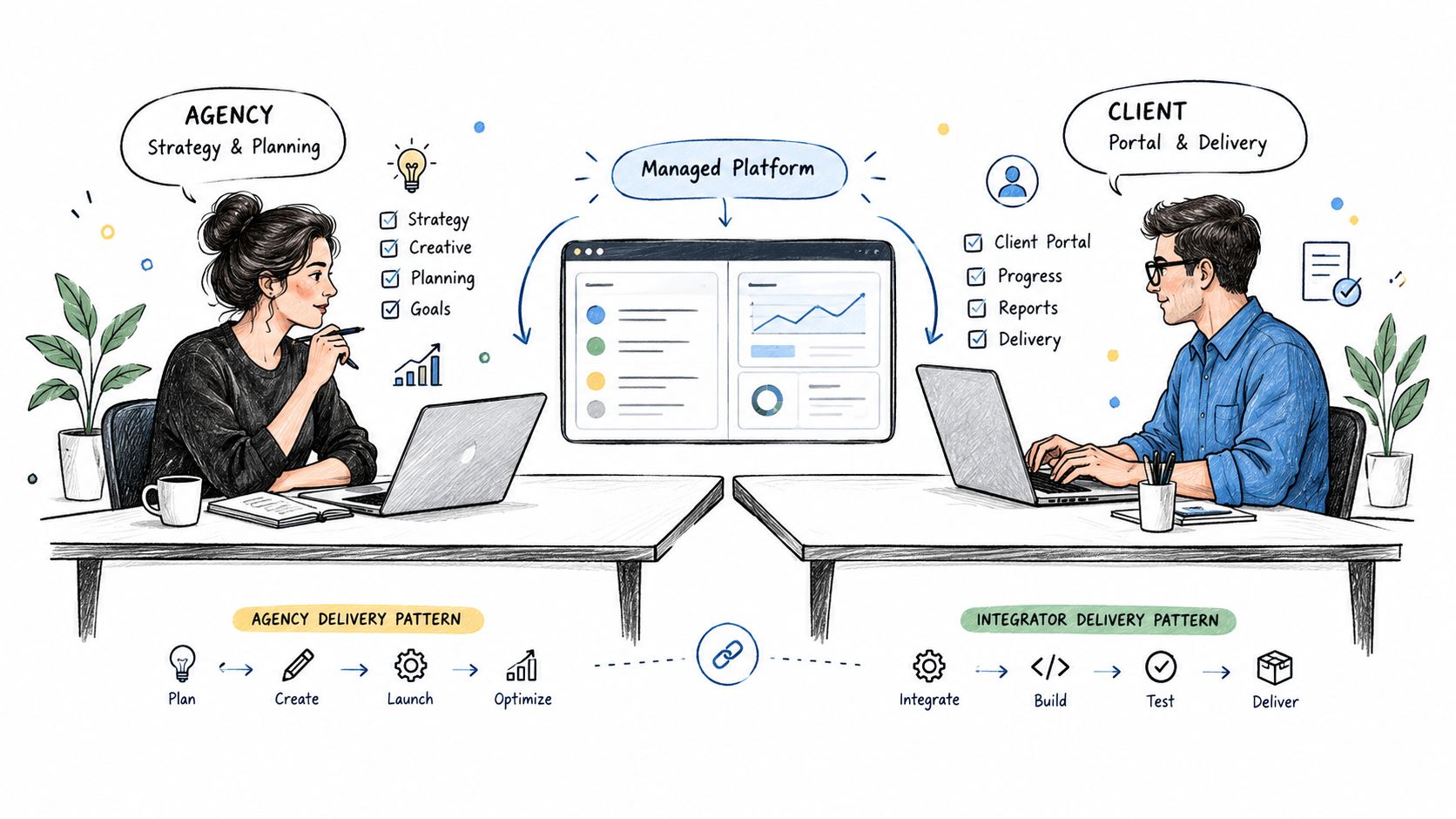
WebinOne is delivered through three patterns, depending on who owns the client relationship, and we support each one as a distinct commercial model. The platform is the same. The contract, branding, and AWS account structure change.
The reseller portfolio is the agency pattern. You provision sites from agency-branded templates, manage staff and billing in your portal, and invoice the client yourself. Wholesale pricing starts at $10/month per site, support tickets run under your brand, and the client relationship stays yours. Delivery details still matter at the edges, including how you collect signoff feedback on staging pages before a template becomes a live client site. Standardize that handoff and every new site starts from an approved pattern, not a fresh negotiation.
The SI and AWS Partner Pattern
For AWS consulting partners, ISV partners, and systems integrators, we run WebinOne as a managed platform in our AWS account across 6 AWS regions, with a custom data center available by agreement. Qualifying SIs can license a version running in their own or the customer's AWS account, including AWS GovCloud, and we deliver government work, including FedRAMP-shaped projects, with those partners. We're an AWS Partner, we've passed the AWS Foundational Technical Review, we hold AWS Qualified Software, we're enrolled in the AWS Software and Services Paths, and we're available on AWS Marketplace.
Know what the review checks before you rely on any vendor's AWS claim. AWS Partner Central documentation on requesting a Foundational Technical Review states the reviewed workload must be the partner solution's primary AWS-hosted workload, assessed against six Well-Architected pillars, with zero high-risk issues in Security, Operational Excellence, and Reliability, validated through a SOC 2 Type II report or a Well-Architected Framework Review. Verify the workload in scope and the findings addressed. Don't accept a logo as diligence.
The third pattern is multi-brand governance, where an enterprise team runs many sites and brands from one console instead of a patched stack only one person understands. That model already operates with US and Australian government clients and partners in 16 countries. For the mechanics of the integrator route, see how integrators deliver client platforms on WebinOne.
How to Move a Portfolio Without Losing Traffic
WebinOne migrations are run by TeamOne as a staged portfolio operation, tested before and after cutover with zero downtime, not as a one-site export you hope holds together. We have thousands of sites migrated behind that claim, including complex live sites moved under deadline during the Adobe Business Catalyst end of life and tangled WordPress, Drupal, and custom builds rebuilt into one clean platform.
The Sequence We Run
- Inventory everything: Content models, media, forms, ecommerce data, SEO metadata, redirects, integrations, and custom code. Sites fail migrations on the items nobody listed, especially forms and transactional data.
- Build the URL map: Every old URL gets a destination before anything moves. Treat redirects as structured migration data, validated before cutover, not cleanup after launch.
- Test in parallel: The new site runs beside the live one while your team checks content, commerce, forms, and member areas against production behavior.
- Cut over with a rollback: DNS changes follow a documented plan with a reversal path, so a failed check doesn't become downtime.
Search visibility depends on step two. Google Search Central guidance on site moves with URL changes instructs site owners to prepare a URL map, implement permanent 301 redirects for canonical pages, keep them for at least 180 days or longer while old URLs still receive Google traffic, and submit a Change of Address request in Search Console for a domain or subdomain move. We work through the detail in our site migration SEO checklist for protecting rankings, and post-launch monitoring of indexed URLs is part of the job, not an optional extra.
Managed Does Not Mean Locked In
Judge exit risk before you sign, on any platform. We lower it with 300+ APIs, documented data structures, audit logs, and an agreed exit process, so content, media, and commerce data can move in batches if you ever leave. Hidden lock-in usually looks different. It's the self-hosted stack full of undocumented plugins and customizations where the runbook lives in one person's head. That dependency doesn't appear in a feature comparison. It appears when that person resigns.
Data residency is selectable across our 6 AWS regions, with dedicated setups by agreement. Ask every vendor the same questions you'd ask us. Who owns credentials and runbooks? How are sites moved in waves? What does rollback look like at hour two, not in the sales deck?
Where Agency CMS Projects Quietly Lose Margin
WebinOne protects your margin only if hours per site fall after launch, and we built our managed operations and AgentOne around that test. The projects that bleed money rarely lack a feature. They lack an operating routine.
Accessibility treated as a widget is the clearest example. US data shows 456 digital accessibility lawsuits in the first half of 2025, roughly 22% of filings, targeted sites that had an accessibility widget installed, from 2,019 lawsuits filed in that period, according to the 2025 mid-year digital accessibility lawsuit report. Accessibility is a portfolio operations problem. You need reusable accessible components and form patterns, checks in staging and production, named issue ownership, and an audit trail, plus guardrails so client edits don't undo accessible structure. An overlay purchase gives you none of that evidence.
The Other Four Leaks
- No performance budget at launch: As noted in the platform criteria above, more tightly managed CMS environments recorded year-over-year Core Web Vitals gains of roughly 11% and 14% in the 2025 Web Almanac data. Governance moves field performance. Debugging each site separately doesn't.
- Unbounded ecommerce scope: We offer broad native commerce, and custom work beyond the product is scoped as a TeamOne project. Write that condition into the proposal or absorb it later.
- SEO and AEO as heroics: If search upkeep depends on someone remembering, it won't happen across forty sites. Package it as a managed service, a discipline we price out in our guidance on managed service pricing for agencies.
- Support without tiers: Managed hosting, security, and platform operations sit with us, with multi-level support included and paid partner support that partners love when a client justifies it.
AgentOne, our Managed Vibe Coding system, closes the remaining gap. It builds sites inside the managed platform and keeps operating them after deployment, handling development, content updates, optimizations, and automations. It generates transparent code your team can read, extend, and reverse, running with scoped permissions and audit logs, and nothing reaches production until it's reviewable. That's the difference between AI output you maintain and AI output you inherit.
Choose the Next Step That Matches Your Role
WebinOne is the right CMS for agencies when the goal is a branded portfolio run on one operating model, and we sell it two ways because agencies and integrators buy differently. Pick the path that matches who owns your client relationship.
If you're an agency owner outgrowing patching, plugin upkeep, and site-builder limits, stop assembling five tools per client and calling it a stack. Your clients should see your brand, your invoice, and your support desk, while we carry hosting, security, and platform operations behind a 99.95% availability commitment. That's how a portfolio scales without a matching rise in developer hours, and how you move clients to bigger projects instead of bigger maintenance bills.
If you're a systems integrator or enterprise team, stop carrying open-source upgrades, security patching, module maintenance, and hosting as unpaid labor inside a delivery contract. Stop leaving the knowledge of how a patched stack works with one or two people. A managed, documented platform with thousands of sites migrated, partners in 16 countries, and government clients in the US and Australia is a safer thing to hand a client than a codebase only your longest-serving engineer can explain.
Before either conversation, inspect what a serious buyer should inspect. Check our public status page, security overview, and roadmap. Bring your hardest questions about patch evidence, exit process, data residency, and field performance. We'll answer them specifically or we'll tell you the work belongs in a scoped TeamOne project.
Agencies, start with the WebinOne reseller program to sell and support sites under your own brand, with pricing from $10/month per site and paid partner support behind you. Systems integrators, AWS partners, and enterprise teams, start a conversation with our team about partnership or migration through WebinOne for enterprise and integrators, including licensed deployment in your own or your customer's AWS account where that agreement applies.