Cloud Native CMS: A Buyer's Guide for Agencies and SIs
Most “cloud native” CMS platforms aren't cloud native in the operational sense. They're hosted applications with a cloud-shaped sales story. The distinction matters because cloud deployment already held 62.88% of the broader CMS market in 2025, with projected growth of 19.1% CAGR through 2031, while cloud deployment represented about 67.11% of headless CMS share in 2025. Those figures show where the market is moving, but they don't prove that every platform using the label can scale, recover, or migrate cleanly.
For agencies and systems integrators, the buying question isn't whether a CMS runs in the cloud. It's whether the architecture reduces delivery risk across multi-site estates, campaigns, integrations, and client SLAs. A cloud native CMS should make infrastructure less of a recurring project, not turn every release into a distributed-systems exercise.
Table of Contents
- What Cloud Native CMS Actually Means in Practice
- The Four Building Blocks of a Cloud Native CMS
- Cloud Native CMS vs Traditional and Headless
- Benefits and Trade-offs Agencies Must Weigh
- Migrating an Estate Without Creating Brittle API Sprawl
- A Vendor Evaluation Checklist That Cuts Through the Pitch
- The Decision and the Next Step
What Cloud Native CMS Actually Means in Practice
WebinOne treats cloud native as an operating model, not a hosting location. A platform earns the description only when its infrastructure, deployment process, service boundaries, and support model are designed for elastic, managed operation from the start.
“Runs in the cloud” is a weak test. A single application hosted on virtual machines can still have tightly coupled releases, shared failure points, manual scaling, and recovery procedures that depend on one specialist. That's hosted software. It may be perfectly serviceable, but it shouldn't be confused with a system designed to behave like cloud infrastructure.
The operational test
A serious cloud native CMS should answer yes to practical questions:
- Can individual services scale independently? Content delivery, search, personalization, assets, and authoring shouldn't all require the same capacity profile.
- Can releases happen without planned downtime? A deployment process that takes the entire platform offline has preserved the central weakness of a monolith.
- Can the platform expose useful observability? Operators need service-level health, logs, alerts, and audit trails, not just a green application dashboard.
- Can the deployment model support more than one cloud environment? Portability doesn't mean every customer should move providers tomorrow. It means the architecture isn't irreversibly bound to one infrastructure assumption.
- Is the capability managed as a service? If the buyer still owns patching, cluster operations, database recovery, and capacity planning, the vendor has transferred the hard work rather than removed it.
The architectural ideas behind this model are covered in this guide to composable architecture, but the procurement consequence is straightforward. A platform must demonstrate how its design changes daily operations for authors, developers, security teams, and client support teams.
Practical rule: Ask the vendor to show the failure path, not just the architecture diagram. A convincing demonstration includes a service degradation, a rollback, an access review, and a migration rehearsal.
Cloud native architecture is valuable because it reduces operational coupling. It doesn't remove complexity. It moves complexity into platform design, automation, observability, and governance. Buyers should pay for that discipline once, through a managed platform and a capable partner, rather than recreate it separately for every client estate.
The Four Building Blocks of a Cloud Native CMS
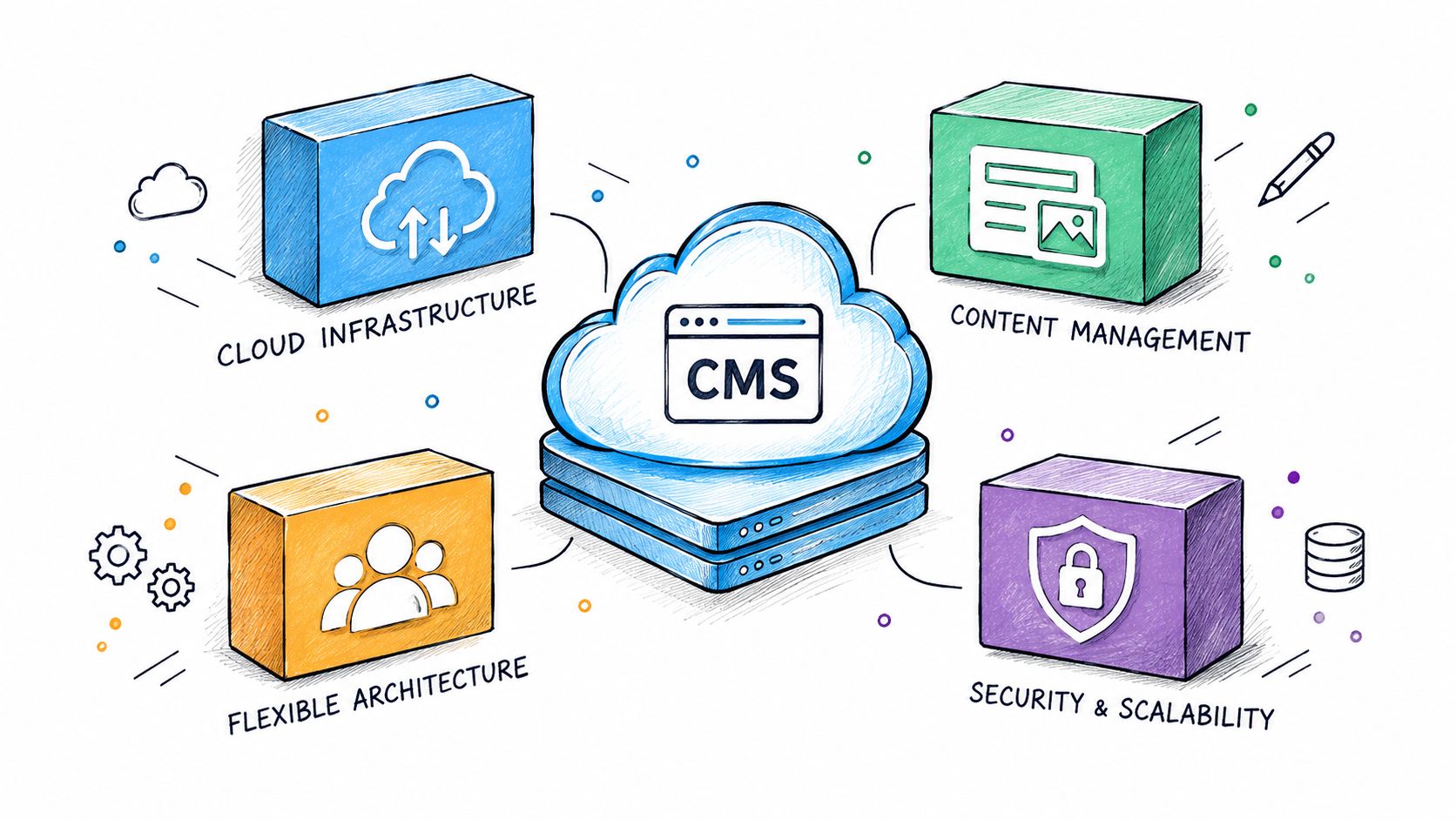
WebinOne maps a cloud native CMS to four building blocks: containers, microservices, managed cloud services, and API-first delivery. Each one changes what an agency can standardize, but each also creates a discipline the delivery team must maintain.
Containers create repeatable delivery
Containers package an application and its runtime dependencies into a repeatable unit. For an agency, that means development, staging, and production can share a more consistent baseline instead of relying on undocumented server differences.
The operational gain is environment parity. A release that works in staging has a better chance of behaving predictably in production. The bargain is discipline around images, secrets, versioning, and vulnerability management. Containers don't make careless deployment safe. They make deployment patterns easier to standardize and automate.
Microservices separate capacity and failure
Microservices divide major platform capabilities into services that can be deployed and scaled independently. Content delivery may need very different capacity from editorial workflows. Search may fail without taking authoring offline. Asset processing may require its own queue and recovery path.
The verified architecture research describes this model as a way to scale individual services rather than an entire monolith, reducing overprovisioning during quiet periods while preserving resilience during demand spikes. (Research on cloud native CMS architecture)
The cost is governance. Each service needs ownership, monitoring, access controls, and a documented dependency boundary.
Managed cloud services remove undifferentiated work
Databases, queues, storage, content delivery networks, backups, and security controls can be operated as managed capabilities rather than assembled and maintained from scratch. That lets an SI focus on client architecture and business integration instead of carrying every infrastructure task indefinitely.
The buyer still owns configuration decisions and access policy. Managed doesn't mean responsibility disappears. It means the provider carries the underlying service operations while the implementation team remains accountable for correct use.
API-first delivery decouples content from presentation
API-first delivery lets structured content reach websites, applications, portals, commerce experiences, and other channels without forcing every channel into one rendering model. A headless CMS can be part of this design, but headless delivery alone doesn't make a platform cloud native.
API-first architecture demands good content modelling, version discipline, authentication, rate controls, documentation, and lifecycle management. Without those practices, APIs multiply faster than the team can govern them. The result is not composability. It's integration debt with a modern name.
Cloud Native CMS vs Traditional and Headless
WebinOne fits the cloud native category when the buying requirement is managed operation plus flexible delivery, not merely a choice between page editing and APIs. The right model depends on the agency's delivery maturity, client estate, and tolerance for operating infrastructure.
A traditional monolithic CMS keeps authoring, templates, storage, and delivery close together. That often gives editors a familiar workflow and agencies a straightforward implementation path. The trade-off appears when one release, traffic pattern, or integration affects the whole application.
A self-hosted headless CMS separates content from presentation, which gives developers control over the frontend and deployment model. That control comes with responsibility for hosting, upgrades, observability, security, and recovery. A SaaS headless CMS reduces some infrastructure work, but the buyer still needs to examine tenant boundaries, regional availability, extensibility, and exit terms.
A true cloud native platform combines managed operation with modular services, scalable delivery, and APIs. It still requires platform literacy. The advantage isn't that it eliminates engineering. The advantage is that engineering effort can focus on client outcomes instead of repeating baseline platform operations.
| CMS Model | Editor Experience | Multi-Channel Delivery | Operational Overhead | Best Fit Agency Profile |
|---|---|---|---|---|
| Traditional monolithic | Usually familiar and tightly integrated | Often centred on the website presentation layer | Concentrated, but tightly coupled | Smaller teams with stable sites and limited integration demands |
| Self-hosted headless | Varies by implementation and content model | Flexible, with frontend responsibility assigned to the delivery team | High, including hosting and platform operations | Technical teams that need infrastructure control and can sustain operations |
| SaaS headless | Often focused on structured content workflows | Strong API orientation | Lower infrastructure burden, with vendor and tenant constraints to assess | Product teams prioritizing fast content delivery through managed APIs |
| Cloud native | Depends on the platform, governance, and authoring design | Flexible through APIs and managed delivery services | Managed baseline, with architectural and governance discipline required | Agencies and SIs operating multi-site, multi-channel, or complex client estates |
Agencies comparing adjacent technology categories may also find value in a focused resource such as this alternative to Apollo, particularly when evaluating whether a platform decision should reduce tool sprawl rather than add another isolated service.
The practical placement is simple. A small studio with a few stable marketing sites may not need a cloud native operating model. An agency managing many client properties, mixed SLAs, recurring campaigns, and complex integrations should stop treating infrastructure as a project-specific improvisation. An SI delivering government, enterprise, or multi-brand systems needs an operating model that can survive staff changes and portfolio growth.
Benefits and Trade-offs Agencies Must Weigh
WebinOne presents cloud native architecture as a trade-off, not a shortcut. It can improve scale, resilience, and delivery flexibility, but it also exposes weak cost controls, unclear ownership, and poor service governance faster than a simple site stack does.
Scalability versus cost predictability
Elastic infrastructure can follow demand more closely than fixed capacity. That helps when campaigns create uneven traffic or when several client properties share a delivery estate. The failure mode is an autoscaling bill nobody has connected to a client SLA or retainer.
Agencies need budget controls, usage alerts, capacity policies, and a clear commercial model before launch. “It scales automatically” is incomplete. The useful question is who approves the scaling boundary and who pays when demand exceeds the forecast.
Security versus shared responsibility
A managed provider can standardize platform security, patching, access controls, backups, and infrastructure operations. The customer and delivery partner still own identity configuration, custom code, data handling, permissions, and integration security.
Misconfigured IAM can expose content APIs even when the underlying platform is well operated. Procurement should therefore request access models, audit evidence, incident procedures, security responsibilities, and a process for reviewing custom extensions.
AWS states that paid, generally available services are covered by service level agreements, and its framework defines availability through measurable service metrics. (AWS service level agreements) That provides a useful baseline for reviewing infrastructure commitments, but it doesn't replace a platform-specific SLA or a clear support escalation path.
Time to market versus operational overhead
Cloud native services can shorten repeated delivery work when templates, workflows, deployment patterns, and integrations are reusable. They can also create a new burden if every project introduces a different service combination.
The failure mode is a Kubernetes or platform-skills gap that turns routine releases into incidents. Agencies should standardize a reference architecture and restrict bespoke infrastructure to cases that justify its long-term support cost.
Developer velocity versus platform fragmentation
APIs make it easier to connect specialized services. They also make it easy for every project team to create a new endpoint, webhook, data copy, or authentication pattern.
The best composable architecture is the smallest one that satisfies the channel and governance requirements.
A single content hub with a thin delivery layer is often more maintainable than a collection of disconnected services. Buyers should assess the number of contracts, credentials, interfaces, and operational owners required by the proposed design.
| Dimension | Benefit | Trade-off | Common Failure Mode |
|---|---|---|---|
| Scalability | Capacity can follow demand | Costs can vary with usage | Uncontrolled autoscaling and unclear billing ownership |
| Security | Managed controls and standardized operations | Configuration remains a shared responsibility | Exposed APIs through weak permissions or identity settings |
| Delivery speed | Reusable services and deployment patterns | Teams need operational discipline | Releases become incidents because platform skills are missing |
| Developer velocity | APIs support flexible channels and integrations | More services create more dependencies | A fragmented estate becomes harder to operate than the original monolith |
An agency leader should score each dimension against actual work. Does the pipeline need elastic delivery, or just reliable hosting? Can the support contract absorb on-call responsibility? Can clients approve usage-based infrastructure decisions? The right platform is the one whose trade-offs match the commercial model, not the one with the most impressive architecture diagram.
Migrating an Estate Without Creating Brittle API Sprawl
WebinOne's migration model should begin with content and governance, then move through controlled delivery waves. A migration that starts with frontend rebuilds and endpoint creation usually creates new integration debt before the old platform is retired.
Phase one starts with discovery
Inventory sites, content types, assets, integrations, workflows, permissions, redirects, and ownership. Mark content that is obsolete, duplicated, legally sensitive, or still required by a live business process.
The checkpoint is content ownership sign-off. No model should be approved until business owners agree what belongs in the new platform and who maintains it. Only then does migration scope become manageable, rather than after the new system has inherited every historical problem.
Phase two aligns models and taxonomies
Translate legacy fields into a structured model that supports the current web estate and likely channels. Align taxonomy, references, localization rules, editorial states, and permissions before building bespoke endpoints.
A single content hub should serve common entities across brands and regions. Frontends can consume a thin delivery layer shaped around channel needs, but each team shouldn't invent a private version of the same product, article, location, or campaign endpoint.
The REST API endpoint guidance from WebinOne is useful at this stage because endpoint design should follow content ownership and delivery requirements, not the preferences of whichever developer starts first.
Phase three runs the systems in parallel
Build the new platform while the legacy estate remains available. Route controlled traffic or selected properties through the new delivery layer, then compare rendering, metadata, permissions, forms, search, integrations, and editorial workflows.
The governance checkpoint is a frozen schema before parallel run. Continuous model changes during comparison make it impossible to tell whether a defect came from migration, content transformation, or architecture drift.
Phase four cuts over with rollback gates
Before switching traffic, define success criteria on the legacy estate, validate redirects and critical journeys, and document the rollback procedure. Delivery and client operations must sign the runbook together.
Legacy platforms often carry hard-coded dependencies, weak documentation, hidden complexity, security vulnerabilities, and a shrinking pool of maintainers. (Analysis of legacy-system migration risks) Discovery must therefore include interviews with the people who operate the estate, not just exports from the database.
A staged cutover protects the business from a false sense of completion. The migration is successful only when editors can work, customers can complete critical journeys, integrations remain reliable, and the client can operate the new platform without depending on undocumented tribal knowledge.
A Vendor Evaluation Checklist That Cuts Through the Pitch
WebinOne should be evaluated through evidence rather than architecture language. A serious vendor can explain how the platform operates during failure, migration, access review, regional delivery, and custom development.
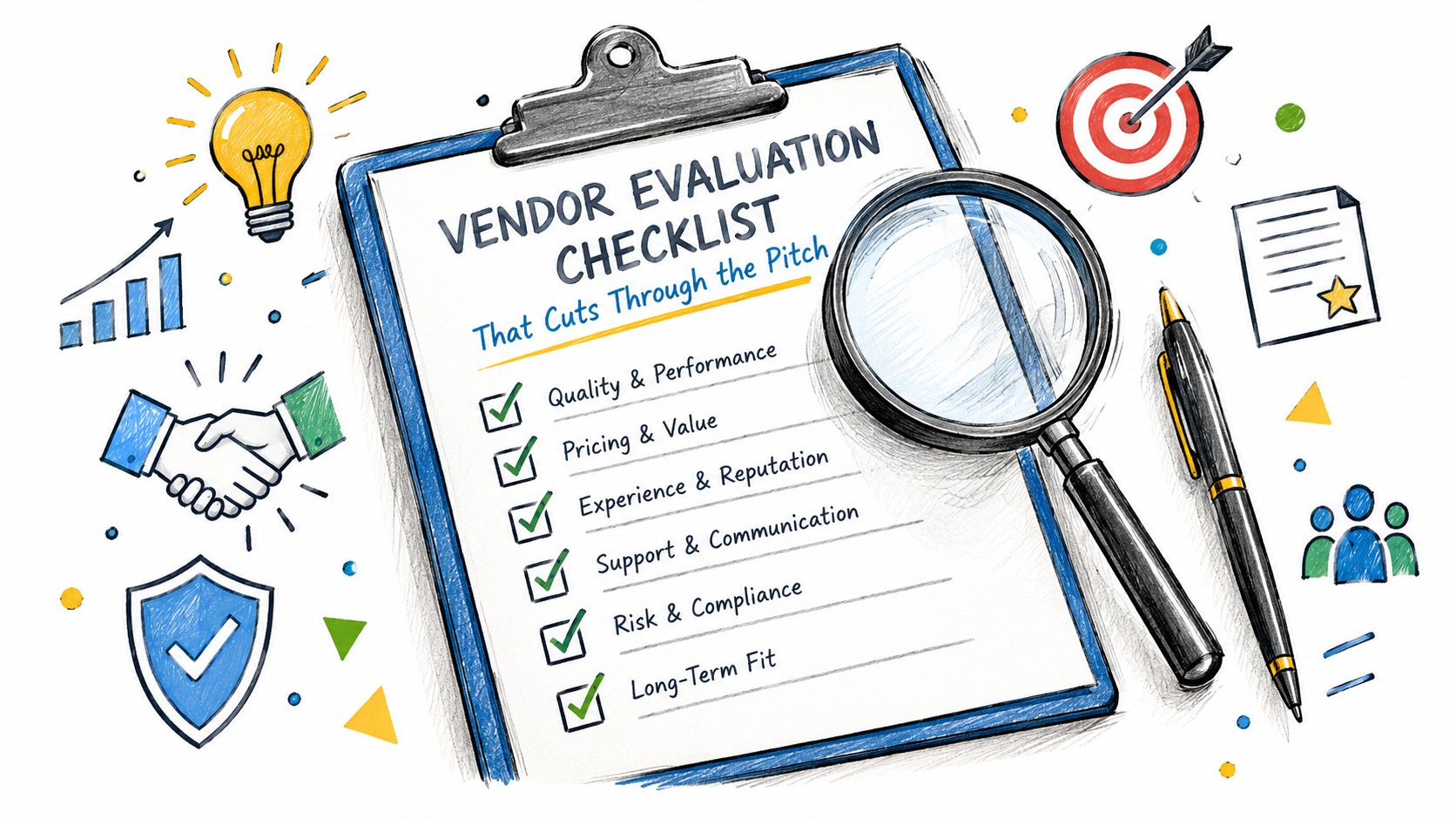
Use the following questions in procurement. Score the answer, the evidence, and the effort required from the buyer to validate it.
What is multi-tenant? A defensible answer explains isolation, noisy-neighbour controls, permissions, and how one client's failure affects others. An evasive answer repeats that the platform is “built for scale.”
Where can the platform run? The vendor should identify deployment regions, residency options, recovery design, and any restrictions. A vague global availability claim isn't an architecture.
Who owns the infrastructure? The buyer should understand what the vendor manages, what the partner manages, and what remains the customer's responsibility. Ambiguity here becomes an escalation problem later.
What does observability look like? Request a demonstration of logs, alerts, audit trails, service health, and incident timelines. A status page alone isn't enough for a serious SLA.
How does incident response work? Ask who receives the first alert, how severity is assigned, how customers are informed, and how post-incident actions are tracked.
How flexible is content modelling? The platform should support structured relationships, workflows, permissions, reusable content, and channel-specific delivery without forcing every requirement into custom code.
What migration tooling exists? Look for mapping, transformation, validation, redirect handling, test environments, and rollback support. “The API can import it” is not a migration plan.
What happens when the contract ends? Ask how content, assets, configuration, code, and data are exported. Portability should be described in operational terms, not legal generalities.
Can the vendor support the buyer's vertical? Request references or evidence from a similar governance, compliance, multi-site, or integration environment. A generic logo list doesn't prove fit.
How are custom contributions handled? The vendor should explain review, ownership, maintenance, security assessment, versioning, and production support. Custom code without a lifecycle becomes tomorrow's platform debt.
A vendor that answers these questions with runbooks, diagrams, service records, contract language, and migration artifacts is easier to govern. The platform guidance for digital transformation can help frame the business case, but procurement still needs direct evidence from the selected vendor.
For AWS-focused buyers, the infrastructure conversation should include regional design and availability targets. AWS documents a 99.99% Monthly Uptime Percentage region-level SLA target for some services deployed concurrently across two or more Availability Zones in the same region. (AWS historical compute SLA information) That target describes an infrastructure arrangement, not an automatic guarantee for every CMS implementation. The platform contract and operating design still matter.
The Decision and the Next Step
WebinOne gives agencies and SIs a clear choice: keep a tightly coupled stack because the delivery model is stable, or adopt a managed cloud native platform because the estate has outgrown project-by-project infrastructure work. The second option only makes sense when the organization is prepared to fund governance, modelling, and operational discipline alongside the CMS.
A migration isn't worth doing just because “cloud native” sounds modern. It earns its place when an agency operates multi-tenant client work, multi-region delivery, content-heavy estates, recurring campaigns, or integrations that a traditional stack can support only through repeated infrastructure heroics.
Choose the delivery model, not just the software
The commitment lasts longer than the implementation. It changes how the agency prices retainers, how an SI defines support boundaries, how security reviews are conducted, how content teams request features, and how clients approve platform changes.
A managed platform can reduce repeated patching, hosting, recovery, and upgrade work. It cannot compensate for unclear ownership or weak content governance. Buyers should reject both extremes: the assumption that a traditional stack will scale indefinitely, and the assumption that a cloud native label removes the need for engineering judgement.
WebinOne operates as an AWS Partner, has passed the AWS Foundational Technical Review, holds the AWS Qualified Software designation, is enrolled in the AWS Software and Services Paths, and is available through AWS Marketplace. It supports headless CMS delivery, multi-site management, API-led integrations, white-label agency operations, and licensed deployments in a qualifying SI or customer AWS account by agreement, including AWS GovCloud projects.
For an enterprise or systems integrator evaluating a migration, the next step is a 30-minute architecture call with the WebinOne team. The discussion should cover the current estate, content model, integrations, operating responsibilities, migration waves, AWS deployment requirements, and the boundary between managed platform services and custom delivery work. A partnership or migration conversation can start through the WebinOne enterprise team.
WebinOne provides a managed, white-label digital experience platform for agencies, systems integrators, and enterprises moving beyond fragmented CMS operations. Visit WebinOne to discuss an architecture review, a multi-site migration, or a delivery partnership that puts cloud native operations into a supportable commercial model.